At a glance
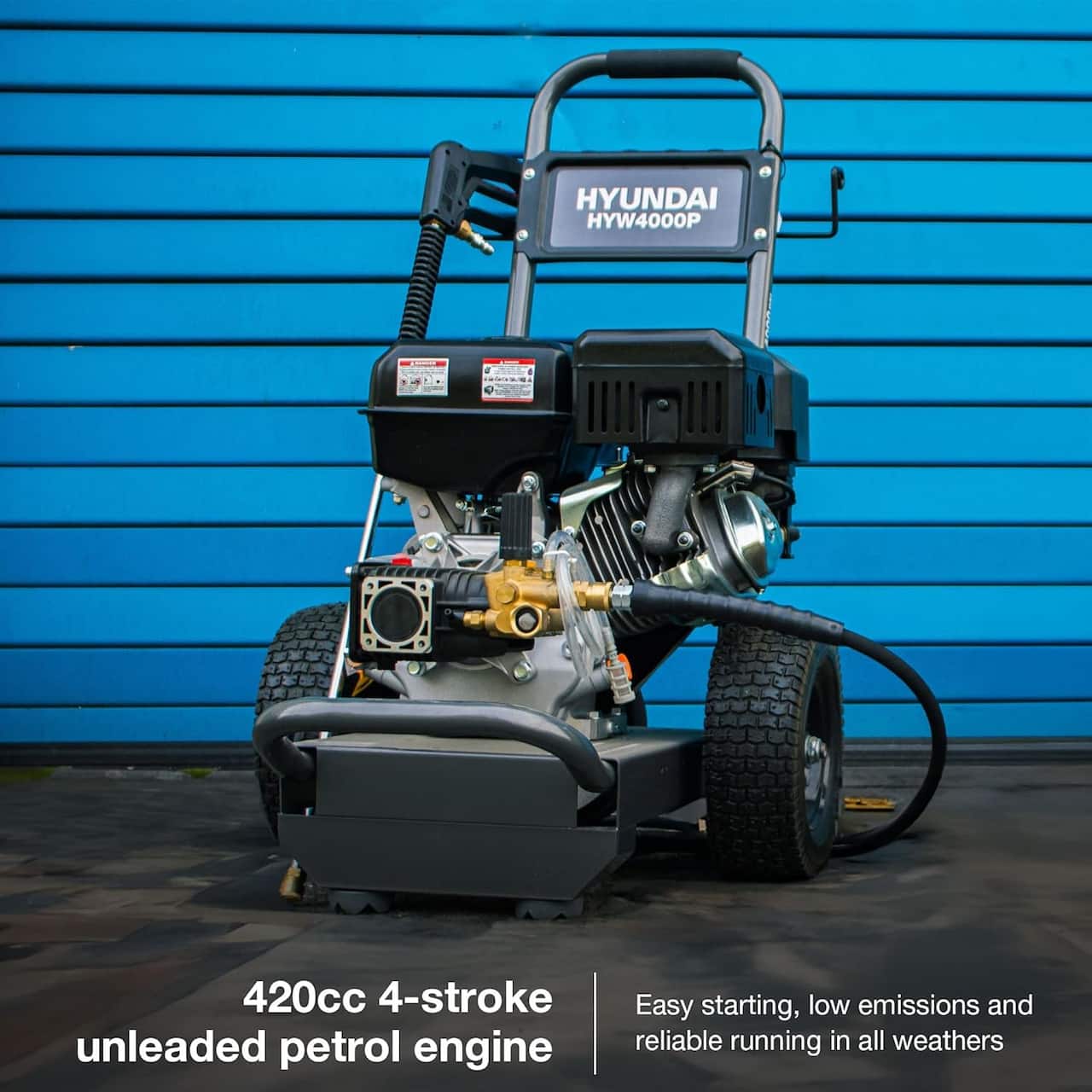
This is the biggest petrol washer Hyundai make, and within a few minutes of using it that becomes obvious in a way the spec sheet doesn’t quite prepare you for. The HYW4000P runs a 420cc, 14HP engine at 275 bar, with a flow rate of 900 litres an hour. Net weight is around 60.5kg. The question wasn’t really whether it had the power, it clearly does, it was whether everything around that power, the water supply, the maintenance, the day to day handling, scales up just as much.
Short answer: it does, and that’s both the appeal and the catch. This rewards being set up properly far more than it punishes being treated casually.
Overview and first impressions
Assembly is straightforward, the handle bolts onto supports already fitted to the main frame, and the multi-coloured nozzles slot into holders built into the handle itself rather than rattling around loose. The tubular steel frame and puncture-proof wheels feel properly substantial, this is noticeably bigger and heavier in the hand than the mid-range Hyundai model, not just on paper.
The manual is specific, and genuinely strict, about water supply before you even start it: it needs more than 14.4 litres a minute at no less than 20psi at the hose end. Starting the engine without the hoses fully connected and the water turned on is explicitly stated to void the warranty, not just risk poor performance, so this is one to take seriously rather than treat as a suggestion.
Engine oil and pump oil are both SAE15W40, the same oil for both, which is a small but genuine convenience over machines needing two different products on the shelf. The sight glass for the pump oil should read at the centre dot, not overfilled. One thing worth knowing: unlike some other petrol washers I’ve used, this doesn’t come with its own suction hose kit, so if you’re planning to draw from a barrel rather than a tap you’ll need to source one yourself, it can still draw with a 2 metre lift, it just won’t be ready to out of the box. Hyundai also recommend connecting it to the mains supply the very first time you use it, even if you intend to run it gravity-fed afterwards, since this frees up any valves that might be sticking from new.
Confirm your water supply meets the minimum before starting. Hyundai’s own figure is more than 14.4 litres a minute at 20psi minimum. Falling short of that risks the pump itself, and starting without water connected and flowing is explicitly stated to void the warranty outright. The manual also repeats a more serious warning throughout: never run this in an enclosed space or inside a vehicle, carbon monoxide from the exhaust is genuinely dangerous, and it wants at least 1.5 metres of clearance on every side including overhead.
Specifications and scores
How it performed in our tests
A long run of driveway block paving, genuinely neglected for a couple of years, was the proper test here. The yellow 15° nozzle cleared general grime and moss in a single pass at a pace that felt closer to a professional job than a weekend one, and switching to the red 0° tip for a few stubborn oil marks lifted them back to bare paving without needing to go over the spot twice.
The turbo nozzle is genuinely the standout accessory, Hyundai claim up to 25% faster cleaning with it and on a patch of ground-in driveway grime that felt about right, noticeably quicker than working through with the standard nozzles alone. The black detergent nozzle did exactly what it should and nothing else would, the white, yellow and red tips simply don’t draw soap at all, confirmed when I tried one out of curiosity expecting nothing to happen, and nothing did. Keeping the nozzle roughly 8 to 24 inches from the surface, as the manual suggests, was enough to avoid any risk of damage even on the more aggressive settings.
I worked the trigger properly rather than letting it idle for long stretches, since the thermal relief valve only tolerates about 3 minutes of running without the trigger pulled before it starts venting water from the side of the pump to cool itself. Once I built that rhythm in, around 30 seconds of spray every few minutes, it never tripped once across a long session.
Pull the trigger for 30 seconds every few minutes, even if you’re not actively cleaning anything. The thermal relief valve has a roughly 3-minute tolerance for sitting idle under pressure. Build the habit in and you’ll never see it trip.
Engine and running costs
The 420cc engine starts with a firm recoil pull, choke applied from cold, and settles into a genuinely substantial drone once running, this is the loudest of any petrol washer I’ve used so far, rated at 111 decibels at 7 metres, and hearing protection is non-negotiable rather than optional. Starting it always requires releasing the spray gun’s trapped pressure first, the manual is explicit that pulling the cord without doing so risks a genuine kickback injury, not just a failed start.
Fuel capacity is 6.5 litres, and the tank should never be filled right to the brim, 25mm of expansion space needs to be left at the top. After every use with detergent, the siphon system needs flushing through with clean water at low pressure for a minute or two, skip this and residue or clogging builds up over time. Only proper pressure-washer detergent should ever go through it, nothing caustic.
Storage matters more here than on a smaller machine, since freeze damage is explicitly excluded from the warranty. Either a proper pump protection fluid or running antifreeze through a short hose into the inlet is recommended before winter, and fuel left in the tank for more than 30 days should be stabilised rather than just left to go stale.
Warranty follows the same pattern as Hyundai’s mid-range petrol model: 3 years for domestic use, 1 year for commercial, terms apply.
Performance and limitations
What this does brilliantly is genuinely scale up rather than just claim bigger numbers. The flow rate keeps pace with the pressure properly, the turbo nozzle’s speed claim held up under real use, and the build feels like it’s made to be worked hard rather than occasionally.
The trade-offs scale up just as honestly. At over 60kg this needs real care moving around, the noise is genuinely the most I’ve encountered from a petrol washer, and the minimum water supply requirement is stricter than anything smaller in Hyundai’s own range, this isn’t a machine to run off a thin garden tap and hope for the best. The detergent flush step is easy to forget and easy to regret skipping.
None of that is really a flaw, more a reflection of what genuinely scaling up power actually costs. Set it up properly and it rewards that effort consistently.
- Genuinely powerful, scales up properly
- Turbo nozzle’s speed claim genuinely holds up
- One oil type for both engine and pump
- 15m hose, genuinely long reach
- Over 60kg, genuinely heavy
- Loudest petrol washer I’ve tested
- Strict minimum water supply requirement
- Freeze damage not covered under warranty
- Long driveways and genuinely large areas
- A proper mains water supply to feed it properly
- Regular, sustained heavy-duty cleaning
- A weak or unreliable water supply
- Anyone needing to move it solo regularly
- Light, occasional jobs that don’t need this much
Final verdict
This earns its place as the top of Hyundai’s petrol range by genuinely scaling everything up, not just the headline numbers. Driveway paving and stubborn oil marks both came up properly, the turbo nozzle’s claim held up, and sharing one oil type across engine and pump is a small but real bit of sense in the design.
It demands more in return though. The water supply needs to genuinely meet the stated minimum, the trigger discipline around the thermal valve needs to become a habit, and the weight and noise are both real, ongoing facts of owning it rather than occasional inconveniences.
Check your water supply against the actual figure before you buy, build the trigger habit in early, and treat freeze protection seriously before winter. Do all three, and this is genuinely the strongest petrol washer in Hyundai’s own range for the jobs it’s built for.
A genuinely powerful petrol pressure washer that scales its demands up alongside its capability. Held back only by its weight, its noise, and a water supply requirement stricter than anything smaller in the range.
Share on socials: