At a glance
There’s a rosehip bush at the back of my plot that’s been winning the argument with every trimmer I’ve owned, mostly because none of them would fold flat enough to get underneath it. I’d more or less given up on that corner and just let it go to nettles every year, which isn’t a great look when the neighbouring plot holder keeps theirs immaculate.
The Einhell GC-ET 4530 turned up as the next attempt, a 450 watt corded trimmer that swaps between a normal head and a vertical edger with a twist of the handle, and I went in not expecting much given how the last few had gone.
Overview and first impressions
Out of the box you get the trimmer itself, a guard hood, an edge guide, four screws, and the instructions. That’s it according to the manual’s own parts list. The box and Einhell’s own website both promise three spare line spools as part of the set, and there’s nothing of the sort listed on the page that tells you what’s in the carton. I went through mine twice assuming I’d missed something before accepting that what the manual says is supplied and what the marketing says is supplied are two different lists.
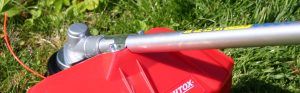
It’s a telescopic handle, which is the bit that sold me on trying it, the shaft adjusts for height and the handlebar angle sets across five positions with an audible click each time it locks. Weight on the manual’s own figures comes to 2.6 kilograms, light enough that I’ve used it one handed round pots without thinking twice about it.
Check for foreign objects before you start. Stones, wire, anything left lying in long grass gets picked up and thrown by the line at speed, and the equipment doesn’t know the difference between rubbish and something that shouldn’t be hit. A walk round first costs two minutes and saves a trip to A&E.
Specifications and scores
The spool count isn’t the only place Einhell’s own paperwork disagrees with itself. The operating manual gives a sound pressure figure of 71.9 decibels at the operator’s ear and a separate sound power figure of 91.9, and leaves it there. The separate declaration of conformity that comes with the same machine, tested through TÜV SÜD and signed off from Einhell’s own offices in Landau an der Isar, repeats that 91.9 measured figure exactly, then adds a guaranteed figure of 96, a full four decibels higher, sitting in a different document entirely. Neither number is wrong, they’re just answering slightly different questions, and only one of them made it into the actual instruction booklet.
Then there’s the warranty. Einhell’s own website carries a banner promising three years across the board. The retailer I’d bought mine through listed a standard one year warranty covering manufacturing faults for this specific model. I’m not in a position to say which one applies if something goes wrong, only that I found two different answers without trying very hard to look.
How it performed in our tests
The line feed is fully automatic, no bump feed, no button, the line simply winds itself back out to full length once it’s worn down, checked between switching off and on again. The one thing the manual’s specific about is the first time you use it, any surplus length on a fresh spool gets trimmed off automatically by a small blade built into the guard hood, so don’t be surprised if you hear a quick snip in the first few seconds that never happens again after that.
That rosehip corner finally went properly this time. The folding handle let the head get right underneath where the old trimmers couldn’t reach, and the nettles and thistles round it, a good fifty centimetres tall in places, went down without the motor labouring. I pushed it harder than that on purpose round the bit of rough ground I never bother mowing properly, the kind that normally wants a proper brushcutter, and it managed the grass and the soft growth up to about waist height before anything with a woody stem started fighting back. Anything thicker than that and you’re into different tool territory entirely, which is fair enough for what this is.
Let it reach full speed before it touches the grass. Moving it into the work too early is what makes the cut feel jerky and uneven, not the line itself. Wait for the motor to settle, then go in at the angle that suits the job.
Assembly and adjustment
Putting it together is genuinely quick, mount the guard on the motor head, two screws, then the edge guide on the last two. The bits that took me longer than they should have were the handle adjustments, not because they’re complicated, more that there are three separate locks doing three separate jobs, height, angle, and the additional handle position, and I spent the first session fiddling with the wrong one before working out which did what.
Converting it to an edger is properly satisfying once you’ve done it, switch off, pull the sleeve back, rotate the top handle a full half turn until it locks, and you’ve gone from trimmer to edger in about ten seconds. I’ve used that more than I expected to, mostly on the path edges where a mower leaves a ragged line.
Performance and limitations
It’s a domestic tool and the manual says so plainly, lawns and small areas of grass in private and hobby gardens, not parks, verges, agricultural land, or anything you’d get paid for. Using it to shred material for composting is explicitly ruled out too, which I’d not have thought to try anyway but apparently somebody has, often enough that it’s worth a line in the manual. There’s even a cap on altitude, nothing above 2000 metres, which says more about Einhell covering every market they sell into than anything relevant to my plot at sea level.
Maintenance is about as low effort as these things get. There’s nothing inside that wants servicing beyond a wipe down and keeping the vents clear, and the troubleshooting section in the whole manual amounts to one entry, check the cable and the fuses, and if it still won’t go, send it for service. That’s either a sign of a simple, reliable design or a sign nobody expected to need more than that written down. After a season of fairly hard use on my end, I’m leaning towards the first one.
- Telescopic handle genuinely reaches awkward corners
- Quick, satisfying switch to an edger
- Fully automatic line feed, no fiddling
- Low effort maintenance, nothing serviceable inside
- Box claims three spools, manual lists none
- Warranty length depends who you ask
- Three separate handle locks take a session to learn
- Troubleshooting guidance is thin if something does go wrong
Final verdict
The corner by the rosehip bush is finally tidy, and that alone has me more won over than I expected to be. The telescopic handle and the edger conversion are the two features that actually earn their place rather than sitting on the box as a bullet point nobody uses.
Where it costs itself marks is paperwork rather than performance, same as more than one machine in this batch. Three different documents giving three different answers on spools, warranty length, and the full noise figure isn’t something I’d expect to have to untangle myself before I’d even plugged it in.
If you’ve got an awkward corner of your own that nothing else has managed, this is worth a look. Just check what’s in your box against the leaflet before you assume the website’s promise is the one that’s true.
A genuinely capable little trimmer with a telescopic handle and edger conversion that both earn their keep, let down by paperwork that disagrees with itself on what’s in the box and how long it’s covered for. Worth it for the corners nothing else reaches.
Share on socials: