At a glance
The Ryobi OCS1830 had been on my radar for a while before I finally got round to buying it, mainly because I was already running half a dozen other ONE+ tools and the thought of the chainsaw using the same batteries was making it harder and harder to talk myself out of it. The thing that pushed me over the edge was a downed ash at the back of the plot. Thick branches, a couple of trunk sections that wanted sectioning, and I just needed to get it done without the faff of the petrol saw. First session with the OCS1830 and I had everything cleared before the tea went cold.
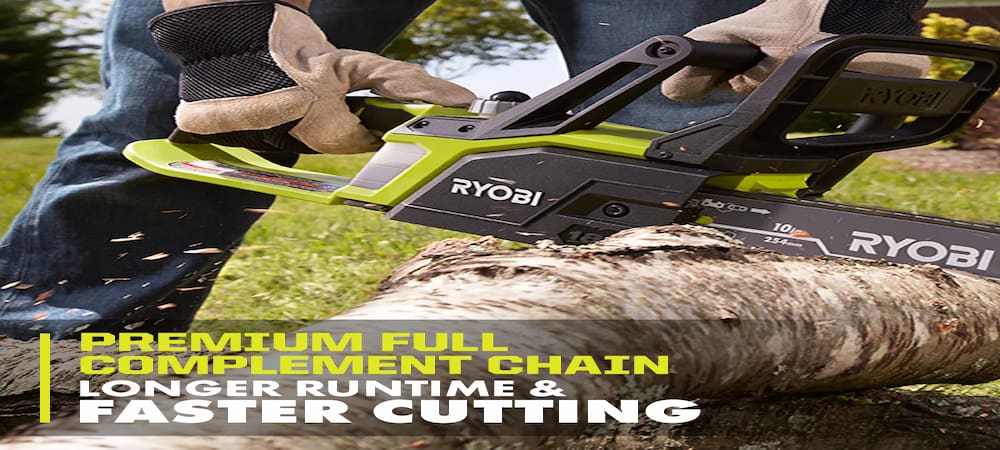
It runs on an 18V ONE+ battery, uses a brushless motor, and comes with a 30cm Oregon bar. The brushless part matters more than it sounds: no carbon brushes to wear down, less heat, and in my experience noticeably more consistent run-time than the brushed equivalents I’d used before. Chain speed is 10 metres per second. The saw weighs 3.2 kg without a battery, which on a morning of solid use is the thing you notice more than anything else. The weight, or the lack of it. Available body-only on Amazon and at B&Q, Argos, and Ryobi direct, and kit versions with battery and charger come up if you’d rather buy once. The 3-year warranty requires registering on the Ryobi website within 30 days of purchase, which is the kind of thing that is very easy to remember to do later and then somehow never actually do.
Overview and first impressions
Once you’re a few tools into the ONE+ system you start to feel the scale of it: over 200 tools on the same 18V battery, and the saw uses all of them. I have the same batteries in my hedge trimmer and my circular saw and my drill, and they all go in the chainsaw. That is the whole argument for this saw if you’re already on ONE+: you don’t start from zero with the battery investment. If you’re not already on ONE+, you buy the battery and charger alongside the saw, and then you have a battery and charger that also works in most of the Ryobi tool range, which is a different calculation than buying a battery that only runs one thing.
The batteries worth using with this saw are the 4.0Ah minimum for anything you’d call real work, and Ryobi’s own recommendation is the 6.0Ah or 9.0Ah for best performance. I’ve used it mostly on a 5.0Ah and had no complaints. The battery has a charge indicator, press the button on the side and it tells you where you are, which matters more than it sounds mid-session. The compatible range runs from the small RB18L13 all the way up to the RB18L90A. The small batteries will run the saw; they just won’t run it for long enough to be useful on any serious job.
Specifications and scores
How it performed in our tests
The first session I did any proper testing on was the Storm Arwen aftermath that left a mess across the back of the plot. I had trunk sections coming in at 50cm diameter, cutting from both sides, and it got through them. Slower than a petrol saw of equivalent size, I won’t pretend otherwise, but the cuts came out clean and the end result was the same. On anything up to about 25cm in a single pass it barely noticed the wood was there. Ash up to 10 inches in diameter cut through cleanly on a 4Ah battery, quickly and without the saw working noticeably hard.
What surprised me most was that the weight came off more than I expected over a full morning. At 3.2 kg without the battery you’re still carrying a chainsaw with a battery on it, but the combination sits differently from a petrol saw that has all its weight up front and to the side. I managed one-handed cuts on a couple of overhead branches without feeling like I was fighting the tool. It is not designed to be a one-handed saw, but the wrap-around handle and the balance mean it stays in control in positions where a petrol saw would have me reconsidering whether the branch could wait.
The noise is considerably lower than any petrol saw I’ve used, and 83.1 dB(A) at the operator’s ear still wants ear protection but it doesn’t have the carrying quality that a petrol motor has. The people across the field didn’t come to see what was going on, which on a Sunday morning is something.
Runtime on the 5.0Ah doing heavy trunk work was around 20 minutes before I needed to swap. On lighter work, limbing and clearing smaller material, that stretched out to closer to half an hour. Ryobi quote 40 cuts on 15cm firewood logs per 5.0Ah charge, and a 4.0Ah gives you 33 by the same measure. Those are controlled figures, not what a mixed session looks like, but they’re in the right area. Two batteries and a charger running alongside the work is the setup for a full day.
Use genuine Ryobi batteries. The runtime difference between a genuine 5Ah Ryobi battery and a non-branded equivalent is real and noticeable in practice. For a saw doing actual work, it’s not the place to save the money.
Battery system and runtime
The chain stops the instant the trigger is released, not after a couple of seconds like a petrol saw spinning down on idle. The motor brake stops it in under 0.12 seconds. That takes some adjustment if you’re used to petrol, because there’s a brief moment every time you expect the chain to still be moving when it isn’t. It’s safer and you get used to it, but the first few sessions you notice it every time.
On the cut figures: Ryobi measure these on 15cm diameter firewood logs, which gives you a comparison point but doesn’t tell you what a mixed session actually looks like. On that basis: 2.5Ah gets you 18 cuts, 4.0Ah gets 33, 5.0Ah gets 40, and 8.0Ah gets 64. For anything beyond light occasional use, start with 4.0Ah as a floor and go higher if the sessions are long. The saw doesn’t run low gradually, it stops cleanly when the battery is depleted, so keep an eye on the charge indicator rather than waiting to feel it tail off.
Performance and limitations
Something I didn’t expect to like as much as I did: the chain tensioning. There’s a wheel on the side of the saw, you turn it, the chain tensions, you lock it, and no tools were involved at any point. The first time I fitted the bar and chain I took longer than I should have because the method is different from a conventional chainsaw and the manual is not as helpful as it could be on this specific step. Once I’d worked it out it took about two minutes. The oil cap is at the top of the saw rather than the side, which means filling it without dribbling oil down the body is much easier than it is on most other saws. The translucent oil window lets you check the level at a glance.
There are two chain brakes, and both work every time. The mechanical one trips from the front hand guard if kickback pushes your hand forward. The motor brake stops the chain the instant the trigger is released. Both are there every time you use it. There’s also a trigger lock on the handle that prevents the trigger from activating accidentally: you need to depress it before the trigger will do anything, which combined with the sliding on/off switch means two deliberate actions before the chain moves. The on/off switch itself is a small grey sliding switch on the top of the rear handle, not a push button like on most saws. It’s a small thing but it catches you out once or twice when you first pick it up looking for a button that isn’t there.
Maintenance is a shorter list than a petrol saw: no air filter, no spark plug, no carburettor, no mixing fuel. Before each use, check the chain brake works: pull the front hand guard forward while the saw is running and the chain should stop immediately. Clean it with a dry cloth after each use, check the fixings now and then, keep the bar groove clear of sawdust and debris. On chain sharpening, Ryobi’s own advice is to replace rather than sharpen, because each sharpening reduces the low-kickback profile of the chain. The replacement is RAC227. I’ve always found that an honest position from a manufacturer: the chain is a consumable and the replacement isn’t expensive.
- Compatible with all 18V ONE+ batteries you already own
- 3.2 kg bare: noticeably lighter than petrol alternatives
- Tool-free chain tensioning and automatic oiling
- Dual chain brake: mechanical + motor (under 0.12 sec)
- Available at Argos, B&Q, Amazon UK; 3-year warranty
- ~20 min runtime on 5Ah doing heavy work
- Initial chain fitting different from conventional saws; manual unhelpful
- Slower than petrol on large diameter trunks
- 12-inch bar is a real ceiling for professional-scale felling
- Existing Ryobi ONE+ users
- Domestic and smallholding use: logs, branches, clearing
- Anyone wanting low maintenance and Amazon availability
- Noise-sensitive environments
- Commercial or professional-scale tree work
- Sustained heavy felling beyond 25cm single pass
- Users with no existing ONE+ batteries (better to buy a kit)
Final verdict: is it worth it?
If you’re already on ONE+ and you’ve been doing what I was doing, looking at the batteries on charge and thinking there must be a chainsaw that uses them, then yes, this is the answer and it is a good answer. The saw performs at a level that surprised me, handles everything I needed it to for the plot and the garden, and hasn’t given me any reason to reach for the petrol saw for anything that fits within a 30cm bar’s range. The platform interchangeability is real, not just marketing, because I have been running the same batteries in the hedge trimmer and the circular saw and now the chainsaw, and none of them care which job the battery just came from.
The honest limitations: 20 minutes on a 5Ah battery doing hard work is real, and if you’re planning a full day of serious timber you need more than one battery. The 12-inch bar is a real ceiling for large trunk work, and someone who had used this saw a lot put it fairly: as good as his petrol version, limited by the 12-inch cutter. That’s the accurate frame. Cutting from both sides handles a lot more diameter than the bar length suggests, but it is a 12-inch bar and there are jobs that need more.
It is quieter than a petrol saw, lighter, needs less maintenance, and starts every time. For the domestic and smallholding work it’s designed for, it does the job well, and for the money it is hard to argue with.
For existing Ryobi ONE+ users the OCS1830 is a very easy decision. The platform argument is real, the saw performs at its class level, and the low-maintenance advantage over a petrol saw is genuine across a season of use. The runtime per charge is the one limitation to manage rather than ignore, but with two batteries it covers most of what a domestic or smallholding user would throw at it.
Share on socials: