At a glance
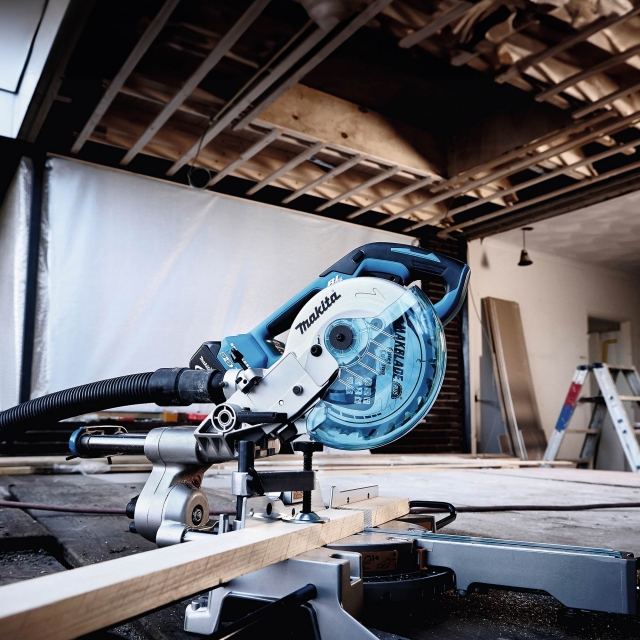
Cut square, right out of the box, no fence or rail adjustment needed before the first proper job. That surprised me more than it should have, because there’s an actual mechanical reason behind it rather than just a well set up unit off the production line. The double sliding mechanism on the Makita DLS714Z runs on four linear ball bearings, and that is specifically what gives the rigidity for adjustment free, precise cuts from the first time the saw comes out of the box. A lot of buyers would put that down to luck. It isn’t.
No workshop here, just a garage that also holds the bins and the bikes, so any mitre saw has to be light enough to carry in and put away rather than live bolted to a bench. Makita build bigger cordless sliding mitre saws in the same family, the DLS111 and the DLS2111, and those come with a laser and AWS wireless dust extraction built in from the factory rather than as an accessory, plus more depth of cut and a wider bevel range. This one gives all of that up specifically to stay light enough to move and store somewhere that isn’t a workshop. The grip backs that up too, a soft anti-slip elastomer surface built for vibration absorption, a handle made for being carried around as much as held steady mid cut.
Overview and first impressions
At 190mm the blade is on the smaller side for a slide compound saw, and the real limit that comes with it isn’t the bevel angle, it’s depth of cut once a bevel gets involved, tighter than the headline capacity figures suggest. That’s a different problem from the bevel range itself, which runs 45 degrees left and only 5 degrees right, a genuine single bevel rather than a token difference dressed up as two numbers. A buyer checking whether angled skirting will clear needs the depth answer specifically, not the angle range. The mitre side is more generous than most buyers realise though, with positive detent stops at 0, 15, 22.5, 30 and 45 degrees rather than a smooth unmarked range from 47 left to 57 right, meaning the angles actually used most often lock in firmly rather than needing the scale read by eye every time.
Specifications and scores
Blade diameter is 190mm, bore 20mm, cutting capacity 52 x 300mm square and 52 x 212mm at a 45 degree mitre, cutting up to 300mm in a single pass. No load speed is 5,700rpm with Automatic Torque Drive, shifting between a high speed mode for light duties and a high torque mode for heavier material rather than running one fixed speed regardless of load. Net weight is 13.5kg. Noise sits at 88dB(A) sound pressure and 97dB(A) sound power, with vibration rated at 2.5 metres per second squared and a 1.5 K factor. Standard equipment covers the blade itself, a dust bag, a hex wrench, a triangular rule, a vertical vice, and two individual holders for supporting longer stock. Soft start gradually increases speed to eliminate start up shock, and a STAR battery protection system guards against overdischarge, high temperature and overload.
How it performed in our tests
No laser, no LED cutline at all, and it’s a genuinely felt gap rather than one person’s pet peeve, since it’s the other thing people commonly wish for on this saw alongside a bigger blade. The best fix I’ve come across is specific enough that it reads like something actually built rather than a vague suggestion: a bendable, flexible USB LED light, a USB male to female switch cable, and a small USB external battery, bought together cheaply. Glue the LED light in front of the blade housing, on top of the blade guard, with a hot glue gun, then stick the USB battery near the carry handle with double sided tape or velcro. That’s exactly the kind of fix a DIYer reaches for rather than sending a working saw back over a missing feature.
The same size blade that limits depth of cut doesn’t forgive an unsupported offcut any better than a bigger one would. A kickback on this saw can be severe enough to chip teeth off the blade and gouge the fence hard enough to push it out of line, needing a replacement blade and the fence sanded flat and realigned before it’s trustworthy again. The actual cause is rarely bad luck, it’s an offcut catching the blade because it wasn’t properly supported or cleared before the head came back up. Two safety features exist specifically to answer risks like this. A two stage safety switch stops an accidental startup happening in the first place, and an electric brake stops the blade dead in three to five seconds once the trigger is released, rather than letting it spin down slowly while a hand is still near it. Worth building the habit of checking the cut area every single time regardless.
Support and clear the offcut, every time. Kickback on this saw comes from an offcut catching the blade because it wasn’t properly supported or cleared before the head lifts. The two stage switch and electric brake help, but they don’t replace the habit of checking the cut area first.
Cut quality on the standard 40 tooth blade handles pre-primed skirting and 4×2 framing timber to a superb finish straight out of the box, no upgrade needed, noticeably better even on the standard blade than an older single battery sibling in the same range. One demonstration cut has shown noticeable tear out on the face though, worth including honestly rather than only the positive experiences, since a single bad cut can come down to a dull edge on that particular blade or damp timber as easily as the saw itself, and it’s fair to wonder whether a better blade would clear it up.
Lock in the common angles. The detent stops at 0, 15, 22.5, 30 and 45 degrees cover most trim and framing jobs. Use them rather than reading the scale by eye whenever an angle matches one of these.
Battery system and runtime
Two 18V batteries run this saw in series rather than one bigger pack, drawing from the same LXT range as everything else already on a Makita platform. Whatever’s already charged for a drill or an impact driver drops straight on. The real question worth asking before buying isn’t about the saw’s features at all, it’s whether Makita batteries are already sitting in the toolbox. If they are, this is close to an easy yes. Starting from nothing changes the maths completely, because the batteries and a charger cost more than most people expect on top of the bare saw, and that cost is exactly what turns an easy decision into a harder one for anyone not already on the platform.
Performance and limitations
Build quality is solid enough to survive being thrown in a van and pulled out somewhere different next time, which matters as much for moving a saw between the allotment, the garage and a friend’s job as it does for a trade crew doing the same thing daily. The real benefit of going cordless here isn’t abstract, it’s not having to drag a step down transformer and a heavy cable along for anywhere without proper power, a hassle that just stops existing once a battery is charged, and it runs noticeably quiet doing it too.
Dust collection is where this saw earns more credit than the usual shrug every mitre saw gets. Set it working next to a single battery rival in the same rough bracket and the difference is obvious: the higher no load speed here creates noticeably stronger suction pulling dust into the bag, the faster rpm funnelling it in more effectively. On top of that, Makita’s own official accessory list for this exact saw includes an AWS wireless transmitter and a matching receiver adaptor, letting a compatible dust extractor start the moment the trigger is pulled rather than needing switching on separately or left running the whole time. Worth knowing the bigger siblings get this built in as standard rather than as an accessory, part of the same weight and cost trade that keeps this saw lighter. Makita documents the accessory version with its own dedicated brochure rather than treating it as a footnote, and most reviews only ever cover the bag because that’s what arrives in the box, so it’s easy to miss entirely.
Registering the saw extends the standard warranty out to a longer term, well worth doing the same day it arrives rather than filing the paperwork away.
- Cuts square out of the box thanks to 4 ball bearing rails
- Dust collection stronger than expected for the class
- Official wireless dust extraction option available
- Runs on the standard Makita LXT battery pool
- No laser or LED cutline as standard
- Depth of cut tightens up on bevel cuts
- Single bevel, only 5 degrees on the right
- Kickback risk if an offcut isn’t supported properly
- Anyone without a proper workshop to store a saw in
- Anyone already invested in Makita LXT batteries
- Skirting, architrave and general trim work
- DIYers who want to move a saw between jobs
- Regular compound cuts needing bevel both ways
- Anyone wanting a laser guide straight out of the box
- Anyone with no existing Makita batteries on a tight budget
- Deep bevel cuts on thick material regularly
Final verdict: is it worth it?
Weighed against what it gives up to stay this light, the trade holds up. No laser has a genuine fix. The depth limit on a bevel is worth checking before it catches anyone out, not a reason to avoid the saw outright. Dust collection is stronger than the spec sheet suggests, backed up by a wireless option most buyers never even discover exists. For anyone without a proper workshop, already on the Makita platform, this earns its place.
A genuinely light saw that cuts square from the first job thanks to a real mechanical reason, with dust collection that beats expectations and an official wireless extraction option most reviews overlook entirely.
Share on socials: