At a glance
I used this to edge profile a run of oak offcuts I’d turned into open shelving, and cut a stopped groove under one shelf for some LED strip lighting, and it handled both without a single complaint. What struck me picking it up for the first time, though, was how overdue it felt. I’ve waited years for Bosch to bring out a proper variable speed cordless trimmer, gave up at one point and moved to a different brand entirely, then moved again a few years after that. This one finally turns up to that argument well equipped.
Speed runs from 10,000 right up to 30,000rpm, and Bosch clearly built that top end for laminate trimming, where speed matters because it drops noticeably the moment the cutter loads up under pressure. Fair enough, that’s a genuine use case. But for the profiled cutters I run most of the time, that top of the dial is more speed than the bits themselves want or need. I live in the lower half of that range for the shelving work and the groove both. If laminate trim is the job, the full range earns its keep. If it’s general profile work, don’t feel you have to chase the top number.
Overview and first impressions
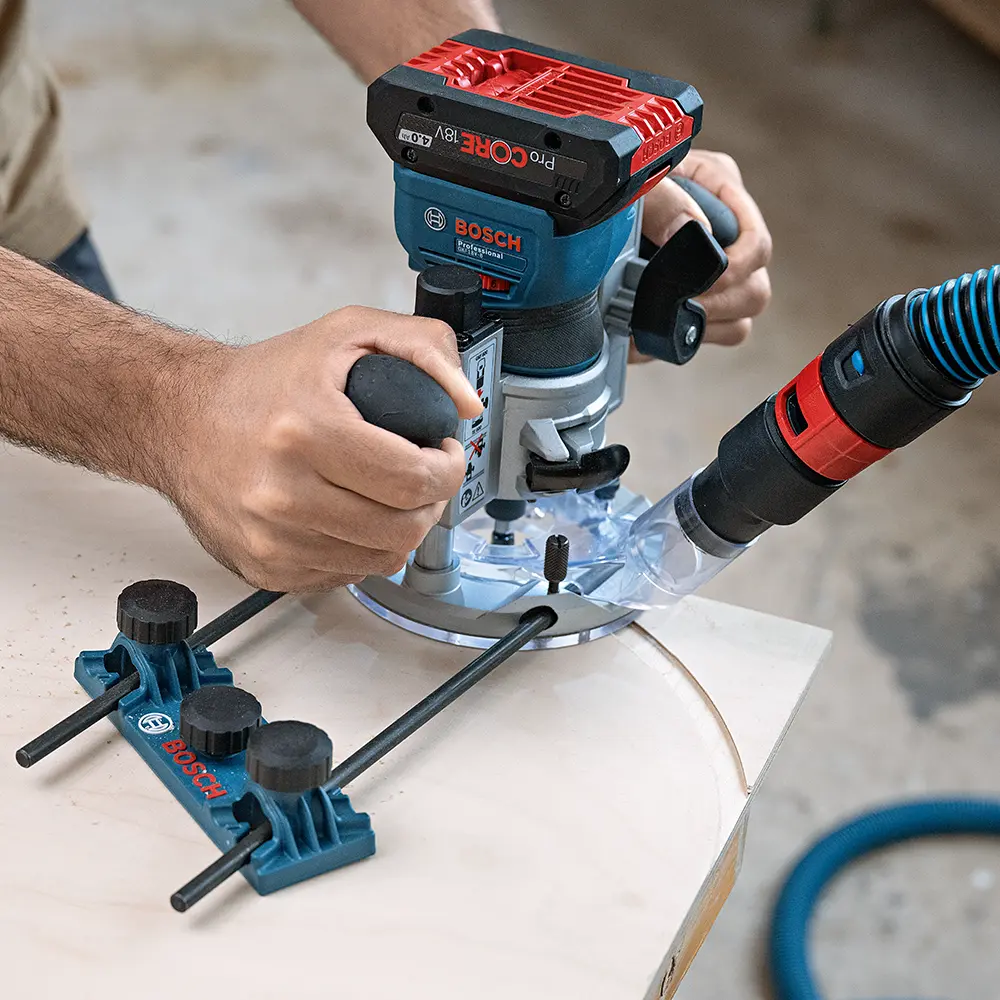
Where this router pulls away from a generic palm router is the dust extraction, and it’s not a token gesture. There’s a dedicated adaptor for surface routing and a separate one for edge routing, built specifically for each situation rather than one generic port doing both jobs badly. The chip shield and the edge routing adaptor click together and work as one unit, not two things you’re fumbling to fit separately. Running the LED groove indoors, the difference was obvious the moment I connected the extractor, hardly any dust in the air by the time I’d finished the pass.
The collet caught me out slightly, and it’s worth knowing before ordering. Mine came fitted with a 1/4in collet and nut, but Bosch also list 6mm and 8mm sizes as compatible, and depending on which listing or bundle gets bought, the collet that ships can differ. Check the exact box contents against the specific part number rather than assuming, because I’ve seen the same router listed with different collets included depending on where it’s bought from.
Bit changes go through a single wrench and a spindle lock, no second wrench needed to hold the spindle still the way older designs make you do it. That alone speeds up a job doing mixed profiles, swap a bit, run a pass, swap again, rather than one long repeated cut all day. Depth adjustment moves between 0 and 34mm in 1mm steps, fine control for something this size, and it held a repeat depth across the whole run of shelving without me having to reset it between boards.
Specifications and scores
How it performed in our tests
The brushless motor is rated at the equivalent of 1000W of corded power, well above its own sibling, the GLF version, which sits at 600W. A constant speed function keeps the cutting speed steady once it’s set rather than letting it sag on a harder pass, which is what gives a clean, consistent finish rather than the rpm figure on its own. Cooling is designed specifically to stop it overheating through a longer session, and after running the whole shelving job back to back it never once felt like it was struggling to shed heat.
There’s a drop control feature that cuts power the instant the tool detects a fall, which matters more than it sounds. A spinning bit landing on a bench edge or a foot after a drop is a second accident stacked on top of the first one, and this stops that happening rather than just reducing the chance of it. Restart protection sits alongside it, stopping the motor firing back up on its own after a power cut with a bit still fitted.
Connect the dust extraction, don’t just carry it. The dedicated surface and edge routing adaptors only do their job properly when actually hooked up to an extractor, not left fitted but unconnected on a quick cut.
Battery system and runtime
It runs on Bosch’s Professional 18V system, including the ProCORE18V range, and it’s also part of AMPShare, a cross-brand battery alliance, so batteries from other AMPShare brands work in it too. That’s a genuine oddity. Most cordless platforms lock you into one manufacturer’s batteries entirely, and having that flexibility matters if you’re already juggling more than one brand’s tools.
Weight is worth being straight about, because the figures floating around don’t agree with each other. Bosch’s own official number is 1.1kg excluding the battery. Other listings I’ve seen say 1.2kg, and some customer facing copy goes as high as 1.4 or 1.5kg. I’d trust the official number over the rest, the higher figures look like they’re either an older running change or just copy that never got corrected. Either way, real weight in the hand depends entirely on which battery you’ve clipped on, since none of these numbers include one.
Performance and limitations
Beyond the standard base, there’s an offset base with its own drive wheel and spindle lock, built to run along a roller or bush guide rather than freehand, which matters for template work where a steady, repeatable offset from an edge is the whole point. Guide bushings, an adapter for them, and a centring cone and pin come into play there too, and having a proper centring tool rather than eyeballing it saves a ruined piece the first time a template job goes slightly wrong, since an off-centre bushing throws the whole dimension out, doubled, on anything symmetrical.
The bundled kits come in an L-BOXX 136 or the bigger L-BOXX 238, and the 238 is the only way to get the TE 600 plunge base included at the point of purchase rather than bought separately afterward. I went bare tool since it was going straight into an existing case rather than being carried to site on its own, but if plunge work is part of the plan from day one, the 238 kit is worth costing in from the start rather than adding the plunge base on later as an afterthought.
The dust extraction point is worth taking seriously rather than treating as a nice to have. I connect it every time I can, keep the space ventilated regardless, and wear a P2 filter mask on top of that, not instead of it, because breathing in fine dust for years catches up on you eventually whether you notice at the time or not. Bosch have clearly put real engineering into the dual adaptor system rather than bolting on a token dust port, which says they take the same view of it.
- Genuine dual dust extraction, not a token port
- Broadest accessory ecosystem in this class
- AMPShare cross-brand battery flexibility
- Drop control and restart protection built in
- Top speed more suited to laminate than general profiling
- Collet size ships differently depending on listing
- Weight figures inconsistent across retailers
- Plunge base only bundled in the largest kit
- Anyone routing enough indoors that dust genuinely matters
- Anyone building out a proper accessory system over time
- Anyone already juggling more than one AMPShare brand
- Anyone assuming the same collet ships on every listing
- Anyone wanting the plunge base without buying the 238 kit
Final verdict, is it worth it
Between the shelving edges and the LED groove, it did everything I asked of it and made the dust extraction feel like it was doing something rather than just being there to tick a box. If you’re doing enough edge or surface routing that dust matters, especially indoors, or you’re planning to build out the wider accessory system over time rather than buy once and stop, this earns the extra thought that goes into a router at this end of the range.
A genuinely overdue, well engineered palm router where the dust extraction and accessory ecosystem do the heavy lifting. Check which collet actually ships before ordering, and it earns its place at this end of the range.
Share on socials: