At a glance
The first thing you notice when you pick up the DHS680Z is the weight. At 3.0kg body-only, it is noticeably lighter than the heavier 18V circular saws in this class and the difference registers in your hand immediately. A joiner who tested it on door hanging and second-fix trim work said the same thing: after a long day on site, that 1kg matters more than any spec sheet suggests.
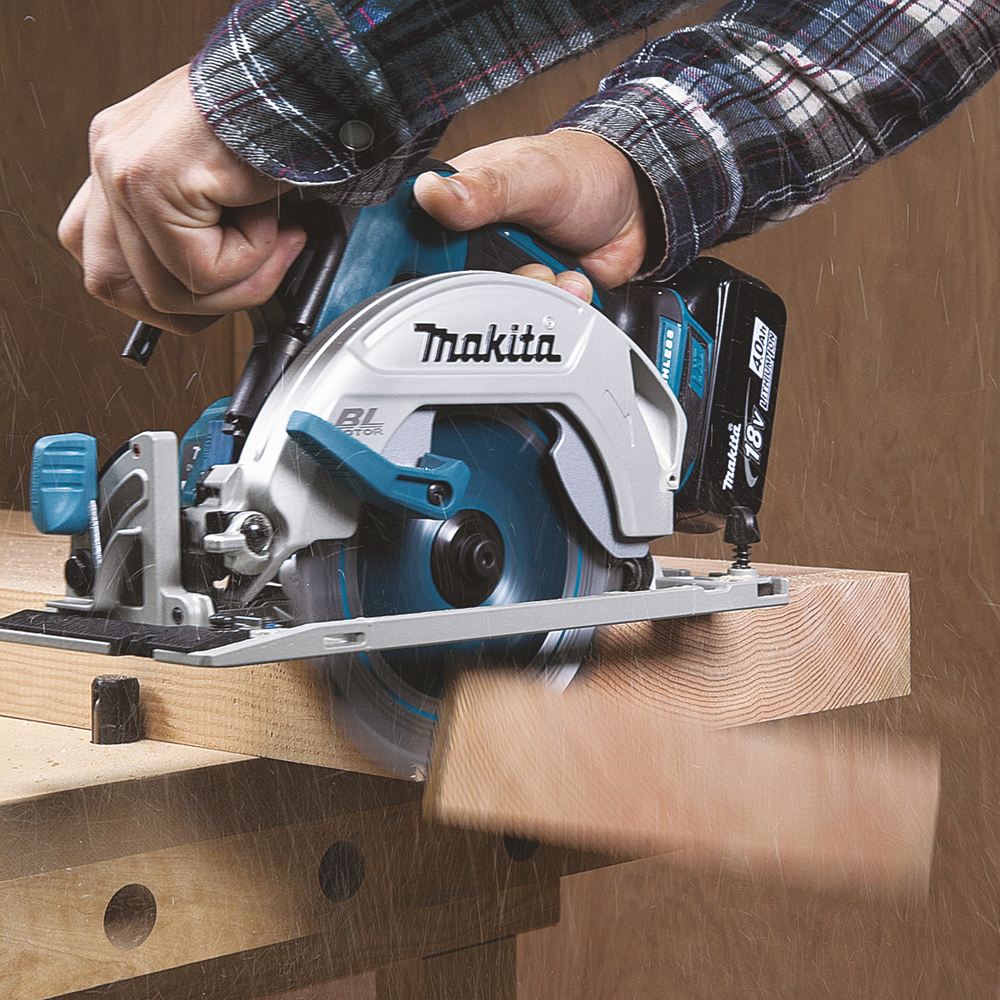
The DHS680Z is Makita’s 165mm brushless 18V LXT circular saw. It is not the most powerful circular saw in the cordless category. It does not have the deepest cut. The maximum cutting depth at 90 degrees is 57mm, which handles standard CLS, 2×4, and most sheet goods without difficulty, but will not get through a 2×6 in one pass. Anyone who needs more depth than that regularly should look at a 184mm or 190mm saw instead. For everyone else, 57mm is sufficient for almost every job that a joiner or finish carpenter will meet.
Overview and first impressions
The blade is on the left side of the motor, and it changes how the saw is used. With the blade on the left, the motor body sits to the right. For right-handed users, this means the cut line is visible directly, without craning the head or shifting the body to see over the motor. On a right-blade saw, the motor is between the eye and the cut line and the view of the cut requires some compensation. On this saw, it does not. The line is just there. After a short while it starts to feel like the obvious way to arrange a circular saw, and the right-blade design feels like an oversight by comparison.
Because the motor sits on the right side of the body, you can register a roofing square against the right side of the shoe and make accurate parallel crosscuts without setting up a fence. The right-angle face of the motor housing gives you a reference surface. It is a small thing but the kind of thing a professional picks up on the first day and uses consistently after that.
Dust direction is the other side of the left-blade layout. With the blade to the left, the saw throws dust toward the operator’s feet rather than away from them. The DHS680Z draws ventilation air in through the front of the tool across the cut line, which clears the line of sawdust during the cut and helps visibility considerably. The rear exhaust port connects to a 35/40mm vacuum nozzle, which is included in the box. With a vacuum connected, dust management is good. Without one, dust on the floor in front of you is normal.
Specifications and scores
How it performed in our tests
The bevel adjustment runs to 50 degrees, left bevel only. There is no right bevel on this saw. For anyone who regularly needs right-bevel cuts, that is a limitation worth knowing before buying. On the left bevel, the action is smooth and the lever locks positively. The 45-degree stop engages cleanly. At 45 degrees there appears to be a hard limit, but a small turret stop can be twisted out of the way to open the bevel up to the full 50 degrees. The extra 5 degrees is not trivial in finish joinery. Walls are rarely perfectly plumb, angles compound, a mitre that closes at 44.5 degrees instead of 45 is not a misset saw, and the additional range gives you room to correct without flipping the workpiece. At 45 degrees on light freehand cuts, the saw’s low weight works against it slightly, stability requires a bit more attention than on a heavier saw. A straight edge clamped to the workpiece or the guide rail adapter resolves this completely.
On crosscuts in dry English oak, the finish was excellent. Fine edges, straight, clean enough that nothing further was needed beyond running a wax over them. On CLS timber at 90 and 45 degrees, the cuts came out consistently clean. On longer freehand rip cuts in softwood, the saw was capable but the lighter weight required more attention to keep the shoe tracking. A rip fence is included in the box, attaching at both the front and rear of the shoe for stability, and it makes rip cuts more manageable. The blade included in the box is a standard 24-tooth TCT, which does the job for construction timber. Upgrading to the Efficut blade, Makita’s 1mm-thick 25-tooth option with a 1.4mm kerf, changes the cutting experience noticeably. The narrower kerf reduces friction, and on hardwood and fine joinery the finish quality is different in kind rather than degree.
The depth at 40mm setting cut to 40.5mm in practical testing, a 0.5mm overcut that is worth knowing about for precise work. It is a minor variance, consistent and predictable, and easily compensated once you know it. The depth lever operates smoothly and locks positively. The bevel scale is clearly marked. Both levers are large enough to use with work gloves, which sounds like a small point until you are trying to adjust a saw on a cold morning with heavy gloves on and discover that most lever designs are not designed with gloves in mind.
Consider the Efficut blade. The standard 24-tooth TCT does the job for general carpentry. The Efficut’s 1.4mm kerf noticeably reduces friction and improves finish quality on hardwood and fine joinery.
Battery system and runtime
Makita’s ADT (Automatic Torque Drive Technology) does not run the motor at full speed all the time. On a light cut through thin softwood, the motor runs at lower speed and lower torque. When it encounters resistance, oak, dense sheet material, deeper cuts at 45 degrees, the system detects the load and increases both speed and torque to hold the cut. The result is that battery power goes where the cut demands it rather than being burned uniformly regardless of the workload. With a 5.0Ah battery, experienced daily users get 90 to 100 cuts through standard softwood per charge. The saw is easy on batteries, which matters if you are working through the day without a charger to hand.
The DHS680Z sits in the Makita 18V LXT system, which has over 300 compatible tools. If a toolkit is already based on LXT batteries, the saw slots in without any additional battery spend. If not, the body-only price needs to be set against a battery and charger purchase. The battery has a three-level fuel gauge, checked by pressing a button on the battery, which is worth glancing at before starting a long cut. The optional guide rail adapter converts the saw into a rail-guided track saw, which on sheet material produces cuts cleaner than most dedicated track saws at the same price point. The 3-year warranty requires registration with Makita within 30 days of purchase, which is worth doing on the day of delivery.
Performance and limitations
The rafter hook is a fold-out metal hook on the back of the saw body. On a ladder or scaffold, you can hang the saw on a joist or rafter while you position the workpiece with both hands. The dual LED lights activate when the safety trigger is pressed before the motor engages, so you can line up the cut before the blade spins. They stay on briefly after the trigger is released. The aluminium blade guard lifts clear during cutting and protects the blade when the saw is set down. The cast magnesium gear housing is noticeably more substantial than a plastic equivalent and takes knocks on site without any suggestion of giving way. None of these are headline features on a spec sheet but they are the kind of features that add up over a full working day.
- Left-blade design: direct sightlines for right-handed users
- Rafter hook included for overhead and ladder work
- ADT extends battery life across varying load conditions
- Cast magnesium gear housing and aluminium guard
- 57mm depth limit: will not cut 2×6 (63mm) in one pass
- No right bevel: left bevel only, up to 50°
- Light weight requires more attention on freehand rip cuts
- Body only: no battery or charger included
- Joiners and finish carpenters on second-fix work
- Anyone working at height or overhead regularly
- Furniture makers and cabinet fitters needing clean crosscuts
- Existing Makita 18V LXT users
- Framing carpenters needing 64mm or more depth
- Anyone needing right-bevel cuts regularly
- Starting fresh without LXT batteries
Final verdict
This is a saw for joiners, finish carpenters, furniture makers, and fitters. It is the saw for second-fix work, door hanging, trim carpentry, and precise crosscuts in timber and sheet goods. It is the right saw for working overhead, working at height, and working in confined spaces where a heavier tool becomes tiring before the job is done. It is not the saw for a framing carpenter who needs to rip through structural timber all day. For that work, the depth and raw power of a 184mm or larger saw is the right tool. For precision and portability on finished work, the DHS680Z is exactly what it should be.
The DHS680Z is not the saw for someone who needs to rip through 4×2 all day. It is the saw for someone who needs clean, controlled cuts in timber and sheet goods, often in awkward positions, without adding 4kg to their wrist. The left-blade design, the rafter hook, and the ADT system all serve the same user: someone who values precision and portability over raw depth.
Share on socials: