At a glance
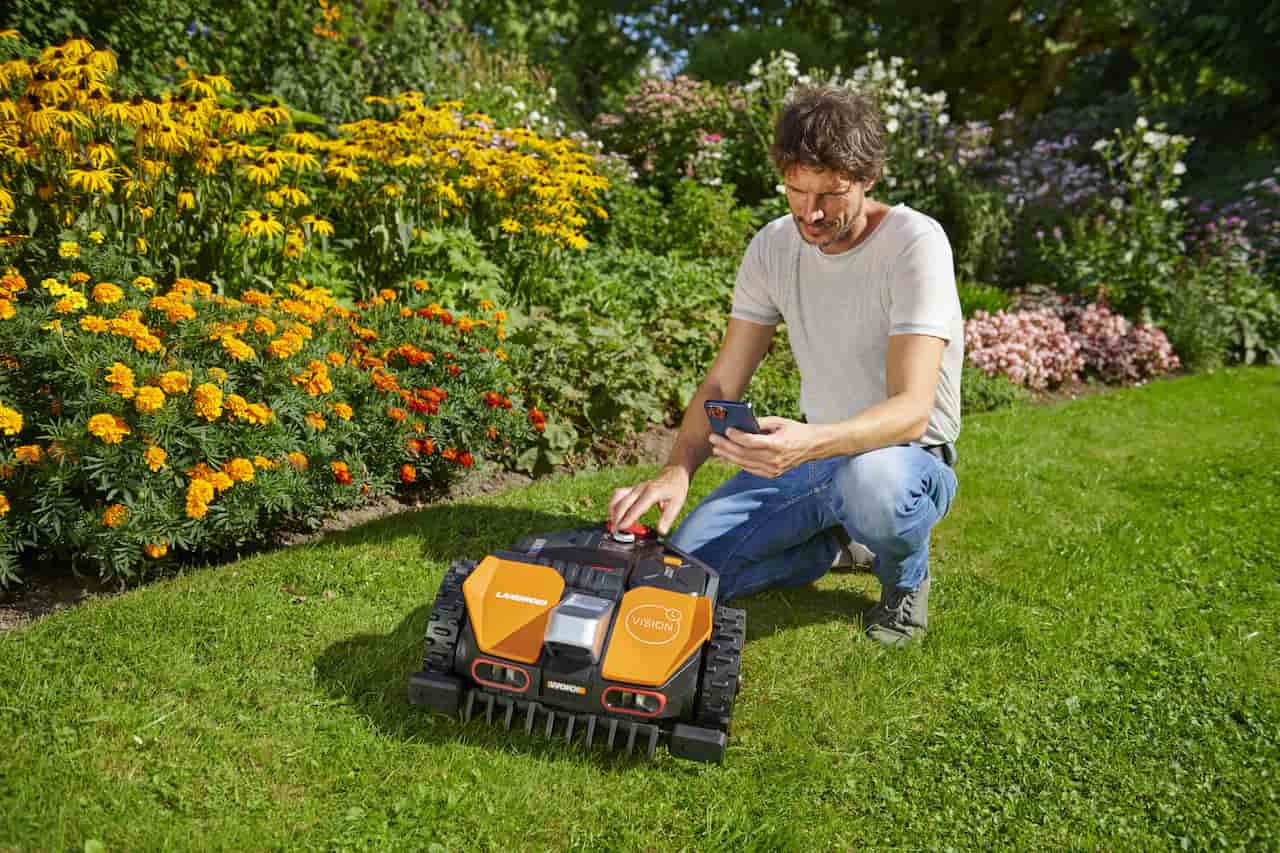
No wire, no peg, no splice. This one finds the lawn by looking at it, through a wide-angle camera and a neural network that decides what’s grass, what’s an obstacle, and where it shouldn’t go. After two wire-guided mowers in a row, that’s a genuinely different proposition, and the question was whether a camera could actually replace the boundary entirely, or whether it would just trade one set of problems for another.
It covers up to 1600m², handles slopes up to 30%, and weighs a substantial 14kg. No installation in the traditional sense at all, just the mower, the charging base, and a button.
Overview and first impressions
The cutting deck floats rather than sitting rigid, adjusting itself over uneven ground to avoid scalping bumps and dips, something that became obvious the moment I turned it over and saw how much the disc could move independently of the chassis. Cutting height is electronic, adjustable between 30mm and 60mm across 7 positions entirely from the app, no dial, no tool.
The 20V 4Ah battery sits on Worx’s wider PowerShare platform, so it’s shareable with other Worx 20V tools if you already own any, and it charges in around 40 minutes thanks to a 5A charging current, the fastest in this particular mower’s own range. Worth knowing plainly: that faster charge is genuinely the headline upgrade this size tier buys, rather than a bigger battery or sharper blades, so the real benefit is less time parked up charging rather than dramatically more cutting power.
In the box: the mower, charging base and pile, battery, charger, spare blades and screws, two 5m magnetic strips, pegs, a hex key, and two RFID tags. An LED headlight for safe night mowing is a separate purchase, not included as standard.
It’s rated IPX5 and hose-washable, a lift sensor stops the blades the instant the body is picked up, and a short series of warning bleeps sounds before the blades actually start, a small but genuinely reassuring touch if anyone’s nearby. Warranty is 2 years as standard, extending to 3 if registered online within 30 days of purchase.
Trim the lawn properly before the first run. The mower won’t cut grass that’s already too long on its first pass, and loose leaves or debris left lying around will simply be treated as obstacles and mowed around rather than over.
Specifications and scores
How it performed in our tests
The genuine difference from a wire-guided mower showed up almost immediately. A tennis ball left on the lawn stopped it dead and sent it the other way. A single leaf got correctly identified and mowed around rather than treated as a threat. Walking the dog across the lawn while it was running, it turned away well before getting anywhere close, which is exactly the kind of real-world reassurance no amount of spec-sheet reading can give you.
Heavy shadow along one side of the garden never got misread as an obstacle, the HDR camera handled the contrast without any of the false stops I half expected. By the third day of a fresh start, most of the lawn had been brought down to a consistent length, a genuinely reasonable settling-in period for something starting from scratch with no prior map.
The floating, self-levelling cutting disc earned its keep on a lawn that isn’t perfectly flat, no obvious scalped patches even where the ground dipped slightly. The app itself was occasionally unstable, a crash here and there, not a dealbreaker but a real rough edge on otherwise polished hardware.
Give it three full days before judging the cut. A fresh lawn with no prior map takes a little time to bring down evenly. Don’t expect a magazine-perfect finish from day one.
Setup and navigation
There’s no bump sensor here at all, navigation and obstacle avoidance both rely entirely on the camera and its neural network, which is a genuinely active form of avoidance rather than a simple physical bump-and-turn. No-go areas use a magnetic strip rather than a wire loop, roughly 32cm from anything you want protected, with any bend in the strip at an angle of 90 degrees or more, and at least 65cm clear of a true lawn edge.
Separate lawn areas are handled with small RFID tags pegged into the ground rather than spliced wire, no stripping or connectors needed at all. After placing or moving any tag, the mower needs a dedicated exploration pass, a “Lawn Explore” run, before it properly understands the new zone layout. Charging station placement is genuinely specific: the right-hand side of the base needs to sit along the lawn boundary with 2m clear in front and 1.5m behind, or alternatively in a corner with a 5-15cm gap from the side boundary and the same 2m clearance ahead.
Once everything’s positioned, the mower runs an initial exploration pass with the blades switched off, learning the lawn’s shape through the camera before any actual cutting begins. No physical installation in the traditional sense, but genuinely real setup steps all the same.
Performance and limitations
What this does genuinely well is exactly what camera navigation promises: real obstacle avoidance rather than blind bumping, no wire to bury or repair, and a setup that’s measured in minutes rather than an afternoon with pliers. The floating cutting deck handling uneven ground without scalping was a real, tangible benefit rather than a marketing line.
The honest limitations are real too. There’s a genuine app gap worth knowing before you rely on it: a rain delay shows on the mower’s own panel but doesn’t reflect anywhere in the app, so there’s no way to check remotely why it hasn’t gone out to mow. The delay length itself is adjustable, and there’s even a “mow when raining” override, though running it in genuinely wet conditions isn’t something I’d recommend for the lawn’s own sake regardless of what the setting allows. The app itself isn’t always rock solid. And at 14kg, this isn’t a machine you’ll casually lift and carry around without using the handle properly.
None of that undoes what the camera genuinely achieves. It’s a different category of limitation to a wire that’s been nicked or a splice gone wrong, software rather than hardware, and the kind of thing continued updates can realistically improve over time.
- Genuine, active obstacle avoidance
- No wire to bury, splice or repair
- Floating deck genuinely prevents scalping
- Fast charging, around 40 minutes
- App can be unstable, occasional crashes
- Rain delay status missing from the app
- Genuinely heavy at 14kg
- Night mowing headlight costs extra
- Larger lawns up to 1600m²
- Households with pets, children or visiting wildlife using the garden
- Anyone who’d rather avoid wire installation entirely
- Anyone needing perfect app reliability from day one
- Gardens steeper than 30% in places
- Anyone wanting night mowing included as standard
Final verdict
The camera genuinely delivers on its core promise. Real, demonstrable obstacle avoidance, no boundary wire to bury or repair, and a cutting deck that handles uneven ground better than I expected. For a lawn busy with people, pets and the odd dropped toy, that’s a real and meaningful advantage over the wire-guided alternatives.
The rough edges sit firmly in software rather than hardware, an app that isn’t always stable and a rain-delay status that doesn’t make it across to your phone. Neither is a dealbreaker, but neither is invisible either.
For a larger, busier garden where genuine obstacle awareness actually matters day to day, this earns its place. For a smaller, simpler lawn, the premium this technology commands buys real capability, but it’s worth being honest about exactly which part of that capability you’re actually paying for.
A genuinely capable camera-guided mower with real, demonstrable obstacle avoidance and no wire to install. Held back by an occasionally unstable app, a rain-delay status that doesn’t reach your phone, and genuine weight to handle.
Share on socials: