At a glance
Carrot fly – Psila rosae – is one of the most frustrating and damaging pests a UK vegetable grower faces. The adult fly itself causes no damage, but the creamy white larvae it lays near host plants tunnel into the roots of carrots, parsnips, celery and parsley, creating the characteristic rust-coloured channels that render the crop inedible. What makes carrot fly particularly difficult to deal with is that by the time the damage is visible – when you pull a carrot and find it riddled with brown tunnels – it is far too late to do anything about that generation of larvae. Effective control is therefore almost entirely about prevention rather than treatment, and timing that prevention correctly around the two main flight periods each year.
The good news is that physical barriers are highly effective against carrot fly because the adult female flies at low level, rarely rising above 45-60cm. This biological quirk means a simple fine mesh or fleece barrier erected around the carrot bed will prevent the vast majority of egg-laying if installed correctly and at the right time. Combined with resistant varieties, careful timing of sowings, and simple companion planting strategies, it is entirely possible to grow a clean carrot crop in most UK gardens even where carrot fly pressure is high. This guide covers everything needed to protect a crop from sowing through to harvest.
Identifying carrot fly damage
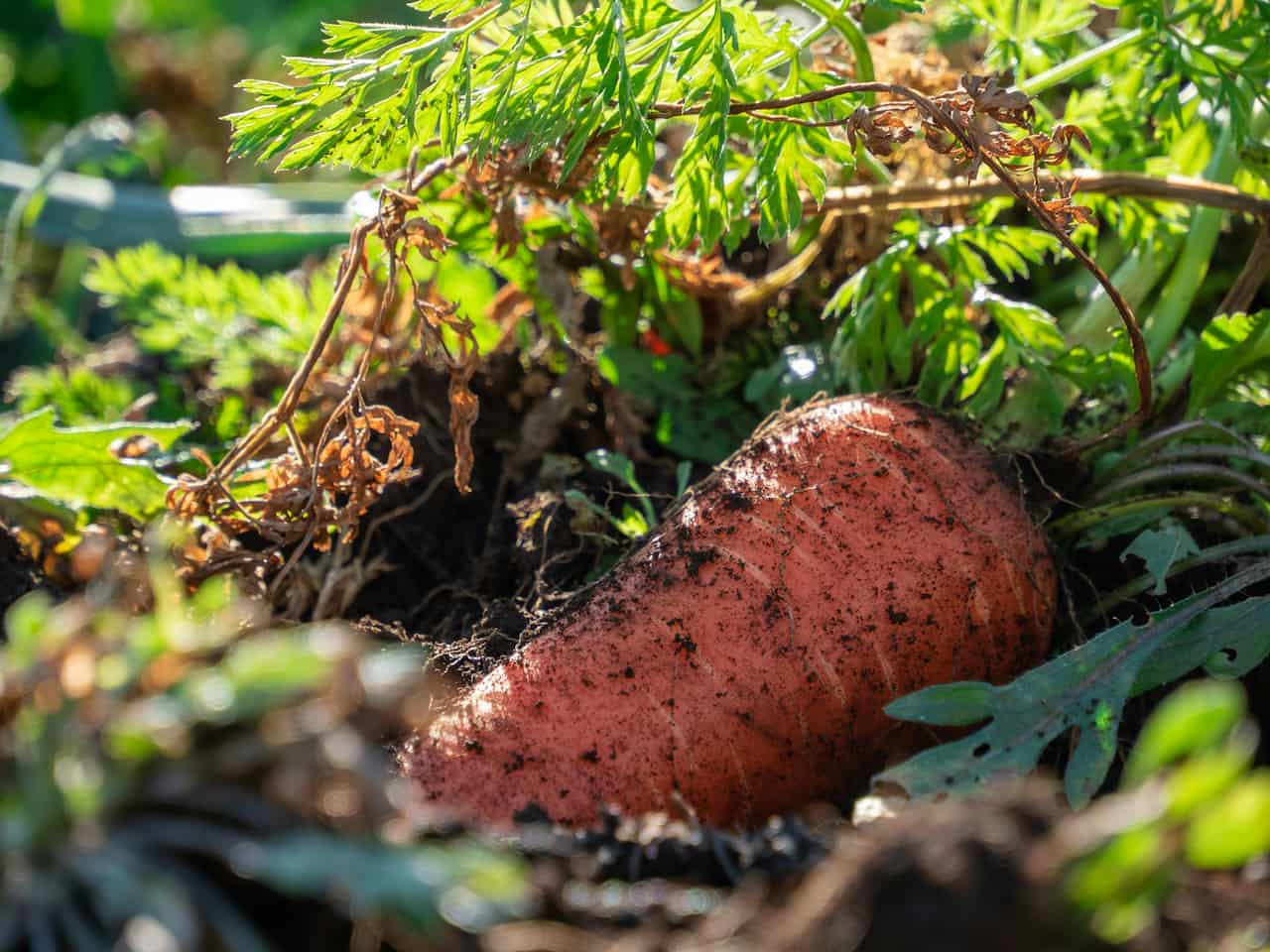
The first sign of carrot fly attack that most gardeners notice is the foliage of affected plants turning yellow or reddish-purple and wilting during warm weather. This above-ground symptom is caused by root damage preventing the plant from taking up water and nutrients effectively. It closely resembles drought stress, which is why many gardeners initially water more in response to carrot fly damage rather than suspecting pest attack. The definitive identification comes when a root is pulled – carrot fly damage produces distinctive rusty-brown, winding channels just below the root surface, created by the larvae boring through the flesh. In severe attacks the channels can penetrate deep into the root, making the carrot completely unusable.
Lifecycle and flight periods
Understanding the carrot fly lifecycle is fundamental to timing protective measures correctly. The fly overwinters as pupae in the soil, emerging as adults in spring. There are two main generations in the UK each year, with a possible partial third generation in warm autumns in southern England. The first generation flies from approximately late April through to June, laying eggs near the base of carrot seedlings and young plants. The second and most damaging generation flies from late July through September, targeting maturing crops. Eggs are laid in the soil close to the host plant stems, and larvae hatch within a week in warm conditions, immediately tunnelling down to the roots.
Sowing timing can be used strategically to reduce exposure to the first generation. Delaying outdoor sowings until late May or early June means the seedlings are not present during the peak of the first flight period in May. The crop will still be at risk from the second generation in August and September, but avoiding two attacks rather than one improves the chances of a usable harvest. Conversely, very early sowings under glass that are transplanted out after the first generation has passed can also reduce first-generation damage, though transplanting is not ideal for carrots and requires careful root disturbance.
Physical barriers
Physical exclusion with fine insect mesh is the single most reliable method for preventing carrot fly damage. The key requirement is that the mesh must have an aperture no larger than 1.3mm to exclude the adult fly, and it must be erected before adults begin flying – typically before mid-April for the first generation. The barrier must be sealed at the edges at soil level, as carrot fly will find any gap. Any barrier above 60cm in height will stop the vast majority of carrot fly because the adults rarely fly higher than this. A simple wooden frame covered with fine mesh, or a series of hoops supporting mesh pinned firmly at the sides and ends, provides effective protection for the season.
Thinning is a major risk event. The smell released when carrot seedlings are thinned is a powerful attractant to carrot fly females that are actively searching for egg-laying sites. Always thin in the evening when flies are less active, water before thinning to soften soil and reduce scent dispersal, and firm the soil around remaining plants immediately after. Remove all thinnings from the site rather than leaving them nearby.
Companion planting and other controls
Companion planting with strong-smelling plants is a popular strategy for confusing carrot fly females that locate host plants primarily by scent. Interplanting carrots with onions is the most widely recommended combination, based on the theory that the onion smell masks the carrot scent and vice versa. The evidence for this is mixed in controlled trials, but many growers report reduced damage when growing the two crops in alternating rows. More reliably, growing carrots in blocks surrounded by onions, garlic, or other alliums rather than in long unprotected rows reduces the exposure of individual plants at the row edges, which tend to suffer more damage than interior plants.
Resistant varieties
Several carrot varieties have been bred with significantly reduced susceptibility to carrot fly attack. These varieties are not completely immune but have structural or chemical characteristics – generally a higher chlorogenic acid content in the roots – that make them less attractive to egg-laying females and less susceptible to larval damage. For gardeners in high-pressure areas or those who prefer not to use physical barriers, resistant varieties are the most practical long-term solution. The most widely available and tested resistant varieties in the UK are listed below.
Using resistant varieties in combination with fine mesh barriers provides belt-and-braces protection that is effective in virtually all situations including high-pressure allotment sites where neighbours may be growing unprotected carrots nearby. For kitchen garden use, starting with a resistant variety and adding mesh only during the peak flight periods of May-June and August-September provides a practical balance between protection and the inconvenience of maintaining permanent mesh covers through the growing season. Crop rotation – not growing carrots or other umbellifers such as parsnips, celery and parsley in the same bed for at least two years – also reduces the overwintering pupal population in the soil, lowering pressure on subsequent crops. Where rotation is practised consistently and combined with resistant varieties, many growers find they can achieve clean harvests without any barrier protection at all, though this approach works better in gardens with low ambient fly pressure than on allotments where neighbouring plots may harbour large overwintering populations that continuously recolonise the site regardless of what is grown there.
Share on socials: