At a glance
Plant rust is a group of fungal diseases caused by various species of the Puccinia and related genera, producing the distinctive orange, brown or yellow powdery pustules on leaves and stems that give the disease its name. Unlike many fungal diseases, rust is host-specific – the rust affecting hollyhocks is a different species from the rust on roses or leeks, and the two cannot infect each other. This specificity matters practically: finding rust on one plant type does not mean every susceptible plant in the garden is immediately at risk from the same inoculum, though spores from a heavily infected plant will spread prolifically to other specimens of the same species nearby.
Rust is prevalent across UK gardens because the cool, damp summers and autumns that characterise the British climate provide near-perfect conditions for spore germination and spread. The disease is rarely fatal on its own, but heavily infected plants lose photosynthetic capacity, weaken progressively through the season and become more vulnerable to secondary problems including cold damage and other fungal infections. The earlier infection is caught and managed, the less impact it has on plant performance and the lower the inoculum load available to reinfect the same plants the following season.
Identifying plant rust
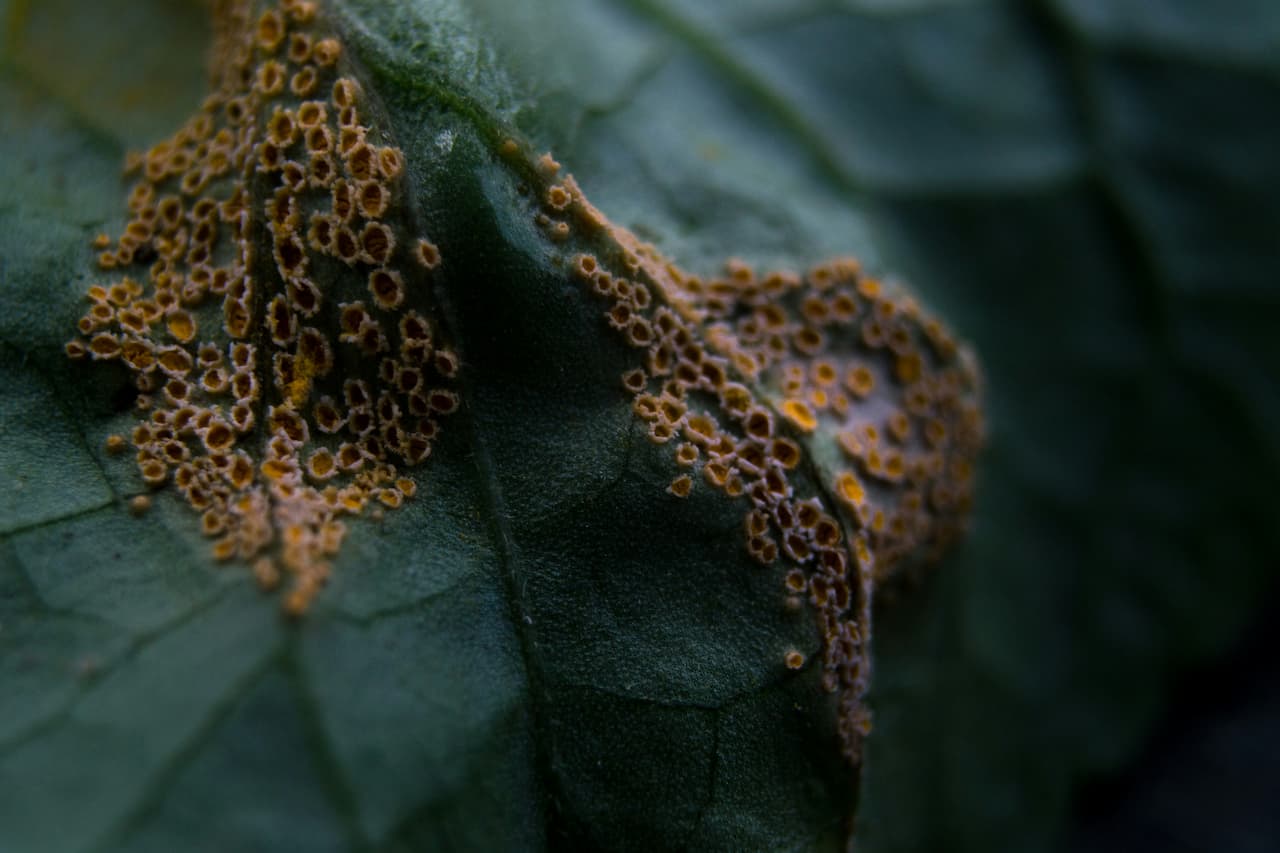
The primary identifying feature of rust is the raised, powdery pustules on the undersides of leaves. These begin as small raised bumps, typically yellow-green on the upper leaf surface with corresponding orange, rust-brown or yellow pustules below. As they mature the pustules burst open and release vast quantities of powdery spores. The upper leaf surface typically shows pale yellow or orange discolouration directly above each pustule cluster. In advanced infections, leaves yellow completely and drop early, reducing the plant’s ability to photosynthesise and build energy reserves for the following season.
Rust is most likely to be confused with the galls produced by gall mites on certain plants, which also appear as raised orange or yellow structures on leaves. The key difference is that gall mite galls are firm and attached to the leaf tissue, whereas rust pustules burst open and release powdery spores when touched. Touching a rust pustule and checking for orange powder on your finger is a reliable on-the-spot test. The underside location of the pustules is also diagnostic – most other common leaf diseases primarily affect the upper leaf surface, while rust almost always starts and is most severe on the underside.
Most affected plants
Virtually any plant can potentially host a rust species, but the most consistently affected garden plants in the UK include hollyhocks, roses, leeks and other alliums, pelargoniums, antirrhinums, fuchsias, mint, blackcurrants and gooseberries. Hollyhock rust – caused by Puccinia malvacearum – is particularly aggressive and will defoliate susceptible plants entirely by midsummer in wet years. Leek rust is widespread and while it rarely kills the crop, severe infection affects the size and quality of the harvest. Rose rust, caused by Phragmidium species, is less common than black spot but produces distinctive orange pustules on stems as well as leaves.
Seasonal pressure and spread
Rust fungi overwinter on infected plant debris and as spores on the soil surface around host plants. In spring, spores are released and carried by wind to the new season’s foliage. Initial infections in spring and early summer are often light and go unnoticed. It is the secondary spread – from these early infections to the expanding foliage below and on neighbouring plants – that builds the damaging levels of infection typically seen from July onwards. The rate of spread is closely tied to the frequency of wet conditions: each rain event deposits spores and provides the leaf wetness that enables them to germinate. The heatmap below shows the typical pattern across the UK growing season.
Treatment – what works
Effective treatment starts with removing all visible infected leaves as soon as rust is spotted, regardless of how light the infection appears. This reduces the spore load available to spread to healthy foliage above and on nearby plants. All removed material must go into the bin – composting infected leaves returns concentrated inoculum to the garden. For ornamental plants where complete defoliation would be too damaging, targeted removal of the most infected lower leaves combined with a fungicide programme is the practical approach. For edible crops such as leeks, the harvest decision is often the best response once rust has progressed beyond early stage.
Never compost rust-infected plant material. Rust spores are extremely robust and survive in most domestic compost heaps. Adding infected leaves or stems to the compost bin and then using that compost as a mulch returns concentrated inoculum directly to the soil around susceptible plants. Always bag infected material and put it in the general waste bin. This is the single easiest way to reduce rust severity year on year.
Prevention and cultural controls
The most effective cultural control for rust is thorough autumn clearance. Collecting and disposing of all infected plant debris in autumn – leaves, stems, and any material fallen around the base of susceptible plants – removes the overwintering spore structures that generate the following season’s primary infection. This single action, done consistently every autumn, reduces the severity of infection each subsequent year and reduces the number of fungicide treatments needed to maintain plants in good health. Leaving infected debris in place over winter, or worse, cutting it up and incorporating it into the soil, guarantees a heavy infection the following season.
Improving air circulation around susceptible plants reduces the duration of leaf wetness after rain, which is the key factor governing how many successful infections occur through the season. For border plants, this means spacing generously and avoiding planting rust-susceptible species together in a dense mass. For soft fruit such as gooseberries, annual pruning to an open, goblet-shaped framework improves airflow through the canopy and significantly reduces rust pressure. Watering at soil level rather than overhead eliminates the splash dispersal that moves spores from infected lower leaves to healthy upper growth – a small change in practice that makes a measurable difference in rust severity by late summer. For hollyhocks in particular, growing them in an open, sunny and well-ventilated position rather than against a wall or fence significantly delays infection onset compared with sheltered positions where air movement is minimal and foliage stays wet for longer after rain. The same applies to roses – a rose planted in the middle of a border with good air movement on all sides will consistently outperform one planted in a corner or against a fence in terms of rust and other fungal disease resistance, regardless of variety.
Share on socials: