At a glance
One of the most common frustrations in a kitchen garden is discovering that a crop peaked and went over while you were not paying attention. Courgettes left three days too long become marrows. Beans left past their prime turn tough and stringy. Lettuces not cut promptly bolt and turn bitter. Growing your own food is only half the equation – harvesting at the right moment is what determines whether you get the flavour, texture and yield that all the work in the ground was building toward.
A well-planned UK garden or allotment can produce something worth harvesting every single month of the year. In the depths of winter that means parsnips, leeks and kale – not the most glamorous produce, but food genuinely improved by frost and worth eating for its own sake. In summer it means the kind of daily abundance that requires a system to stay on top of. This guide covers every month from January to December with clear reference tables showing what is in season when, alongside the context, decision-making and specific guidance you need to get the timing right. Regional variation across the UK is real – southern and coastal plots can run two to three weeks ahead of northern and upland ones – so treat all timings as a framework and let the plant itself have the final say.
How to know when crops are ready
The most reliable way to know a crop is ready is to look at the plant rather than the calendar. Most vegetables give clear visual and tactile signals at their peak, and learning to read those signals is one of the most valuable skills a kitchen gardener develops. Dates and calendars tell you when a crop is typically ready. The plant in front of you tells you whether that moment has actually arrived.
Several universal principles apply across all crops regardless of type or season. Harvest in the morning when temperatures are cooler and plant cells are still fully turgid – produce cut in the heat of the afternoon wilts faster and keeps less well. Lift root crops on dry days when soil is not waterlogged, which reduces the soil clinging to roots and lowers the risk of rot developing during storage. Pick herbs before they flower if you want the best flavour – the essential oils are most concentrated before the plant diverts energy into flowering and seed production. For cut-and-come-again crops like lettuce, kale, chard and spinach, harvest outer leaves regularly without stripping the plant – this allows regrowth from the centre and extends the productive season significantly.
The single most important principle for summer crops is that regular picking is also plant management. Courgettes, beans and peas all respond to fruit being left on the plant by reading the signal as successful reproduction and slowing production. A courgette plant from which fruits are harvested every two to three days at 15-20cm will produce continuously for months. A plant from which a courgette has been left to develop into a marrow will almost stop. This is why summer plot visits every two to three days are not optional – the frequency of harvesting directly determines total yield for the entire season.
January and February
January
January is the leanest month in the harvest calendar but it is far from empty, and understanding this matters: the crops available in January are not consolation prizes left over from autumn. They are genuinely excellent food at their seasonal peak. Cold concentrates sugars in root vegetables and brassicas in a way that no other season can replicate. A parsnip lifted from frozen ground in January is noticeably sweeter than one pulled in October before the first frost. Brussels sprouts that have been hardened through sustained cold have a depth of flavour that summer vegetables simply cannot match. Winter harvesting is not making do – it is accessing produce at exactly the moment it is best.
The reliable January list is parsnips, leeks, Brussels sprouts, kale, swede, celeriac, and winter cabbages including Savoy and January King types. Chard and perpetual spinach, if established before winter, continue to produce leaves through January. Hardy salad leaves such as lamb’s lettuce, winter purslane and land cress, if sown the previous September under cover or in a cold frame, are harvestable through January even though they make almost no growth in the short dark days. They hold well and can be cut regularly. Stored produce from autumn – onions, garlic, squash, potatoes – forms a large part of the January kitchen and the quality of that stored produce depends entirely on how well it was prepared and stored in September and October.
The most important January harvest task is not picking but checking. All stored produce needs looking at at least once a week. A single rotting potato in a sack generates warmth and spreads bacteria to its neighbours within days. One soft onion with neck rot will contaminate the bulbs around it. Prompt removal of anything deteriorating – however small the patch of damage – is what maintains a well-stocked winter larder through to spring. Check potatoes for greening, onions for soft necks, squash for soft patches, and garlic for any bulb that has started to sprout. Sprouting garlic is still usable – the flavour is stronger and the cloves can be used immediately – but it will not keep much longer.
February
February adds purple sprouting broccoli to the harvest list in milder areas and sheltered plots in the south, and this is one of the most eagerly awaited harvests of the entire year. After three or four months of parsnips and kale, the first purple spears emerging from overwintered plants are a genuine seasonal event. Cut them when tightly budded and before any individual floret has opened into yellow flower – this is the moment of peak quality, tenderness and flavour. Once the central crown spear has been taken, sideshoots follow over several weeks, often extending the harvest into April on well-grown plants. The mistake is waiting for spears to reach a particular size – small, tight spears cut at the right stage are far superior to large, open ones left too long.
February is also when forcing rhubarb produces results if you covered crowns in December or January. The pale pink stems that emerge in complete darkness – from under a bucket, forcing pot or upturned bin – are tender, sweet and noticeably different in character from outdoor rhubarb cut in spring. Forced rhubarb is typically ready four to six weeks after covering. Pull the stems rather than cutting, gripping at the base and twisting to detach cleanly. Do not force the same crown two years running – it needs a summer of normal growth to recover its energy before it can be forced again.
Leeks are excellent through February and are arguably at their peak right now. They can be left in the ground through the coldest weather without damage and lifted individually as required, which means they double as both a reliable fresh vegetable and an in-ground storage system. Check leeks weekly from February onward for signs of bolting – any plant sending up a flower stalk should be lifted and used immediately as quality deteriorates rapidly once bolting starts. A bolting leek is still edible but the stem becomes tough and the flavour sharpens unpleasantly. Use it in a slow-cooked dish rather than fresh.
March, April and May
March
March is still predominantly a winter harvest month but the first real signs of the season turning arrive. Purple sprouting broccoli is at its absolute peak for most UK growers in March – established three-year-old plants can produce prolifically for six to eight weeks if cut regularly and correctly. The rule is simple but important: cut the moment the spear is well-formed with tightly closed buds, before any floret has opened. Cutting at this stage produces the most tender, sweet result and encourages the fastest development of new sideshoots. Leave a spear until it opens into flower and the quality drops sharply, the texture coarsens, and the signal to the plant is that it has successfully reproduced – production slows in response.
Spring cabbage starts to heart up in March and into April. The test for readiness is to squeeze the developing head through the outer leaves – it should feel firm under pressure, not soft and loose. Cut promptly once the heart is solid, as spring cabbages do not hold as long as winter types and can split or deteriorate if left past their peak. Kale plants that have been providing harvests through winter start to run to seed as days lengthen significantly in March – use up any remaining kale promptly once you notice the central growing point throwing up a flower stem, as quality declines sharply once bolting begins.
March is also when the annual reckoning with stored produce begins. Root vegetables kept through winter in sand boxes, onions hanging in net bags, squash on shelves and potatoes in sacks have all been in store for five or six months now. Some will be showing signs of ageing. Use anything that is softening – a slightly soft carrot, a potato beginning to wrinkle, an onion with a softening neck – before it deteriorates further. This is not waste; these are still perfectly edible. The mistake is leaving them in store until they are genuinely unusable, at which point the work of producing and storing them has been entirely wasted.
April
April is the month of the asparagus season opening and the rhubarb harvest beginning properly. Both are genuinely seasonal treats that cannot be rushed, cannot be replicated by anything bought in a supermarket, and have specific quality windows that reward attention.
Asparagus from established beds starts around the third week of April in most parts of England, though this varies by year, variety and plot. The golden rule is to cut spears when they are 15-20cm tall with tightly closed tips – before the scales on the tip have begun to open. Any spear that has opened into a feathery fern should be left; it is no longer worth harvesting and the fern it develops through summer is how the crown rebuilds the energy reserves it needs for next year’s harvest. Do not harvest asparagus from beds less than three years old – the crowns need that time to develop the root system that produces the quantity and quality of spears that makes asparagus worthwhile. Cutting too early weakens crowns and reduces both the current season’s and future seasons’ yields.
Rhubarb that was not forced is ready to pull from April. Grip the stalk at its base and pull with a slight downward twist rather than cutting – this removes the stalk cleanly without leaving a stub that can rot. Never take more than a third of the stalks from a single crown in any one session, and stop harvesting completely by the end of June at the latest. The leaves power the root system through summer and autumn and removing too many – or harvesting too late into the season – weakens the crown and reduces the following year’s production. This is a rule frequently broken and the consequences compound over several years as crowns gradually produce less and less.
Spring onions pulled in April provide fresh flavour at a time when the allotment is still predominantly delivering winter produce. Early radishes sown in February or March under cover can be ready from April – check them weekly by pulling one and testing size. Radishes left too long become hollow and hot; there is a short window of perhaps a week when they are at their sweet, crisp best. Overwintered broad beans planted in autumn will be producing their first pods in April in mild areas and on sheltered southern plots. Check these regularly – the quality of broad beans is strongly related to harvesting at exactly the right moment.
May
May is when the transition from winter to summer cropping accelerates. Asparagus is at its peak through May and demands daily attention – the season closes at midsummer and there is no extending it. The asparagus harvest is one of the most time-sensitive in the garden: spears grow several centimetres overnight in warm May weather and can go from perfect to over-mature in twenty-four hours. Checking beds every day during the peak weeks is not excessive.
Broad beans arrive in earnest from late May sowings. The quality window for fresh broad beans is one of the shortest in the kitchen garden – the beans are at their best when the pods are well filled and the skin on the individual beans is still bright green and tender. Test by breaking open a pod and squeezing a bean: it should split easily and taste fresh and sweet. The moment a grey, starchy outer skin begins to develop the beans are past their best for fresh eating, though they can still be shelled and dried for winter use. This transition from fresh quality to past-best can happen in as few as three to five days on a warm May plot.
Early new potatoes planted under fleece in March can be ready by late May on warm southern plots. The test is not to lift the whole plant but to root around carefully with a hand beneath the haulm once the flowers have opened and begun to fade. If the potatoes are marble-sized, leave them another week. If they are egg-sized or larger, they are ready and the flavour difference between a home-grown new potato eaten within an hour of lifting and anything available in a shop is genuinely remarkable. Strawberries under cloches or fleece can colour up by late May in a good season – check daily once fruit begins to colour and remove any slugs at the same time.
May is also when all the cut-and-come-again crops and herbs move into full production. Lettuce, spinach, chard, rocket, parsley and chives are all excellent from May onwards. Cutting herbs hard once or twice through summer – removing the top third of growth including any developing flower heads – keeps plants bushy and productive rather than tall and leggy. Herbs left to flower stop producing the leaf growth you want; the flavour concentrates in the leaves before flowering but dissipates in the leaves after. Regular cutting delays flowering and maximises leaf production through the season.
June
June is when the harvest calendar shifts emphatically from winter-mode to summer-mode. The long-anticipated crops arrive in quick succession and the character of kitchen garden work changes fundamentally. Broad beans, peas, early new potatoes, strawberries, asparagus in its final weeks, the first courgettes on warm plots – June delivers genuine abundance after months of root vegetables and brassicas.
Broad beans and peas demand immediate attention once they arrive. Both have a quality window measured in days not weeks, and missing it produces noticeably inferior results. Broad beans are at their best when pods are plump and the skin on each individual bean is still bright green and smooth. Break a pod and feel the beans – firm and bright green means perfect. Any hint of a grey or white outer skin means the beans have passed their best for fresh eating. Left further still, they become starchy and floury, better suited to drying for winter soups than eating fresh. Peas should be picked when pods are well filled but not tight to bursting – taste a raw pea. A sweet, fresh raw pea will always make a sweet, fresh cooked one. Visit the plot every two days once peas and beans are producing; leaving it four or five days in warm June weather produces a dramatic deterioration in quality.
New potatoes lifted in June from plants put out in March have a flavour that justifies all the work. The test is to root around carefully with a hand below the haulm rather than lifting the whole plant – if tubers are egg-sized or larger they are ready. Eat within a few hours of lifting if possible; the conversion of sugars to starch begins the moment a potato is separated from its plant, and a potato boiled forty minutes after lifting and a potato boiled forty-eight hours after lifting are noticeably different in flavour.
Strawberries from outdoor plants come in from June and require daily checking once they begin to colour. The window between perfect ripeness and overripe is genuinely twenty-four to forty-eight hours in warm weather, and slugs track the ripening process with equal precision. Check under the leaves and around the crowns every morning. The asparagus season closes at midsummer – make the most of the remaining weeks. Gooseberries are ready for cooking picked firm in late June; for eating raw, leave until they are fully soft and sweet. Cherries on established trees ripen from June – net them before the fruit colours or birds will clear the tree in a single morning.
July and August
July
July is peak abundance and the most demanding month in the harvest calendar. The volume of what is simultaneously ready – courgettes, cucumbers, French and runner beans, tomatoes, garlic, onions, summer cabbages, beetroot, carrots, soft fruit – requires genuine commitment to stay on top of. The golden rule for July is simple and unambiguous: visit the plot every two to three days, minimum. A week away from the plot in peak July returns you to courgettes the size of rugby balls, bolted lettuces, runner beans that have developed leather pods and raspberries that have gone soft and fermented on the cane. The harvest window for the majority of July crops is measured in days, not weeks.
Courgettes are the crop that most brutally punishes infrequent harvesting. The ideal harvest size is 15-20cm – at this point the flesh is firm, the flavour is nutty and fresh, and the seeds inside are small enough to eat without noticing. Leave the same courgette four days and it will be 30cm and beginning to turn marrow. Beyond the obvious quality drop, an overmature courgette left on the plant sends a biological signal that the plant has successfully set seed, causing it to slow production markedly. Pick young and pick often. The same principle applies to cucumbers, which become bitter and seedy once overmature, and to French and runner beans, which toughen from tender pods into chewy, fibrous ones once the seeds inside begin to develop fully.
Garlic is one of the most timing-sensitive harvests of the year. The cue to lift is when more than half the foliage has yellowed and fallen – not when all of it has. Waiting for all leaves to die back risks the bulb splitting and losing the papery wrapper skins that protect it during curing and storage. Lift on a dry day, shake off loose soil without washing, and lay the bulbs out in a single layer in a warm, airy location – on wire mesh or old wooden pallets in a sunny spot – for two to three weeks to cure. Properly cured garlic, stored in a cool dry place in net bags, keeps for eight months or more. Garlic stored without curing, or stored damp, develops neck rot within weeks. The two or three weeks spent curing is not optional – it is what determines whether garlic lasts through winter or rots in October.
Onions lift once the foliage has fallen completely and naturally. Never force the necks down – this tears the junction between leaves and bulb, breaks the natural seal and creates an entry point for neck rot. Leave them in the ground until they are ready, then lift on a dry day and lay them out to dry for two to three weeks before storing. Onions going into store must be completely dry – no exceptions. A single damp bulb in a bag will spread neck rot to its neighbours within a fortnight.
Raspberries peak in July and need picking every two to three days as they ripen. A ripe raspberry parts from the core with absolutely no resistance – if you have to tug, it needs another day. Pick into a wide, shallow container to avoid crushing lower layers. Blueberries, blackcurrants and redcurrants also peak through July. Strip blackcurrant bunches once all berries are fully ripe. Redcurrants and whitecurrants are better picked individually or in small clusters as they reach full colour, as not all berries in a bunch ripen simultaneously.
August
August maintains the pressure of July while beginning the transition toward autumn. Two things happen simultaneously: the tail end of the summer surge and the start of serious preparation for the seasons ahead. Understanding both helps manage the month without feeling overwhelmed.
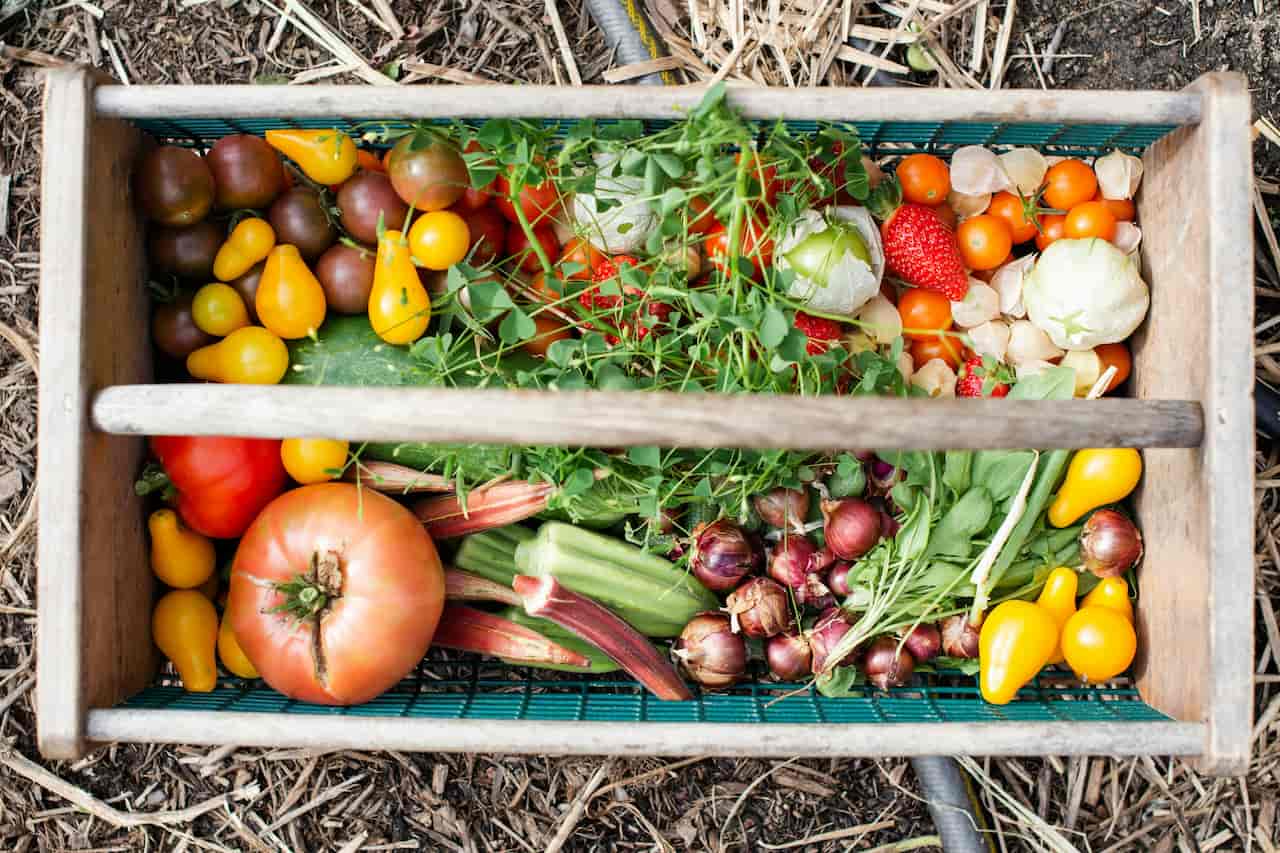
Tomatoes enter their main season in August and require consistent management. Water regularly and thoroughly – erratic watering, where plants dry out significantly between waterings and then receive a large amount, causes blossom end rot (a physiological calcium deficiency caused by inconsistent moisture uptake, not soil calcium levels) and fruit splitting. Both problems are caused by the plant being unable to absorb calcium consistently because the water supply is inconsistent, rather than by anything wrong with the soil. Water little and often or, better, water deeply twice a week and mulch around plants to retain moisture between waterings. Feed weekly with a high-potassium liquid feed once the first fruits have set. Harvest tomatoes at the colour stage for the variety – heritage types may be yellow, orange, striped, chocolate-brown or near-black at full ripeness, not red. The reliable test across all varieties is a gentle squeeze: a ripe tomato gives slightly under even, gentle pressure. An unripe tomato feels hard; an overripe one is soft and water-soaked.
Sweetcorn is ready when the silks at the top of the cob have turned completely brown and dry, and a pressed kernel releases milky white liquid rather than clear. Do not rely on the appearance of the cob or the leaves alone – the silk and kernel tests are the only reliable guides. Sweetcorn is best eaten within an hour or two of picking; the conversion of sugar to starch begins the moment the cob is separated from the plant and is rapid. The difference in flavour between a corn cob boiled thirty minutes after picking and one boiled the following day is genuinely dramatic.
Maincrop potato haulms should be cut down to ground level in August, two weeks before lifting. This period in the ground after cutting allows the potato skins to set firm – a thin-skinned potato lifts with skins that rub off at a touch, while a properly set potato has firm, protective skin that dramatically improves storage life. After two weeks, lift on a dry day, leave tubers lying on the soil surface for an hour or two to skin over further, then store in paper sacks in complete, total darkness. Even brief, repeated exposure to daylight through a transparent sack will turn skins green and produce solanine, making the potatoes unfit to eat. Use paper sacks or wooden boxes. Never plastic bags – they trap moisture and encourage rot.
The August sowing calendar tilts firmly toward autumn and winter. Spring cabbages, winter lettuces, claytonia, land cress, spinach, spring onions and oriental greens sown in August will provide fresh harvests through autumn and into winter. Begin systematically clearing beds of spent crops – pull pea and bean plants once their productive run is over, leaving the nitrogen-fixing root nodules in the ground. Compost the haulm. On cleared beds not immediately needed for an autumn sowing, sow a green manure such as phacelia, mustard or field beans to protect and improve the soil through winter.
September and October
September
September is the main harvest month – the moment when the long-season crops that have been developing since spring come due simultaneously. Maincrop potatoes, squash and pumpkins, late tomatoes, sweetcorn and the first leeks all demand attention in September, while autumn raspberries produce their final flush and early apples begin to drop. It is also, crucially, the month when the planting calendar for the following year begins: overwintering onion sets and garlic go in now, and hardy salad crops sown now will provide fresh produce through the darkest winter months.
Squash and pumpkin readiness is one of the most important judgement calls of the entire year and the most commonly misjudged. The test is unambiguous: press a fingernail firmly into the skin. If it leaves any dent at all, the squash is not ready and will not store well regardless of how large or colourful it appears. A truly ready squash has skin that resists the fingernail completely. Once cut from the plant, the curing process is non-negotiable: ten to fourteen days laid in a single layer in a warm, dry, sunny position – on a south-facing wall or windowsill is ideal – before moving to cool storage. Curing heals any small cuts or scuffs that could become entry points for rot, and concentrates the sugars significantly. Uncured squash placed directly into a cool store will rot within weeks regardless of storage conditions. Well-cured squash, by contrast, will keep for three to five months and often longer, providing excellent food right through winter.
Late tomatoes that are still on the plant as September’s cooler nights arrive need managing carefully. Below 10°C at night, tomato plants stop producing effectively and fruit quality deteriorates. Do not try to hold plants in production into late September unless conditions are genuinely warm. Before the first forecast frost, pull entire plants from their supports and hang them upside down in a frost-free shed, garage or porch. Green tomatoes on the plant in this position will ripen over several weeks indoors, often producing better results than trying to ripen green tomatoes cut from a plant laid flat. Any fruit that does not ripen can be used for green tomato chutney, which is an excellent use of the late-season abundance.
September is when seed saving should happen if you intend to save varieties for next year. Peas, beans, tomatoes, squash, chillies and many herbs all produce viable seed. Leave seed pods or fruits intended for seed saving until they are completely dry and ripe on the plant – sometimes past the point you would normally harvest for eating. Harvest into paper bags or envelopes, allow any remaining moisture to evaporate in a warm dry location for a week, label clearly with variety and year, and store in a cool, dry, dark place. Well-stored seeds remain viable for three to five years or more for most vegetable species.
October
October is predominantly about roots, apples and consolidation. The urgency of summer harvesting has gone and a more methodical approach becomes appropriate – working through the plot systematically, assessing what needs lifting before hard frost and what can safely stay in the ground, processing the harvest into storage, and beginning the winter digging that will pay dividends next spring.
Parsnips are the quintessential October-to-winter crop. The rule with parsnips is to leave them in the ground until needed – frost converts their starches to sugars and each subsequent cold spell improves them further. An October parsnip before any frost is perfectly edible. A December or January parsnip that has been through several hard frosts is noticeably sweeter and more complex in flavour. There is no benefit to lifting and storing parsnips unless your plot is prone to waterlogging severe enough to rot the roots or freezing solid enough to make lifting impossible. In most UK conditions, they are better left where they are. The same logic applies to celeriac in milder areas, though it is less frost-hardy than parsnips and should be lifted and stored in damp sand in cold inland areas once hard frosts are forecast.
Carrots and beetroot can be left in the ground through October in most parts of the UK and lifted as needed. Both improve slightly with cold and hold well in the ground until a hard freeze threatens. In areas with consistently cold winters or high waterlogging risk, lift and store in boxes of slightly damp horticultural sand in a frost-free shed before mid-October. In milder coastal and southern areas they can often stay in the ground well into December. The decision should be based on local knowledge of your plot’s conditions rather than any fixed date.
Apple and pear harvesting peaks through October and the variety knowledge required to get it right is significant. The twist test is the most reliable guide across all types: cup the fruit in your palm and lift with a gentle quarter-turn. A ready fruit parts cleanly from the spur with almost no resistance. An unready fruit holds firmly. Early varieties like Cox and Worcester Pearmain are ready in September and October and should be used promptly as they do not keep long. Late keepers such as Bramley, Blenheim Orange and Orleans Reinette are picked in October but will not be ready to eat until November, December or even January – the flavour of a fresh-picked Bramley is harsh and overpowering, while the same apple stored for eight weeks is balanced and sweet. Store late keepers individually wrapped in paper in a cool, dark shed and check monthly.
November and December
November
November is the month when cold begins to do its finest work on the kitchen garden. The crops available now are not a diminished rump of what was available in summer – they are excellent produce at their seasonal best. Brussels sprouts that have endured repeated frosts develop a sweetness and depth they do not have in October. Parsnips left in the ground through November are sweeter with every passing frost. Leeks in November are full-flavoured and fat-stemmed. Kale is essentially indestructible through any cold the UK produces and provides a steady supply of tender young leaves regardless of temperature. November is not the end of fresh harvesting – it is the beginning of a different but equally valuable season.
Brussels sprouts should be harvested from the base of the stalk upward, taking the lowest, most developed buttons first and leaving the upper sprouts to continue sizing up. The test for readiness is the squeeze: a good sprout should feel dense and solid under gentle pressure, not soft or separating at the outer leaves. A loose, open sprout has either been frosted too hard and thawed, or simply gone past its best – it will be unpleasant to eat and should be composted. Tight, frost-hardened sprouts from the base of the stalk in November and December are among the finest things the kitchen garden produces and deserve better than being dismissed as a vegetable people do not like. Almost always, the sprouts people dislike are large, overmature or poorly cooked ones – small, tight, properly cooked sprouts are a completely different food.
Leeks remain excellent through November and well beyond. They can be lifted individually as needed right through to March in most years and represent one of the most reliable fresh vegetables the winter garden offers. Check leeks regularly for rust – orange pustules on the leaf surfaces – which is a fungal infection that spreads through the crop. Mild rust does not affect eating quality below the waterline but heavily infected plants should be used promptly rather than left to deteriorate further and spread spores to neighbouring plants.
November is also when stored produce from September and October reaches the point where checking becomes most critical. Potatoes that have been in store for six or seven weeks may be developing soft spots, particularly any that were not fully skin-set before storage. Squash that was not properly cured will show the first signs of softening now. Apples that looked fine at harvest may be past their best and should be used or pressed. Walk through everything in store once a week in November and remove anything deteriorating before it affects its neighbours. This discipline between now and January determines how well the kitchen is stocked through the darkest months of the year.
December
December harvesting is quieter than any other month but the quality of what is available is genuinely exceptional. This is the month when the cold has had the longest time to work on the crops left in the ground, and the results are remarkable. A December parsnip, lifted from frozen ground, is at peak sweetness. Brussels sprouts in December after multiple hard frosts are as good as they ever get. Kale continues to produce tender leaves in all but the most severe conditions. The kitchen garden in December provides produce that cannot be bought anywhere – not because it is rare, but because the flavour of a vegetable at its seasonal peak, harvested and eaten the same day, is simply different from anything transported and stored.
Stored produce through December needs careful attention. Potatoes, onions and garlic have been in store for three to four months now. Some will be showing natural signs of ageing – potatoes beginning to soften, onions starting to sprout, garlic losing its firmness. Use anything showing these signs promptly; they are still excellent food at this stage but will not improve. Squash stored since September should still be in excellent condition if properly cured, but check the skin for any soft spots. Apples and pears need monthly inspection – remove anything softening and use it. Keep apple and pear storage completely separate from vegetable storage; ethylene released by the fruit accelerates ripening and decay in root vegetables and squash stored nearby.
Storing your harvest
How well a harvest keeps is determined primarily by two things: storage conditions and the discipline of the initial sorting. Most vegetables need cool, dark, frost-free and moderately humid conditions – the classic conditions of a traditional root cellar, unheated shed or cool outbuilding. Modern heated homes are too warm for long-term storage of root vegetables, potatoes and squash: onions sprout, potatoes soften and sweeten, and squash deteriorates in weeks rather than months. If no outbuilding is available, a north-facing garage, a cool cupboard under the stairs, or an insulated box in an unheated utility room are all workable alternatives.
The sorting rule is absolute: never put damaged, bruised, wet or diseased produce into long-term storage alongside sound crops. A single infected potato generates heat and spreads bacteria to neighbouring tubers within days. A soft onion with neck rot contaminates those around it. A squash with an uncured surface cut will rot from that point within weeks. The discipline of sorting thoroughly at harvest – keeping only perfectly sound, undamaged, dry produce – is what determines whether a well-stocked larder in September is still a well-stocked larder in January. Walk through everything in store once a week through autumn and winter and remove anything deteriorating the moment it is found. Do not wait to see whether a soft spot gets worse. Remove it immediately.
Share on socials: