At a glance
Winter is not a gap in the gardening calendar. It is the season when seeds that need cold to germinate are best served by being sown, when hardy plants can be started ahead of the season without any heating equipment, and when a late-winter start indoors for tender crops can give those plants the longest possible growing season. Understanding which seeds belong in which category transforms the cold months from dead time into productive time.
There are three distinct types of winter seed sowing. Cold stratification is the process of exposing dormant seeds to sustained cold and moisture to break their dormancy before germination. Hardy annual and perennial sowing takes advantage of the fact that many UK garden plants germinate freely in cold or cool conditions and need no warmth at all. Indoor late-winter sowing under warmth prepares tender crops for the growing season ahead. Each of these has different equipment requirements, different timing and different failure modes.
Why winter sowing is worth doing
The reason winter sowing matters is that many plants perform better, germinate more freely or flower earlier when they experience cold as part of their natural cycle. A sweet pea sown in October and overwintered in a cold frame produces a stronger root system and earlier flowers than one sown in March. A hellebore seed sown fresh in autumn and left to experience the winter may germinate the following spring; the same seed held until spring and sown without cold will often sit dormant for another full year. Understanding which plants benefit from cold allows a gardener to make use of winter rather than simply waiting for it to end.
The practical benefit is also significant. Starting seeds in late January and February indoors gives tender crops an extra six to eight weeks of growing season compared to waiting until the propagator is needed for everything at once in April. Spreading the sowing season across winter reduces bench space pressure and produces stronger, less rushed seedlings than a compressed spring sowing period.
Cold stratification
Many trees, shrubs, climbers and perennials have evolved a dormancy mechanism that prevents them germinating in autumn. A brief warm spell in October could otherwise trigger growth that would be killed by the frosts that follow. The seed waits for a sustained cold period and then warming temperatures before committing to germination. Cold stratification replicates this natural cycle deliberately.
The simplest method for UK gardeners is outdoor winter sowing. Sow seeds into pots or deep trays of peat-free seed compost in November or December and place them in an unheated greenhouse, cold frame or sheltered position outside. The seeds experience the natural cold of winter and germinate in spring when temperatures rise. No special equipment is needed. This works reliably for most hardy trees and shrubs including hawthorn, blackthorn, crab apple, rowan and most Rosa species. Perennials including hellebores, primulas, aquilegias, astrantias and many clematis species germinate far more freely after a winter outside than they do without it.
Refrigerator stratification is useful when seeds arrive in spring or summer and cannot wait until the following winter. Mix the seeds with barely damp vermiculite or peat-free compost in a sealed plastic bag and keep in the refrigerator for four to twelve weeks depending on the species. After stratification, sow into trays at room temperature. This compresses the cold period into a defined window and allows germination to begin much earlier than outdoor stratification would permit.
What to sow outdoors in winter
A wider range of seeds than most gardeners expect can be sown directly into prepared ground or into modules placed outdoors between late October and late February. The cold does not harm these seeds. It holds them until conditions are right, and they emerge in spring as stronger plants than those sown later in warmth.
Sweet peas are one of the most popular choices for winter sowing. Sown in October or November into deep modules or root trainers placed in an unheated greenhouse or cold frame, sweet peas germinate best at around 10 to 15 degrees Celsius and establish a stronger root system over winter than spring-sown plants develop. They are typically ready to plant out in March or April and flower significantly earlier. Hardy annuals including cornflowers, larkspur, nigella, calendula and ammi majus can all be sown in late autumn and will germinate naturally in spring, producing more robust plants with earlier flowers than spring-sown equivalents.
Broad beans sown in October or November in pots under cover, or directly in the ground in milder areas, develop slowly over winter and come away strongly in early spring. They crop weeks ahead of spring-sown plants. Garlic is planted rather than sown from seed, but requires a cold period to develop properly and is planted in autumn for the same reason.
Equipment for winter sowing
The equipment that matters most for winter sowing is not a heated propagator. It is protection from extreme wet and wind while still allowing the seeds to experience cold temperatures. The list below covers what actually makes a difference.
Perlite improves winter sowing compost significantly. A ratio of roughly three parts peat-free seed compost to one part perlite drains freely enough to prevent the root rot that cold, wet winters otherwise cause in standard mixes.
Indoor sowing in late winter
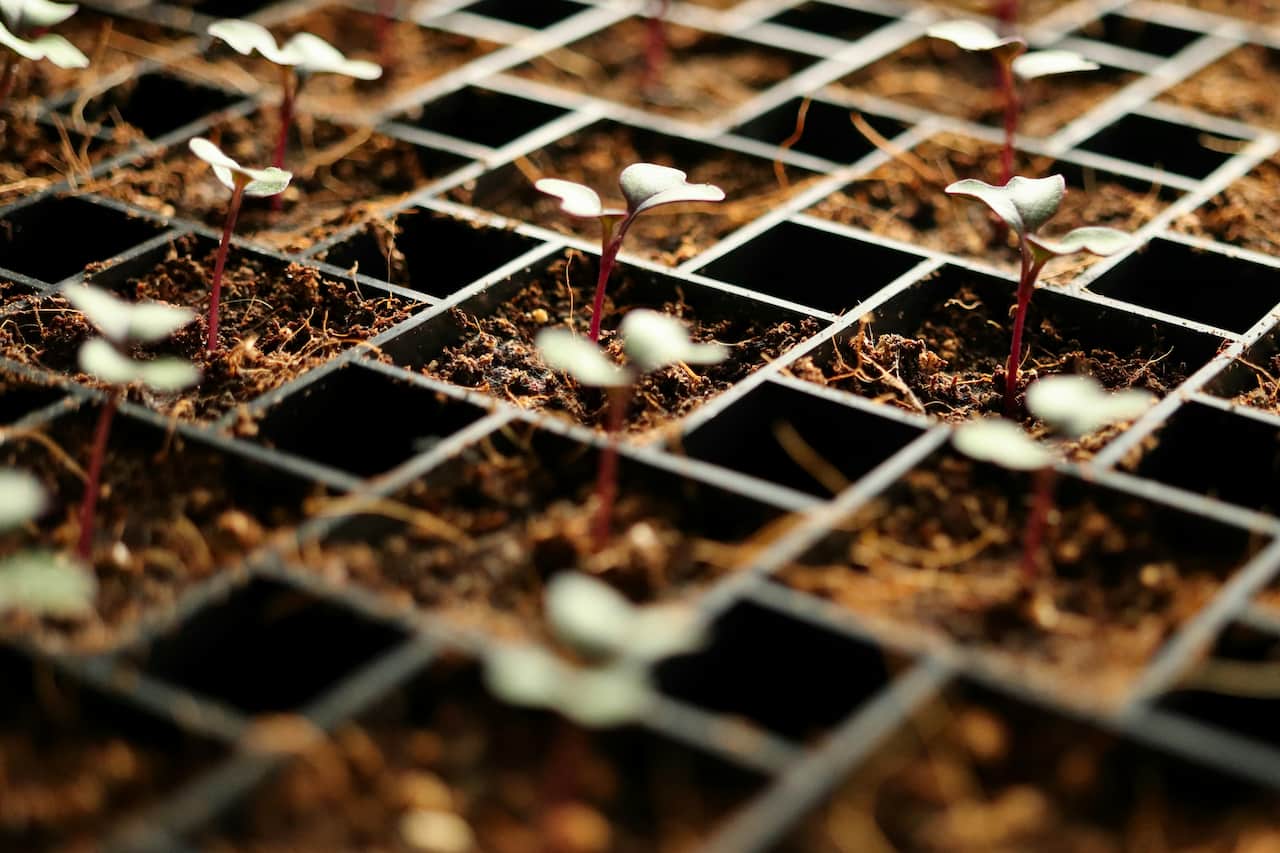
From late January through February and into early March, indoor sowing from a south-facing windowsill becomes practical without any supplementary equipment other than a warm room. Light levels are still low in January but improve noticeably through February, and the combination of ambient room temperature and reasonable light makes this period effective for a range of crops.
Light
Low light is the most limiting factor for indoor winter sowing. Day length in January and February is short and even a south-facing windowsill receives a fraction of the light that the same position provides in April. Seedlings respond to insufficient light by stretching toward the source, producing drawn and weak stems that do not recover fully even when conditions improve.
A grow light on a timer providing 14 to 16 hours of light per day, positioned 10 to 15 centimetres above the tops of the seedlings, transforms the quality of plants produced in January and February. It does not need to be an expensive setup. A basic LED grow strip running on a plug-in timer is entirely sufficient. Without supplementary lighting, most seeds started before late February will produce poor-quality seedlings regardless of how carefully everything else is managed. Rotating trays on a windowsill every two or three days prevents one-sided growth toward the light source.
Watering in winter
Overwatering is the most common cause of seedling failure in winter. Evaporation is slow in cold conditions, roots grow slowly, and compost can remain wet for a week or more between waterings. Before watering any seed tray or pot, press a finger into the compost surface and check whether it feels damp more than a centimetre below the surface. If it does, do not water.
Water from below wherever possible. Place the tray in a shallow container of water and allow the compost to draw up moisture through the drainage holes until the surface just begins to darken. Remove immediately and do not leave standing in water. This method avoids wetting the foliage and the surface layer of compost, both of which create the damp conditions that promote damping off. A small fan running on low in the growing area reduces ambient humidity significantly and makes a real difference to damping off rates.
Never water winter seedlings just because it is the scheduled day. Check the compost first, every time. Cold slows evaporation considerably. A tray watered on Monday may still be wet the following Monday if temperatures have been low.
Which seeds need heat and which do not
Understanding which seeds need warmth to germinate and which germinate freely in cool or cold conditions is the most useful distinction in winter sowing. Sowing heat-requiring seeds into cold compost wastes both seeds and time. The two categories below are worth memorising.
Hardening off winter-sown seedlings
Any seedlings raised indoors during winter or early spring must be hardened off before planting outside. Moving plants directly from a warm house to outdoor conditions in cold spring weather causes transplant shock that can set them back by two to three weeks or kill them outright.
Hardening off means acclimatising plants to outdoor conditions gradually over seven to fourteen days. Begin by placing seedlings outside in a sheltered spot on mild days, bringing them back inside before evening. After several days, leave them outside overnight when temperatures are reliably above five degrees Celsius. A cold frame makes the process much easier, allowing the lid to be propped open progressively each day without having to carry trays in and out. Do not rush this stage. A seedling that has spent its entire life in a centrally heated room needs the full two weeks to adjust.
Common problems with winter sowing
Most winter sowing failures have straightforward causes once the pattern is recognised. The table below covers the problems that come up most often.
Share on socials: