At a glance
The snake plant (Dracaena trifasciata, formerly Sansevieria trifasciata) is one of the most widely recommended houseplants for beginners, and with very good reason. It tolerates neglect that would kill most houseplants – irregular watering, low light, dry indoor air, temperature fluctuation and weeks without attention – and continues to look good while doing so. It is also genuinely attractive, with bold upright foliage that works well as a structural element in any interior, and it is available in a wide range of sizes and variegations to suit different spaces and tastes.
Despite its reputation for near-indestructibility, the snake plant does have one consistent weakness: overwatering. More snake plants are killed by too much water than by any other cause, and understanding this single point is the key to keeping one successfully for many years. Get the watering right and almost everything else about snake plant care is straightforward.
Varieties and types
Snake plants are available in a wide range of sizes, leaf shapes and variegations. The classic variety with tall, dark green leaves banded with grey-green is the most widely available, but a number of distinct forms offer different ornamental characteristics worth knowing before purchasing.
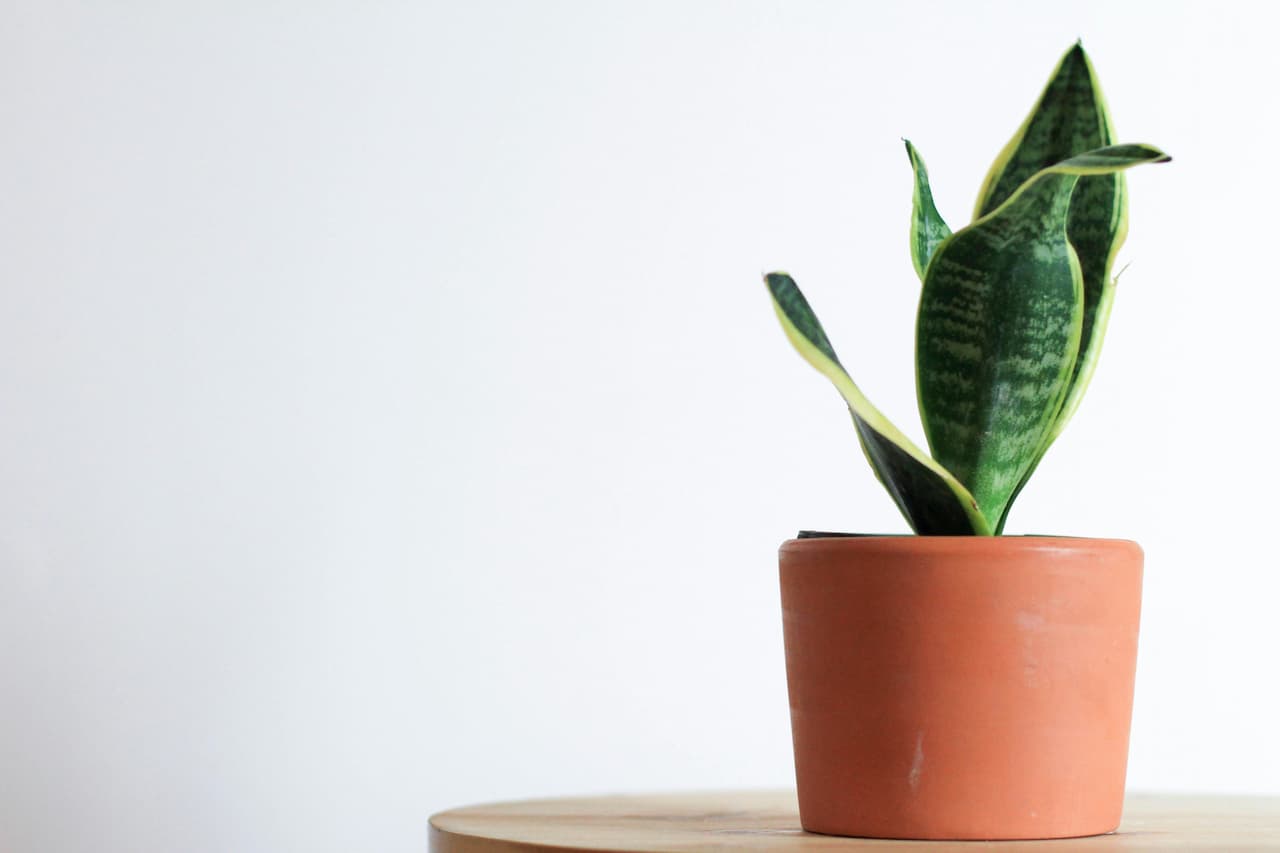
Laurentii is the standard variety found in most garden centres and supermarkets and is an excellent starting point. It is vigorous, tolerant and produces the bold upright foliage that makes snake plants such effective structural houseplants. Moonshine is increasingly popular for its distinctive pale colouring – it grows slightly more slowly than Laurentii and benefits from a little more light to maintain its silvery tone. The dwarf Hahnii varieties are ideal for shelf or windowsill placement and have identical care requirements to their taller relatives despite the very different growth habit.
Light and position
One of the snake plant’s most useful qualities is its adaptability to a very wide range of light conditions. It will survive in quite dark corners of a room where few other houseplants would persist – a position several metres from a window with no direct sunlight will keep a snake plant alive and reasonably healthy. However, “survive” and “thrive” are different things. In brighter indirect light – near a north or east-facing window, or a few feet back from a south or west-facing window where direct sun does not fall on the leaves – the snake plant grows more vigorously, produces more leaves and maintains better colour.
Avoid prolonged direct summer sun through south or west-facing glass, which can scorch and bleach the leaf markings, particularly on variegated varieties. The snake plant is equally adaptable to the typical UK home environment – it handles central heating dryness well, is not troubled by draught-free cool rooms, and does not require the high humidity that makes some tropical houseplants difficult to keep in the UK climate. Minimum winter temperature of 10°C is the main limitation – do not place near a cold windowsill or in an unheated room through winter.
Watering and feeding
Overwatering is the primary cause of snake plant death, and it is easy to do because the plant shows no obvious signs of thirst until the problem has become serious. The golden rule is to wait until the compost is completely dry before watering – not just dry at the surface, but dry throughout the pot. Push a finger 3-4cm into the compost. If any moisture is felt at that depth, do not water. In the UK, this typically means watering every two to three weeks in summer and every four to six weeks in winter, though the actual interval depends on pot size, compost type, temperature and light level.
When watering, water thoroughly until it drains freely from the drainage holes, then empty the saucer after 30 minutes. Never allow the pot to sit in standing water – the roots will rot rapidly in waterlogged conditions. Use room-temperature water if possible, as cold tap water can sometimes cause brown spotting on the leaves. During the active growing period from April to September, feed once a month with a balanced liquid houseplant fertiliser diluted to half the recommended strength. Do not feed in autumn and winter when the plant is growing slowly or not at all.
Soil, potting and repotting
Snake plants need a free-draining compost that does not hold moisture for long periods. Standard multipurpose compost is too moisture-retentive on its own and increases the risk of root rot. The best mix is two parts multipurpose compost to one part perlite or grit, which creates an open, fast-draining structure. A purpose-made cactus and succulent compost also works well and can be used straight from the bag without amendment. The pot itself must have drainage holes – snake plants in pots without drainage almost always develop root rot eventually, regardless of how carefully they are watered.
Snake plants prefer to be slightly pot-bound and do not need repotting frequently. Repot when roots are visibly circling the base of the pot or growing through the drainage holes, or when the plant becomes top-heavy and unstable – typically every two to three years. When repotting, choose a pot only one size larger than the current one. An oversized pot holds more compost, which retains more moisture, which increases the root rot risk. Spring is the ideal time to repot, just as the growing season begins. At repotting time, inspect the root system and remove any soft, brown or mushy roots with clean scissors before placing in the new pot.
Propagation
Snake plants propagate readily by two methods: division of offsets and leaf cuttings. Division is the faster and more reliable approach. As the plant matures it produces offsets – small new plants growing from the base alongside the main plant. These can be separated at repotting time by carefully pulling or cutting them away from the parent plant at the rhizome, ensuring each offset has some roots attached. Pot each offset individually in the same free-draining compost mix and treat as a mature plant from the outset.
Leaf cuttings are a slower but interesting method. Cut a healthy leaf into sections approximately 8-10cm long, allow the cut ends to callous over for a day, then push the lower end into damp compost or stand in a small amount of water. Roots develop over several weeks and small offsets eventually emerge from the base of each cutting. The one important caveat for variegated varieties like Laurentii is that leaf cuttings will not preserve the variegation – the resulting plants will revert to plain green. Division is the only propagation method that reliably maintains the yellow-edged variegation of Laurentii and similar forms.
Snake plants are mildly toxic to cats and dogs. All Dracaena species, including snake plants, contain saponins which cause nausea, vomiting and lethargy if ingested by pets. If you have cats or dogs that nibble houseplants, place the snake plant out of reach or choose a pet-safe alternative such as a Boston fern or bromeliad.
Common problems and solutions
Share on socials: