At a glance
Borrowed this one off a mate rather than dragging my own saw through someone’s hallway. Skirting and architrave, a stretch of house still being lived in while the work went on, and my usual mitre saw lives on its own stand in the shed, the sort of thing you carry through a front room sideways while trying not to catch the bannister. Not worth the risk for a job this size.
First thing that caught me out was the box calling it the Naked edition. Sounds like a joke until you realise it just means body only, no battery, no charger, no case. Mine came with a battery already on the bench from another job so it didn’t matter, but anyone starting from nothing needs to budget for that separately. It’s also bigger in the hand than it looks in the photos, one of those tools that photographs smaller than it actually is.
Overview and first impressions
Weight was the next thing, and it’s genuinely a fair bit lighter than what I’m used to. My own saw, a mains powered full size mitre saw, comes in around 32.6kg. This one is closer to a third of that, body weight sat around 10.5kg depending which listing you trust, some still print 11.5kg from what looks like an older sheet nobody’s gone back to correct. Either way it went upstairs in one hand without a second thought, which is really the whole point of a saw like this. You don’t buy one as your only saw. You buy it once the big one’s proved itself too much tool for the small, awkward jobs.
Carry handles sit at either end of the deck, lock the head down and it’s one lift with no case to wrestle separately, and the base is aluminium rather than steel, which is most of where that lighter weight comes from without the saw feeling like it’ll walk off the table mid cut. Motor’s a double insulated design putting out 590W at 3750rpm no load, brushed rather than brushless, which is the one thing that marks this out as the older, cheaper design next to the newer saws in the same bracket. Worth knowing if brushes wearing down eventually matters to you, they get replaced at a service centre rather than the whole motor going.
Specifications and scores
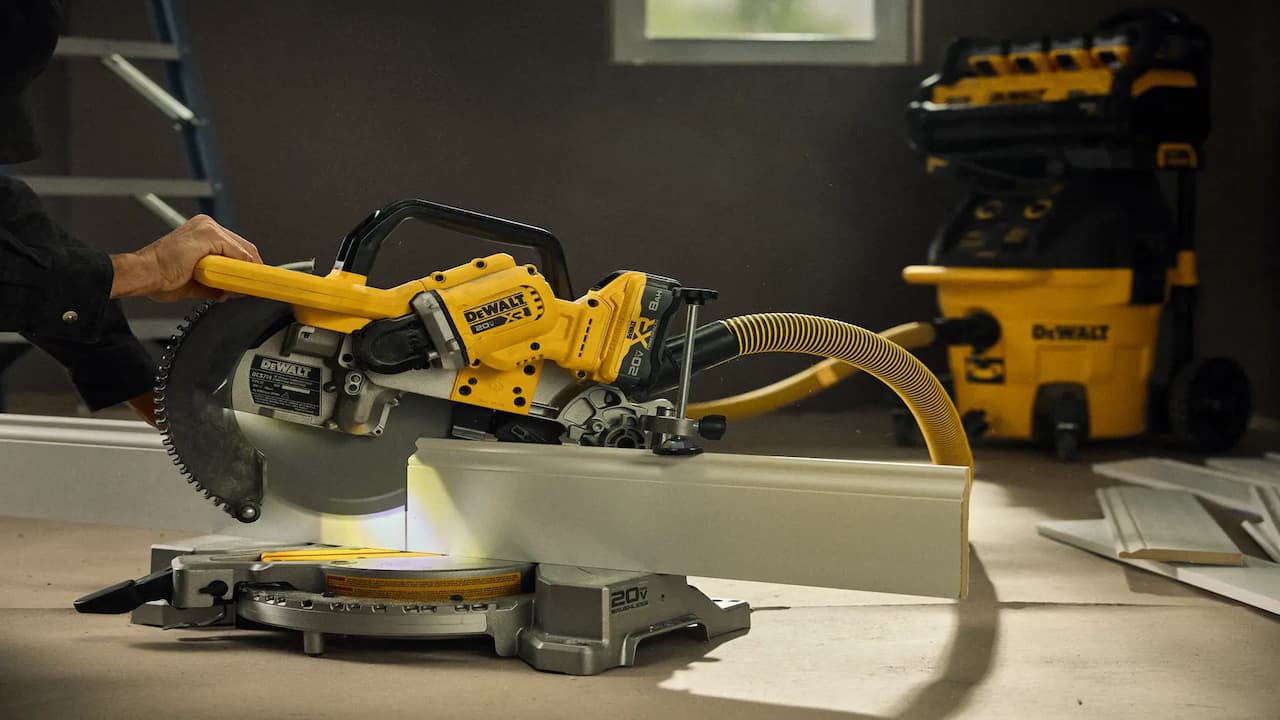
I nearly wrote it off as a fixed head saw too, purely on size. It isn’t. DeWalt’s own manual calls it a cordless sliding compound mitre saw, and there are rails under the head that let it run back and forth, which is the only reason a 184mm blade gets anywhere near a decent capacity. Mitre swings to 48 degrees either side with eleven stops on a stainless plate, and you feel every one of those clicks once you’re three or four cuts into a repeat angle and the arm keeps landing exactly where it did last time. Bevel’s 48 too, left only.
That last figure, both angles maxed out together, is the one that actually matters when you’re scribing a compound angle into a corner rather than the single-axis numbers most listings lead with.
How it performed in our tests
Skirting went through clean, and the thing I kept noticing while I was at it was the shadow rather than a red dot. Set the blade spinning and it throws its own shadow onto the timber from an LED in the guard, and you nudge the fence until that shadow sits on your pencil mark. Nothing to knock out of alignment the way a laser can, and it held its line all afternoon without me touching it once. Architrave round the door frame is where things got interesting. A length started tearing out slightly on the back edge, and I put it down to the saw at first. Turned out cordless mitre saws like this run thin kerf blades, the same style fitted to cordless circular saws, to keep the load off a battery fed motor. A blade going off doesn’t just cut slower on one of these. It pulls more current doing the same job, so the saw feels gutless and the battery drains quicker before the cut itself looks obviously rough. Swapped to a fresh edge and the tearing stopped straight away. It ships with a 184mm 40 tooth blade as standard, and DeWalt sell a 24 tooth for rougher rip work and a 60 tooth fine option for exactly the kind of faced trim that had been giving me grief. Kept two in rotation for the rest of the job after that, one for the straightforward runs, the fine one for anything with a faced edge.
A saw that suddenly feels gutless is usually a blade problem, not a saw problem. Try a fresh or sharpened edge before assuming the tool itself has gone off, especially on faced or laminated trim.
Dust was the other lesson, and it’s not really this saw’s fault so much as every mitre saw’s fault, the blade cuts down and back through the material in a direction no bag catches cleanly. The one supplied, part N126162 if it ever splits and needs replacing, did the job for a few cuts before I gave up and ran the DWV9000-XJ adapter to a proper vacuum instead, the only sensible way to get through a full afternoon indoors without sweeping between every cut. Just the single material clamp and the dust bag in the box otherwise, nothing else.
Battery system and runtime
250 cuts per charge is the figure DeWalt quote, though it drops closer to 200 on thicker stock and climbs toward 320 on thinner material, and mine roughly tracked that, the finer architrave cuts using less per pass than the skirting so the pack lasted further into the afternoon than I’d planned for. It’s an 18V saw but it took a FlexVolt pack without complaint, running down in 18V mode the same as any standard one, which is worth doing on purpose for the extra capacity if you’ve already got one sat in a bag from another tool.
Performance and limitations
Registering it with DeWalt inside the standard window pushes the warranty from the base one year out to three, took about five minutes online and is worth doing the day it turns up rather than once the receipt’s gone missing in a drawer. Worth knowing too, if you ever pick up the separate DE7023 leg stand rather than a bundle, that the DE7025 mounting brackets needed to actually fix a saw to it are sold apart. Turn up with just the stand and there’s nothing to attach the saw with. No height stop for a trench or stopped cut either, which never came up on this job but would be the one thing to check first if that’s what you need it for regularly.
- A real sliding saw despite the compact size
- Shadow line held its mark all afternoon, no calibrating
- Light enough to carry through a house one-handed
- Takes a FlexVolt pack for extra runtime
- Sold bare, battery and charger cost extra
- Standard blade tore out on faced architrave
- Dust bag not enough for a full job indoors
- DE7023 stand needs DE7025 brackets bought separately
- Anyone already on DeWalt 18V or FlexVolt
- Skirting, architrave, jobs the big saw can’t reach
- Working inside a house where a big saw’s a liability
- A first mitre saw with no batteries already owned
- Anyone needing a depth stop regularly
Final verdict, is it worth it
Handed it back with the hallway finished, and I’d genuinely think about picking one of these up for myself. Not to replace the shed saw, that’s not the point of it, but to stop carrying that thing through someone’s front room every time something small needs doing indoors.
A light, genuinely sliding compact mitre saw that earns its keep as a second saw for anyone already on the platform. Sold bare and built to a price rather than to match the newest brushless saws above it, but it did exactly what a hallway trim job needed of it.
Share on socials: