At a glance
Calatheas have earned their reputation as demanding houseplants – and that reputation is largely deserved. Native to the tropical rainforests of South America, they evolved in conditions that are nothing like a centrally heated UK home: high humidity, filtered light, warm and stable temperatures and soft water. Getting all of those conditions right simultaneously is the challenge calathea care presents, and it is why so many calatheas bought as impulse purchases decline and die within a few months of arriving home.
The good news is that once the specific requirements of calatheas are understood, meeting them is not complicated. The main issues UK calathea owners encounter – brown leaf tips, curling leaves, yellowing and loss of pattern vibrancy – each have a specific identifiable cause that can be corrected. This guide covers what each problem indicates and how to address it. Calatheas are closely related to prayer plants (Maranta) and share similar care needs – if you enjoy one you are likely to enjoy the other. For a lower-maintenance alternative with similarly striking foliage, the snake plant tolerates a much wider range of conditions.
Light requirements
Calatheas need bright, indirect light. Direct sunlight bleaches the intricate leaf patterns that make calatheas so attractive – the markings fade and the leaves take on a washed-out appearance in direct sun. At the same time, they need enough light to maintain their colour and support healthy growth. Deep shade produces leggy growth and faded patterns.
The ideal position in a UK home is close to an east or north-facing window, or a metre or two back from a south or west-facing window where a net curtain or another plant filters the direct sun. In winter UK light levels drop significantly and calatheas may need moving closer to the window to compensate. A position that works in July may need adjusting by November.
Calatheas move their leaves in response to light – this is normal and not a sign of stress. Calatheas are known as “prayer plants” because their leaves fold upward in the evening and open flat during the day in response to changing light levels. This daily movement – technically called nyctinasty – is a sign of a healthy, well-lit plant, not stress. If the leaves stop moving, it is often a sign that light levels are too low.
Watering correctly
Water quality is the most commonly overlooked factor in calathea care, and the most common cause of the brown leaf tips that frustrate so many UK calathea owners. Calatheas are sensitive to the fluoride and chlorine present in UK tap water – in many parts of the UK, particularly where water is hard, tap water causes progressive browning of leaf tips that no amount of humidity adjustment will fix.
- Use rainwater or filtered water – collect rainwater in a water butt and use this for calatheas year-round. A filtered water jug works well as an alternative. In areas with soft tap water the effect is less pronounced but rainwater remains the best option.
- Allow tap water to stand overnight – if rainwater is not available, filling a jug with tap water and leaving it overnight allows chlorine to off-gas. This partially reduces the problem but does not address fluoride.
- Water when the top 2cm is dry – check the compost by pressing a finger 2cm into the surface. Water when this feels dry. Calatheas do not tolerate waterlogging but should not be allowed to dry out completely either. In winter, watering frequency drops significantly as growth slows.
- Water at room temperature – cold water from a tap shocks the roots of tropical plants. Always use water that has reached room temperature before applying it.
Humidity – the key challenge in the UK
Humidity is where most UK calathea care fails. Calatheas need a relative humidity of at least 50%, ideally 60-70%. The average UK centrally heated home in winter runs at 30-40% humidity – the heating that keeps us warm dries the air to levels that calatheas find very difficult to tolerate. The result is the progressive browning of leaf tips and edges that is so common in calatheas kept in living rooms next to radiators.
| Humidity method | Effectiveness | Notes |
|---|---|---|
| Electric humidifier | Best – measurably raises humidity | Use distilled or filtered water in the humidifier |
| Pebble tray with water | Moderate – raises immediate microclimate | Pot must sit above water level, not in it |
| Grouping with other plants | Moderate – collective transpiration helps | Most effective when plants are close together |
| Bathroom or kitchen placement | Good if naturally bright and humid | Many UK bathrooms have insufficient light |
| Misting | Low – effect is brief, can encourage fungal issues | Widely recommended but limited in practice |
Never place a calathea near a radiator or on a windowsill above one. The hot, dry air rising from a radiator is directly contrary to everything a calathea needs. A calathea placed on a windowsill with a radiator beneath will decline regardless of watering or humidity efforts elsewhere. Move calatheas away from all heat sources – including fireplaces and air conditioning units – and keep them in a stable, draught-free position.
Feeding and repotting
Calatheas are not heavy feeders. A balanced liquid houseplant fertiliser applied at half the recommended strength once a month from April to September is sufficient. Do not feed in winter when the plant is not actively growing – excess fertiliser in the compost with no growth to absorb it builds up as salts that burn roots and cause leaf tip browning.
Repot every 2-3 years or when roots are visibly growing through the drainage holes. Choose a pot only one size larger – calatheas do not like being in a significantly oversized pot as the excess compost holds moisture around the roots and can cause root rot. Use a free-draining houseplant or tropical compost mixed with a small amount of perlite to improve drainage. Spring is the best time to repot.
Common problems and causes
| Problem | Most likely cause | Fix |
|---|---|---|
| Brown leaf tips and edges | Low humidity or tap water fluoride | Switch to rainwater, add humidifier |
| Yellowing leaves | Overwatering or root rot | Check roots, reduce watering, improve drainage |
| Curling leaves | Underwatering or low humidity | Water thoroughly, raise humidity |
| Faded or washed-out leaf pattern | Too much direct sun | Move away from direct light |
| Drooping leaves | Cold temperatures or draught | Move away from cold windowsill or draught |
| Spider mite – fine webbing, pale stippling | Low humidity encouraging mite populations | Raise humidity, treat with neem oil or insecticidal soap |
Popular calathea varieties
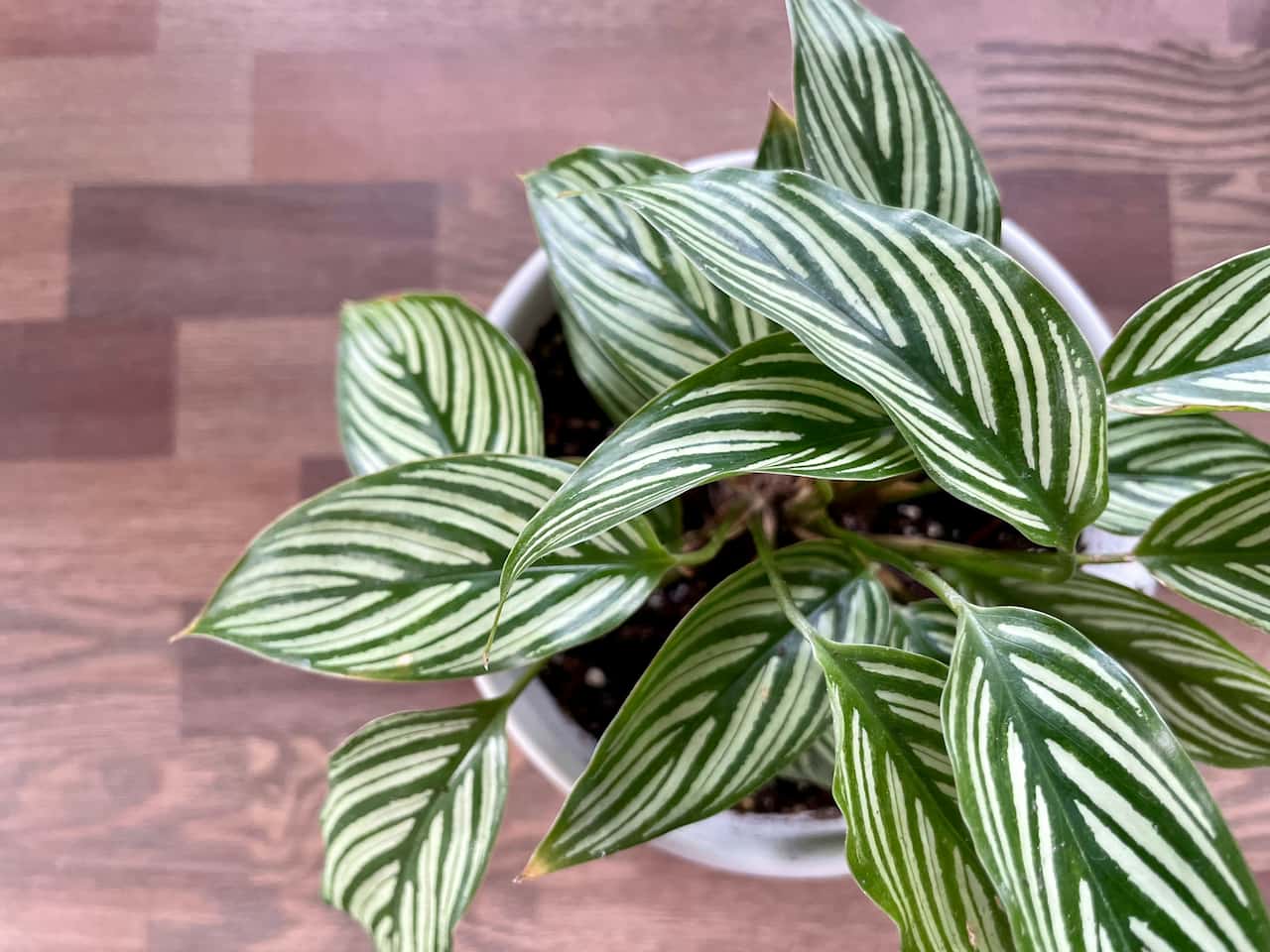
The calathea genus (now partially reclassified as Goeppertia) includes dozens of varieties with different leaf patterns and sizes. All have similar care needs, though some are more forgiving than others. The varieties most commonly available in the UK include Calathea ornata (pin-stripe pattern, dark green and pink), Calathea makoyana (peacock plant, distinctive window-pane pattern), Calathea lancifolia (rattlesnake plant – often considered easier than other calatheas) and Calathea zebrina (bold zebra stripes, large leaves).
If calathea care proves persistently challenging, the Ctenanthe and Stromanthe genera are closely related with similar foliage and are generally considered more tolerant of typical UK indoor conditions. They make a good bridge for those who love the calathea aesthetic but are finding the humidity and water requirements difficult to manage consistently.
Share on socials: