At a glance
The Makita DHP486 is the drill in our best cordless drills UK comparison that makes every other compact drill look underpowered on paper. At 130Nm it produces nearly double the torque of the DeWalt DCD796 at 74Nm, and more than three times the output of the Ryobi RCD18-0 at 40Nm. That power gap is real and becomes apparent in use the moment tasks step up to large diameter timber drilling, sustained masonry work or long screws driven repeatedly into dense hardwood.
The trade-off is size and weight. At 210mm body length and 1.9kg with a 3.0Ah battery, the DHP486 is a full-size professional combi drill rather than a compact one. It is the right tool for demanding domestic work and light trade tasks, and the natural choice for anyone already invested in the Makita LXT ecosystem. For lighter occasional use, the DCD796 covers the same bases at a lower price and in a more manageable package.
Overview and first impressions
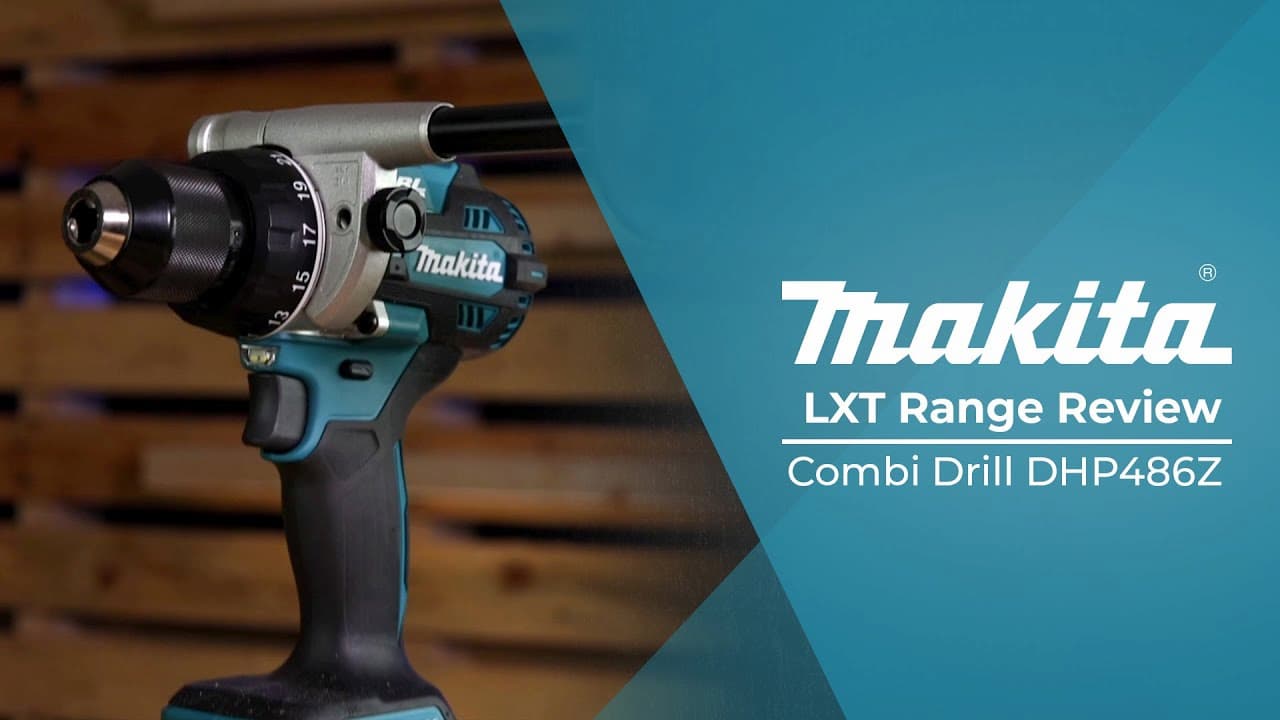
The DHP486 is immediately a noticeably larger and heavier tool than anything else in our comparison. Picking it up after a compact drill driver is a clear step change in mass and size. The Makita teal and black livery, the aluminium gear housing and the well-weighted grip all convey quality and purpose immediately – this is a tool built to work hard and last.
The controls are straightforward and well-positioned. The two-speed selector sits at the top of the body where your thumb reaches it naturally. The 21-position clutch collar has a satisfying positive engagement between each setting, giving finer torque control than any other drill in our comparison – 21 positions versus the 15 offered by the DeWalt alternatives. The mode ring selects cleanly between drill, driver and hammer drill without any vagueness. The forward/reverse switch is well-placed and clicks firmly between positions.
Build quality is excellent throughout and reflects Makita’s professional tool standards. The aluminium gear housing dissipates heat more effectively than plastic alternatives, which matters during sustained heavy use sessions. The 13mm keyless chuck is tight and runs true with no measurable wobble. The LED work light is brighter and throws a wider spread than those on smaller tools, which is genuinely useful when working in the darker corners of a room. First impressions are of a tool designed to earn its keep under demanding conditions.
130Nm of torque demands respect when drilling large diameter holes in timber. The DHP486 can kick back sharply if a large auger bit catches in the material. Always use both hands when drilling with large diameter bits, ensure the workpiece is secured and maintain a firm controlled grip throughout. This is not a beginner drill for casual use.
Specifications and scores
How it performed in our tests
The DHP486’s 130Nm torque advantage becomes most apparent on the tasks that push compact drills toward their limits. Large auger drilling through dense structural timber, driving 100mm screws repeatedly into hardwood joists and sustained hammer drilling into engineering brick are where the gap between this drill and the compact alternatives becomes a practical difference rather than just a number on a spec sheet.
In our 32mm auger test through 90mm structural timber the DHP486 completed the hole quickly and without the motor temperature rising noticeably – the kind of task where a compact drill either works visibly hard or needs a rest between holes. In medium density brick it drills 8mm fixing holes faster than any other drill in our comparison. The 21-position clutch gives fine enough control to protect both screws and workpiece across the full range from delicate chipboard assembly to structural driving tasks.
The DHP486’s real competition is not other combi drills – it is SDS drills. At 130Nm the DHP486 handles the masonry work that most homeowners encounter without needing a separate SDS hammer drill. Only sustained professional drilling into hard aggregate or reinforced concrete makes an SDS genuinely necessary over the DHP486 for domestic use.
Battery system and runtime
The DHP486 runs on Makita’s 18V LXT platform – the largest professional cordless tool ecosystem in the world by tool count, with over 250 compatible products. LXT batteries are available through Screwfix, professional tool suppliers and Amazon, though they are somewhat less ubiquitously stocked in mainstream UK DIY stores than DeWalt XR batteries. For trade professionals already in the Makita ecosystem the platform breadth is outstanding – for first-time buyers starting fresh it is worth factoring in where you will source batteries and chargers locally.
The brushless motor handles battery charge efficiently for a drill of this power. Under heavy use – sustained masonry drilling and large diameter timber work – a 3.0Ah battery gives approximately 60-90 minutes of demanding work before needing a charge. With a 5.0Ah battery a full day of mixed domestic tasks is realistic. Charge times are approximately 45 minutes for a 3.0Ah pack and 75 minutes for 5.0Ah with a standard LXT charger. For existing Makita LXT owners who already run the platform across garden tools, power tools or both, adding the DHP486 to the battery pool costs nothing incremental in battery investment – a significant practical advantage over starting fresh with a new platform.
Performance and limitations
The DHP486’s limitations are primarily physical rather than performance-related. At 210mm and 1.9kg it is the largest and heaviest drill in our comparison, and that shows in two practical ways. In confined spaces the additional length requires more careful positioning than a compact alternative. For sustained overhead work the weight becomes noticeable more quickly than with lighter alternatives. These are honest descriptions of what full professional drill performance costs in handling terms – not criticisms of the tool itself.
The 21-position clutch merits specific attention as a differentiator over compact rivals. The finer granularity between positions is most valuable at the lower end of the torque range – settings 1 through 6 give progressively more precise control for delicate assembly work than the 15-position clutch on DeWalt alternatives. For a drill used regularly on a range of tasks from chipboard flat-pack to structural timber, that fine control at the low end is genuinely useful rather than a marginal specification advantage.
- 130Nm – highest torque in our comparison by far
- Outstanding masonry performance for a combi drill
- Aluminium gear housing for heat management
- 21-position clutch for finer torque control
- Makita LXT – largest professional cordless ecosystem
- 210mm / 1.9kg – largest and heaviest in comparison
- Higher price than compact alternatives
- LXT batteries less ubiquitously stocked than DeWalt XR
- Power is overkill for light domestic use
- Existing Makita LXT tool owners
- Heavy domestic users and light trade work
- Regular substantial timber or masonry work
- Those wanting to avoid a separate SDS for domestic masonry
- Light domestic users – DCD796 is better value
- Those needing a compact drill for tight spaces
- First-time buyers not already in the LXT ecosystem
Final verdict – is it worth it?
The Makita DHP486 is the right drill for a specific buyer – one who regularly pushes beyond what compact brushless drills can manage comfortably, and who either already owns LXT batteries or is committed to building within the Makita ecosystem. For that buyer it is an outstanding tool: 130Nm of brushless torque in a professional-grade body that handles every domestic task and most light trade work without complaint or hesitation.
Where the DHP486 loses ground is on size and platform. At 210mm and 1.9kg it is noticeably larger and heavier than the compact alternatives, and that matters in everyday use – particularly in confined spaces or sustained overhead work. The Makita LXT platform is excellent for trade professionals but less immediately convenient for homeowners than the DeWalt XR ecosystem, which is stocked in virtually every UK DIY retailer as standard.
The aluminium gear housing is a detail worth calling out explicitly for heavy users. Under sustained demanding work, brushless motors generate heat, and heat is the primary cause of long-term motor degradation. The aluminium housing dissipates that heat more effectively than the plastic-bodied alternatives, which means the DHP486 should maintain performance more consistently across years of heavy use than compact rivals. For a buyer who genuinely uses their drill hard and wants it to last a decade of demanding domestic work, that thermal management is worth having.
For the majority of UK homeowners whose drilling demands are moderate to typical, the DCD796 delivers 80% of the real-world capability in a more manageable package. Buy the DHP486 if you genuinely need it – if you are not sure whether you do, the DCD796 is the safer starting point and a very capable drill in its own right.
The most powerful drill in our UK comparison and the obvious choice for heavy domestic and light trade use. 130Nm handles tasks that compact drills struggle with. Existing Makita LXT owners should buy it without hesitation – everyone else should consider whether the DCD796 covers their needs first.
Share on socials: