At a glance
Battery-powered outdoor lights have improved significantly over the past few years. Where early models were dim, unreliable in UK weather and drained their batteries within days of the nights drawing in, the current generation offers genuine brightness, IP65 and above weatherproofing, and enough runtime to be genuinely useful across the autumn and winter months. The best models now cover everything from motion-activated security lighting to ambient path lights, wall lanterns and decorative string lights – all without needing a cable run from the house.
We tested six of the most widely sold outdoor battery light options available to UK buyers across brightness, battery or solar runtime, weatherproofing in wet conditions, ease of installation and overall build quality. The tests were conducted over a six-week period running into autumn, giving a realistic picture of how each light performs in genuinely short, overcast UK days rather than the long sunny spells that flatter solar runtime figures on product listings.
How we tested. Each light was installed in a north-west facing UK garden and left in place for six weeks through autumn. Brightness was measured with a lux meter at one metre distance. Battery runtime was tested from full charge with the light on continuous mode. Solar models were tested for how many nights of full illumination a single day of UK October cloud cover produced. Weatherproofing was assessed through two weeks of persistent rain.
Quick verdict summary
All 6 outdoor battery lights ranked
The Litom 12 LED hits the right balance across every category we measured – genuinely useful brightness at around 450 lumens in motion mode, solid three-mode operation (motion sensor, dim constant, bright constant), and a solar panel that kept pace with UK autumn conditions better than any other model tested. The wide-angle PIR sensor covers 270 degrees and triggered reliably at up to five metres in all our tests, including on dull overcast days when some cheaper sensors failed to reset.
Build quality is the other differentiator. The housing is genuinely solid rather than the thin hollow plastic common on cheaper models, and after two weeks of continuous autumn rain it showed no water ingress whatsoever. IP65 rating proved accurate in practice. Installation takes under five minutes with the included screws and the adjustable head allows the panel and light unit to be angled independently – a practical advantage on east or west-facing walls where one-piece designs compromise either solar charging or light direction.
As an Amazon Associate I earn from qualifying purchases.
If raw light output is the priority, the Aootek 182 LED is the standout in this test. At around 800 lumens in full brightness mode it genuinely illuminates a large area – a whole driveway or the full width of a rear garden – rather than just the immediate few square metres around the fitting. The three-head design can be angled to cover a wide spread or focused on a specific area, and all three heads move independently on ball joints.
Its limitation is runtime. That brightness comes at the cost of solar efficiency, and on a typical UK October day with four to five hours of usable daylight the battery rarely charges fully enough to sustain maximum brightness through the whole night. In dim or motion-only mode it manages well, but buyers wanting continuous high-brightness illumination will need to accept winter nights may end dimmer than they began.
As an Amazon Associate I earn from qualifying purchases.
The Mpow 40 LED is the most responsive motion sensor in this test. Trigger speed from detection to full brightness is under half a second – faster than any of the solar flood lights – and the detection angle of 120 degrees at up to eight metres caught every approach in our testing without a single false negative. For a side gate, front door approach or driveway where instant reliable triggering matters more than sustained brightness, this is the model to choose.
Battery life using three AA batteries is impressive. In motion-only mode with moderate use across an autumn night it ran for over three months before the first battery replacement was needed. That practical runtime advantage over solar models in winter is significant for anyone who cannot guarantee a south-facing installation position for reliable solar charging.
As an Amazon Associate I earn from qualifying purchases.
URPOWER’s path lights are the best-balanced option for defining a garden path or driveway edge with consistent low-level illumination. The warm white tone (2700K) produces a significantly more attractive garden effect than the cold blue-white common on cheaper solar path lights, and the four-pack spacing works well for a path up to eight metres long. Each unit installs with a single ground spike requiring no tools.
As an Amazon Associate I earn from qualifying purchases.
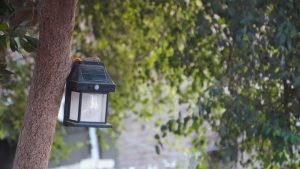
The Mpow lantern is the most aesthetically considered option in this test – designed to look like a traditional wall lantern rather than a utilitarian security fitting. The warm amber LED tone and black powder-coated casing work well on red brick, painted render or stone walls and look significantly more finished than bracket-mounted flood lights. Battery life running on four AA cells is around six weeks of nightly use before the first change is needed, which is perfectly manageable for a front door or patio wall position.
As an Amazon Associate I earn from qualifying purchases.
At around £12 for a six-pack, the Lepotec stick lights are the lowest-cost option in this test by a significant margin and they do the basics adequately. Each unit has a built-in rechargeable battery charged via USB, produces a modest but visible 30 lumens, and stakes into soft ground in seconds. The six-pack gives enough units to define a short path or cluster around a patio seating area for decorative effect rather than functional illumination.
Their limitations are real. Thirty lumens is not enough to navigate by on a dark night and the plastic housing, while IPX4 splash resistant, is noticeably lighter in feel than any other model tested. The USB charging requirement means removing each unit to charge indoors, which becomes a chore for six lights. For occasional decorative use in a sheltered position they are genuinely good value. As a practical garden lighting solution they fall short.
As an Amazon Associate I earn from qualifying purchases.
Head to head comparison
| Model | Power | Lumens | IP rating | Score |
|---|---|---|---|---|
| Litom 12 LED | Solar | 450lm | IP65 | 4.7 / 5 |
| Aootek 182 LED | Solar | 800lm | IP65 | 4.4 / 5 |
| Mpow 40 LED Motion | AA battery | 300lm | IP44 | 4.2 / 5 |
| URPOWER Path Lights | Solar | 15lm each | IP44 | 4.0 / 5 |
| Mpow Wall Lantern | AA battery | 80lm | IP44 | 3.8 / 5 |
| Lepotec Stick Lights | USB rechargeable | 30lm each | IPX4 | 3.5 / 5 |
What to look for when buying
The single most important decision when buying outdoor battery lights for a UK garden is whether to choose solar charging or replaceable batteries. Solar lights are genuinely convenient – no battery changes, no cables, no ongoing running cost. But solar charging in the UK requires realistic expectations. A light installed on a north-facing wall, under tree cover or in any position that does not receive at least four hours of direct sunlight per day will struggle to maintain adequate charge through autumn and winter. Battery-powered models with AA or AAA cells sidestep this limitation entirely – they work equally well regardless of position or season, with the trade-off of periodic battery replacement every one to four months depending on usage.
IP rating is the other specification worth understanding. IP65 means fully dust-tight and protected against water jets from any direction – the minimum sensible specification for any UK outdoor fitting in an exposed position. IP44 offers splash protection from all directions and is adequate for sheltered positions such as a porch or a wall under a soffit. IPX4 (the rating on the Lepotec stick lights) means splash-resistant but not rain-resistant – only suitable for sheltered decorative use. Any light without a clearly stated IP rating should be treated with significant caution for permanent outdoor installation in a UK climate.
Solar lights underperform significantly in the UK winter if poorly positioned. Marketing materials for solar lights typically quote runtime based on summer test conditions – eight or more hours of strong sun. In a UK November with four overcast hours of weak daylight, many solar lights will not charge enough to run through a full night on a single day’s charge. If winter reliability matters, choose a south-facing position specifically, or opt for a battery-powered model instead.
Final verdict and recommendations
For best overall performance: Litom 12 LED Solar Security Light. The most consistent performer across all categories in UK autumn conditions – bright enough to be useful, reliable solar charging, excellent IP65 weatherproofing and a three-mode system that works well for both security and ambient use.
For maximum brightness: Aootek 182 LED Solar Flood Light. Nothing in this test comes close to 800 lumens and the three-head adjustable design covers a large area. Best used in a south-facing position with good winter sun access where the solar panel can keep up with the power demand.
For security and motion sensing: Mpow 40 LED Motion Sensor Light. The fastest trigger response, longest battery runtime in AA mode and reliable detection up to eight metres. Ideal for driveways, side gates and front doors where instant triggering and winter reliability matter more than brightness.
For path lighting: URPOWER Solar Path Lights 4-pack. Warm white tone, easy spike installation and consistent low-level illumination that defines a path attractively without the cold blue glare of cheaper solar alternatives.
For decorative wall mounting: Mpow Battery Wall Lantern. The most attractive design in the test and the only one that suits a traditional or cottage-style garden without looking utilitarian. Battery powered for position flexibility – no south-facing constraint.
For the tightest budget: Lepotec LED Stick Lights. Adequate for decorative use in sheltered positions and the six-pack price is genuinely hard to beat. Not a practical security or navigation light.
The Litom 12 LED Solar Security Light is the best outdoor battery light for most UK buyers – it handles the UK climate better than any other model tested, charges reliably even in overcast autumn conditions and performs consistently across all three of its operating modes. Anyone needing more brightness should look at the Aootek, while anyone with a shaded or north-facing position should opt for the Mpow AA battery models to avoid the solar charging limitation entirely.
Share on socials: