At a glance
Timber is the most versatile material available for garden projects – it can be used for decking, raised beds, garden structures, cladding, fencing, furniture and storage. The problem is that not all timber is equal, and the differences matter significantly outdoors. A softwood board that has been pressure-treated with preservative will outlast an untreated one by decades. Hardwood costs more per metre but requires far less maintenance and develops an attractive silver-grey patina outdoors without any treatment. Composite and engineered board products offer performance advantages that natural timber cannot match but at a cost premium that only suits certain applications.
The choice of timber for any garden project should be driven by three questions: how long does it need to last, how much maintenance are you willing to do, and what budget is available. Choosing premium hardwood for a vegetable bed that will be moved in five years is wasteful. Choosing untreated softwood for a permanent decking area will result in rot, structural failure and a costly replacement within a decade. The five timber types covered in this guide represent the main categories available to UK buyers, covering the full range from affordable treated softwood to premium tropical hardwood and modern composite alternatives.
How we assessed these timber types: Each timber is scored on outdoor durability (years of service life with normal maintenance), maintenance burden, ease of working with standard tools, and value for money relative to lifespan. All prices are typical UK merchant and DIY store pricing per linear metre for a standard board section.
Quick Verdict
All 5 Timber Types Ranked
Pressure-treated softwood – typically Scots pine or spruce impregnated with a preservative under high pressure – is the right choice for the vast majority of UK garden projects. It is widely available from builders merchants and DIY stores in a comprehensive range of sections (from 25x100mm decking boards to 100x100mm structural posts), it is easy to cut and fix with standard tools, and it offers a service life of 15-25 years when correctly specified and maintained. The treatment process forces the preservative deep into the timber cell structure rather than just coating the surface, giving genuine long-term protection against rot and fungal decay that a brush-applied treatment simply cannot match.
The critical thing to check is the hazard class of the treatment – UC3 (Use Class 3) is appropriate for decking, cladding and above-ground structures, while UC4 is required for timber that will be in ground contact (fence posts, sleeper wall timbers). Using UC3 timber below ground is one of the most common causes of premature rot failure in garden projects. Most merchant-grade pressure-treated timber is UC3 by default – specifically ask for UC4 if the timber will be in ground contact.
As an Amazon Associate I earn from qualifying purchases.
Hardwood boards – whether European oak, West African iroko or South East Asian balau – offer genuinely superior outdoor performance compared to softwood and require minimal maintenance to achieve a 30-50 year service life. The natural density and oil content of these timbers gives inherent resistance to rot, insect attack and weathering that softwood can only approximate with chemical treatment. Over a 30-year ownership period, the higher initial cost of hardwood frequently works out comparable to softwood when replacement cycles are factored in, making it better value than the price per metre suggests.
Oak is the premium choice – beautiful grain, exceptional durability and widely available in UK. Iroko is a lower-cost West African hardwood that performs comparably to oak outdoors with a finer, more uniform grain. Balau is commonly used for high-specification decking and is particularly dense and slip-resistant. All three will weather to an attractive silver-grey if left untreated, or can be maintained with a hardwood oil for a richer colour. Hardwood is harder to cut and fix than softwood and requires pre-drilling to avoid splitting.
As an Amazon Associate I earn from qualifying purchases.
New oak railway sleepers – sold as garden sleepers rather than genuine railway-used stock – are the standard material for UK garden retaining walls, raised bed construction and garden steps. The 200x100mm section gives exceptional structural strength, and new oak sleepers have a service life of 20-40 years in ground contact without any treatment. They are sold by the linear metre and available from most garden centres and landscaping suppliers in 2.4m lengths. The main practical challenge is their weight – a 2.4m oak sleeper weighs approximately 60kg and requires two people to handle safely. Cutting sleepers to length requires a reciprocating saw or a large circular saw with a deep blade – a standard handsaw will not manage the 200mm depth. For retaining wall construction, sleepers are typically stacked horizontally and fixed with through-bolts or long rebar stakes driven through stacked courses.
As an Amazon Associate I earn from qualifying purchases.
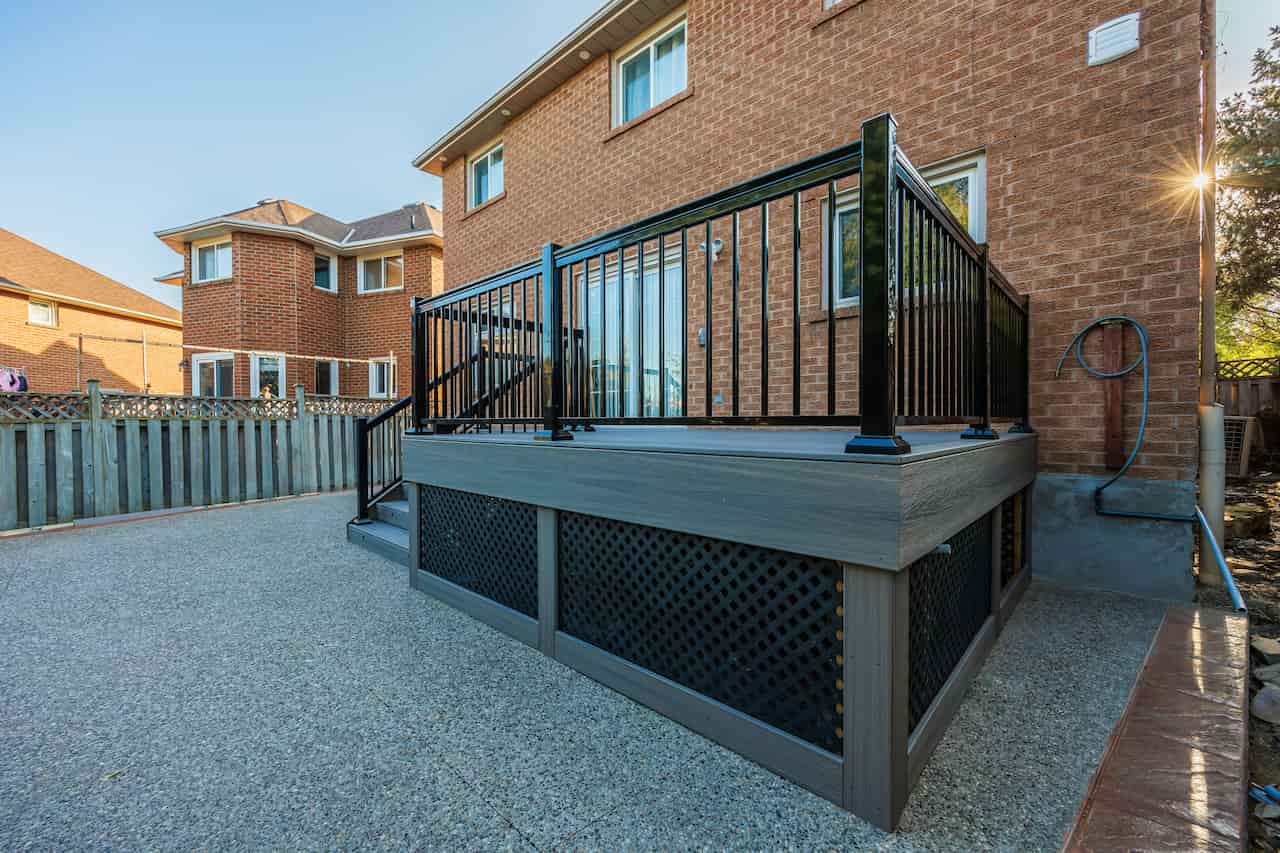
Composite decking boards – made from a mixture of recycled wood fibre and plastic – offer genuinely maintenance-free outdoor performance that no natural timber can match. They do not rot, warp, splinter or require annual oiling or staining, and most quality composite boards carry a 25-year warranty against structural failure. The aesthetic has improved significantly in recent years and the better products convincingly replicate a natural timber appearance. They are available in a wide range of wood-effect finishes and colours. The higher initial cost is the main barrier for most buyers, but this is partially offset by the zero ongoing maintenance cost.
As an Amazon Associate I earn from qualifying purchases.
Untreated structural softwood – classified as C16 or C24 depending on its strength grade – is widely available and very cheap, but it is emphatically not suitable for outdoor use. Untreated softwood exposed to moisture will begin to rot within 2-5 years regardless of any surface paint or stain applied. It is included here because it is frequently purchased for garden projects by builders who think it can be treated adequately after installation – it cannot. If a project requires timber that will be exposed to weather or ground contact, treated or naturally durable timber is not optional. The only garden application where untreated softwood is acceptable is for covered structures where it will not be exposed to direct rain or ground moisture – a pergola with a solid roof being the main example.
As an Amazon Associate I earn from qualifying purchases.
Feature Comparison
Cost vs Lifespan Comparison
The lifespan data makes the value argument clearly. Untreated softwood is cheap upfront but fails quickly – poor value over any project lifespan longer than 5 years. Pressure-treated softwood occupies the best position on the chart for most projects: low cost with a genuinely long service life. Hardwood and composite both cost significantly more initially but deliver proportionally longer lifespans – hardwood in particular offers excellent long-run value once the 30-40 year service life is factored in. The key takeaway is to avoid judging timber purely by initial cost; the total cost of ownership over the project’s intended life is the number that matters.
Whatever timber type you choose, three installation rules apply across all of them. First, always treat any fresh cut end of pressure-treated timber with a brush-on end-grain preservative – the cut exposes untreated wood fibre that will rot from the end inward if left unprotected. Second, maintain a 10mm gap between adjacent deck boards to allow rainwater to drain and air to circulate – boards butted together trap moisture and rot faster than boards with drainage gaps. Third, use stainless steel or hot-dip galvanised fixings throughout – zinc-plated screws corrode within a few years of outdoor exposure, causing rust staining of the timber surface and weakening of the fixing itself. These three details are small in cost and effort but make a disproportionate difference to how long a garden timber structure performs before requiring significant maintenance or replacement.
Share on socials: