At a glance
Pothos (Epipremnum aureum) has a well-earned reputation as the most forgiving houseplant commonly available in the UK. It tolerates low light, irregular watering, fluctuating temperatures and extended periods of general neglect with a resilience that very few houseplants can match. It is reliably recommended for beginners, for rooms where other plants struggle, and for anyone who has found houseplant care difficult in the past. But calling pothos merely an easy plant undersells what it is capable of when actually well grown. Given adequate light, consistent watering and occasional feeding, it produces long trailing stems that can reach several metres, develops increasingly large leaves, and fills a shelf or high ledge with genuinely striking foliage.
Pothos is also among the easiest houseplants to propagate – a single mature plant yields dozens of cuttings over its lifetime, making it ideal for filling multiple rooms from one purchase or sharing with others. The name situation around pothos is genuinely confusing: several distinct plants are sold under the pothos label in UK shops, including species from a different genus entirely. Understanding the difference matters practically, both for setting the right care expectations and for avoiding the frustration of buying what you think is a simple golden pothos and finding the care requirements are not quite what the label suggested.
About the pothos
Epipremnum aureum is native to French Polynesia and the Solomon Islands, where it grows as a climbing and trailing plant in tropical forest. In its natural habitat it ascends trees to reach the canopy, producing leaves that can exceed 60cm across on mature plants – far larger than the 10-15cm leaves typical of pothos kept in small pots in UK homes. In the wild, vines can grow to 20 metres in length. This context matters for UK growers: a pothos given more space, better light and something to climb will produce noticeably larger leaves and a more dramatic appearance than one trailing from a small pot in moderate light.
The common name pothos has a complicated history. Epipremnum aureum was previously classified under the genus Scindapsus, then Rhaphidophora, before botanists settled on Epipremnum. In some European countries it is still commercially labelled as Scindapsus aureus. The name “pothos” itself is from the original genus the plant was classified under – which it no longer belongs to. This creates real confusion in shops, where the name is now used loosely to describe several unrelated trailing aroids. Devil’s ivy, Ceylon creeper and hunter’s robe are other common names for the same plant.
Epipremnum aureum is toxic if ingested, to both people and pets. The insoluble calcium oxalate crystals in the leaves and stems cause mouth and throat irritation, excessive drooling, vomiting and difficulty swallowing when chewed or swallowed. This toxicity is confirmed across all varieties regardless of leaf colour or pattern. In households with cats, dogs or young children, pothos should be kept out of reach – a shelf or hanging basket positioned genuinely high enough is more reliable than leaving it accessible and hoping it will be avoided.
Varieties and look-alikes
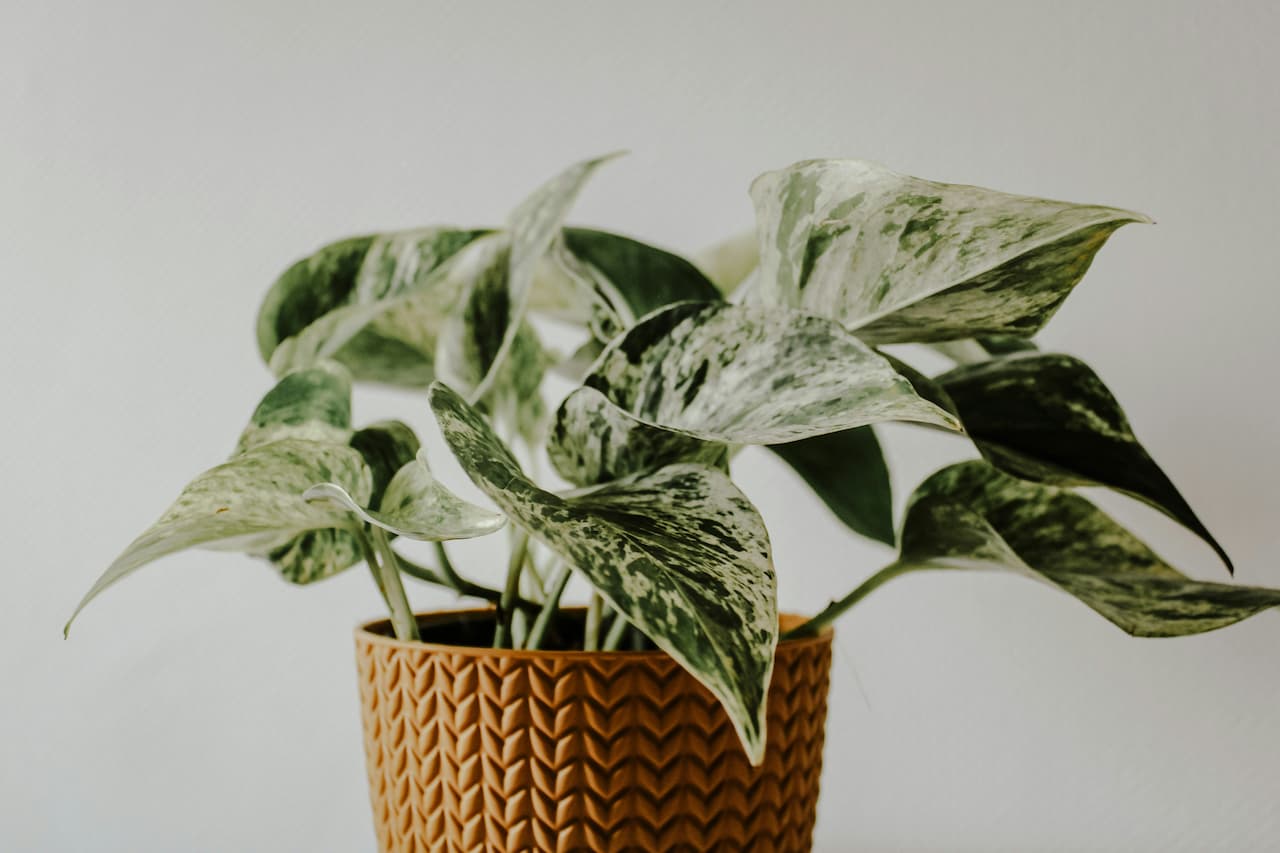
Epipremnum aureum has a number of named cultivars with different leaf colours and variegation patterns. A key rule applies to all variegated varieties: the more white or yellow in the leaf, the more light the plant needs. White and yellow sections contain no chlorophyll and cannot photosynthesise, so a heavily variegated plant like Marble Queen needs significantly more light than the plain-green Neon Pothos to grow at the same rate. In low light, variegated varieties produce progressively greener leaves as the plant attempts to maximise photosynthesis – moving to a brighter position usually restores the variegation.
Variegated pothos losing its pattern? In low light, variegated varieties like Marble Queen progressively produce greener leaves as the plant prioritises photosynthesis over appearance. This is reversible – move to a brighter position and new leaves will regain their variegation. The already-green leaves will not change back, but the new growth will.
Light, temperature and humidity
Pothos tolerates a wider range of light conditions than almost any other commonly available houseplant. Golden Pothos will survive and grow, slowly, in a north-facing room or a hallway with no direct natural light. In bright indirect light it grows much faster and produces larger, more impressive leaves. Direct harsh sun scorches the leaves. For a UK home, the ideal position for any variety is within 1-2 metres of an east or west-facing window, or set back from a south-facing window with a sheer curtain filter. Heavily variegated varieties – Marble Queen particularly – need to be closer to the light source than Golden Pothos to maintain their variegation and growth rate.
Pothos handles the typical UK home temperature range well. It is comfortable between 15-29°C and should not be exposed to temperatures below 10°C, which rules out unheated conservatories in winter and positions near draughty single-glazed windows in cold spells. Draughts and cold air cause sudden leaf yellowing and drop – often misdiagnosed as overwatering. If a pothos is correctly watered but dropping leaves suddenly, check for cold air movement around the plant before adjusting the watering routine.
Humidity is something pothos prefers at 40-60% but tolerates at typical UK room levels without serious complaint. The most common sign of insufficient humidity is brown leaf tips and edges. A tray of damp pebbles under the pot or grouping several houseplants together raises local humidity effectively. Kitchens and bathrooms with adequate light are naturally good rooms for pothos given their higher ambient humidity. Misting provides brief benefit but is not a substitute for consistently higher ambient humidity levels.
Watering, feeding and repotting
Water pothos when the top 2-3cm of compost feels dry to the touch. In a warm UK home in summer this typically means watering every seven to ten days. In winter with lower light levels and slower growth, every fourteen to twenty-one days is more appropriate. The plant gives clear signals: leaves that curl slightly inward indicate it is thirsty; leaves that soften and yellow suggest overwatering. These are reliable indicators and checking them before each watering is more accurate than following a fixed schedule.
Feed pothos with a balanced liquid houseplant fertiliser monthly during the growing season, March to September. Reduce to every six to eight weeks or stop entirely from October through February. Pothos is not a heavy feeder and overfeeding causes leggy growth with small leaves and white mineral crust on the soil surface – if this appears, flush the pot with plain water a few times to leach the excess.
Repot when roots grow through the drainage holes or when the compost dries out within a day of watering – signs the root system has filled the pot. Choose a pot one size larger (2-3cm more in diameter) and use a well-draining houseplant compost. Standard multipurpose compost works well; adding around 20% perlite improves drainage further. Spring is the best time to repot. Pothos tolerates being somewhat root-bound and does not need frequent repotting – every one to two years is typical for a well-grown plant.
Display – trailing, climbing and pruning
The two main ways to display a pothos produce noticeably different results and it is worth choosing deliberately rather than defaulting to whatever the pot allows. Trailing from a shelf or hanging basket emphasises the length of the stems and suits smaller-leaved varieties like Neon and Marble Queen. Climbing up a moss pole or trellis encourages the plant to produce significantly larger leaves – this is how pothos grows in its natural habitat, ascending trees, and the leaf size difference between a climbing and a trailing specimen can be dramatic over time.
Pruning pothos serves two purposes: controlling the length of trailing stems and encouraging the plant to produce bushier, more branched growth rather than a few very long stems. Cutting a stem back to a node – the point where a leaf joins the stem – causes the plant to branch and produce new growth from lower down. The cut sections can be propagated immediately rather than discarded. A pothos that has become bare and leggy at the base, with all the leaves clustered at the end of long bare stems, benefits significantly from being cut back hard in spring. New stems emerge from the soil level, producing a much fuller plant within a few months.
Propagation
Pothos is one of the most straightforwardly propagated houseplants available in the UK. A stem cutting with at least one node – the small bump on the stem where a leaf joins – will produce roots reliably in water within two to four weeks. Remove the lowest leaf to expose the node cleanly, place the cutting in a glass of room-temperature water in bright indirect light, and change the water weekly. Once roots are 3-4cm long, pot into houseplant compost and treat as a young plant. Multiple cuttings placed together into one pot produce a fuller, more immediately impressive plant than a single cutting.
Common problems and seasonal care
Most pothos problems are caused by one of three things: too much water, too little light, or cold draughts. The plant is genuinely difficult to kill outright but it does show clearly when conditions are wrong – learning to read the signals accurately means problems rarely become serious.
Pests are not commonly a serious problem for pothos but mealybugs and spider mites do appear, particularly in warm, dry conditions. Mealybugs appear as white cottony clusters in stem joints and leaf bases – treat with neem oil or insecticidal soap applied weekly until gone. Spider mites produce fine webbing on the undersides of leaves and a dusty, stippled appearance on the upper surface – increasing humidity and wiping leaves regularly prevents most infestations before they establish. Both pests spread to nearby plants, so treating promptly and isolating the affected plant while treating is worthwhile.
Share on socials: