Apple trees in the UK are susceptible to a predictable set of fungal and bacterial diseases that recur year after year unless actively managed. The good news is that most of these diseases follow a well-understood cycle, arrive at known times of year, and respond to straightforward cultural controls that do not require chemical intervention in most gardens. Understanding which disease you are dealing with – and when it is most likely to strike – is the foundation of effective management.
The UK climate is particularly conducive to apple tree diseases. Cool, wet springs create ideal conditions for fungal spore germination and spread, and the damp autumns that follow mean fallen infected leaves persist as a reservoir of disease through winter. Most apple tree problems are not caused by bad luck or poor variety choice – they are the predictable result of spores carried over from the previous season finding favourable conditions in spring. Breaking that cycle through good autumn hygiene is the single most effective disease prevention measure available to UK apple growers.
Apple scab
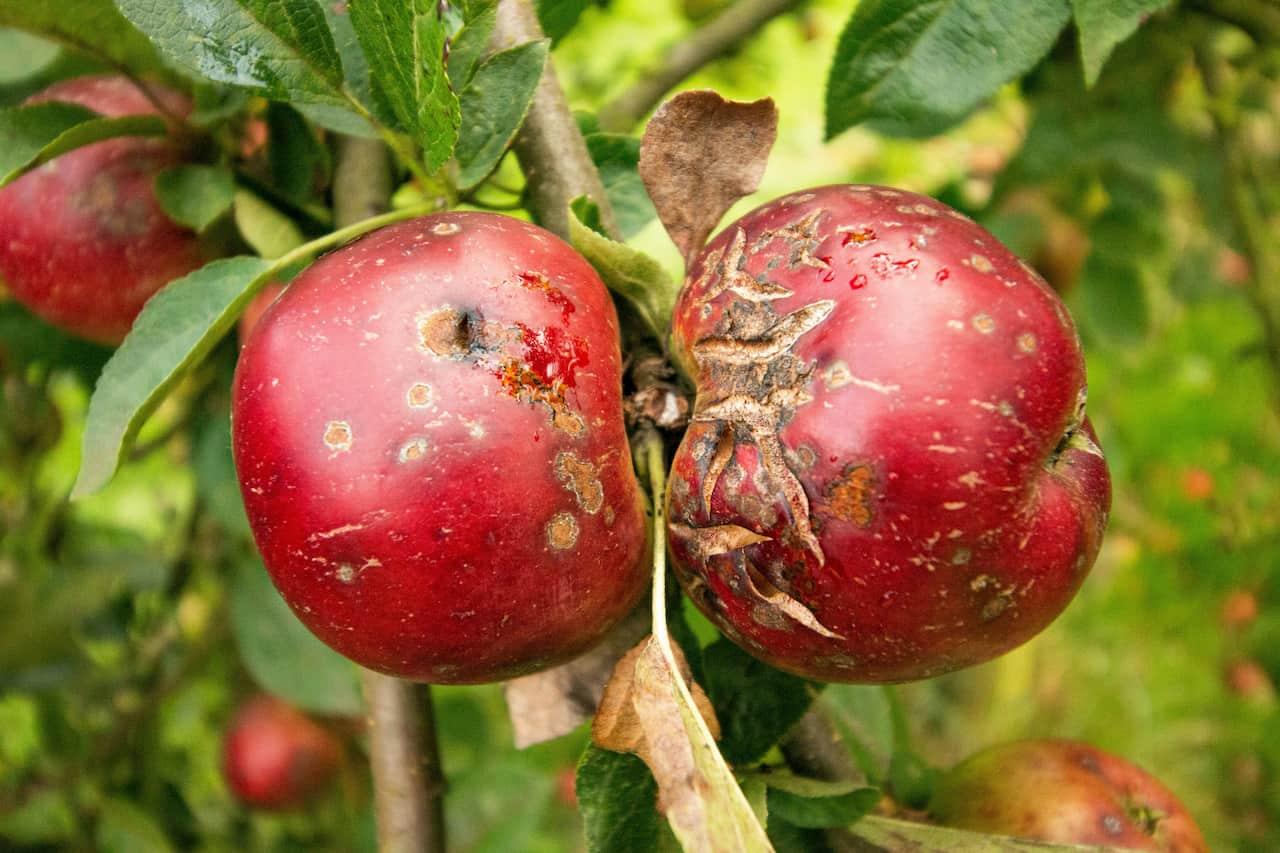
Apple scab, caused by the fungus Venturia inaequalis, is the most widespread apple tree disease in the UK. It overwinters in fallen infected leaves and releases spores in spring, infecting young leaves and developing fruitlets during wet weather from April onwards. Scab is a wet-weather disease – infection requires leaf wetness for a minimum period that varies with temperature, which is why the UK’s cool, wet springs create such consistently favourable conditions for it.
Apple scab – symptoms, timing and treatment
Symptoms
Olive-green to dark brown blotches on leaves, often with a scabby, cracked texture. Infected fruitlets develop dark corky scabs on the skin. Severely infected leaves may yellow and drop early. In bad years, fruit becomes so heavily scabbed it is unmarketable even if edible.
Treatment
Collect and remove all fallen leaves in autumn – this is the primary control. Prune to open the canopy and improve airflow. Resistant varieties (Scrumptious, Discovery, Greensleeves) are the long-term solution for scab-prone gardens. Copper-based fungicides can reduce infection in spring if applied before rain events.
Peak period
April to June. Primary infection occurs as leaves emerge and fruitlets develop. Secondary spread continues through summer in wet conditions. Autumn leaf fall is the reset point – remove leaves before spores have time to re-infect soil.
Severity in UK
High. Scab is present in most UK apple-growing gardens to some degree and will recur annually unless the leaf litter cycle is broken. Resistant varieties reduce but do not eliminate risk. Chemical control is only partially effective and needs repeating through spring.
Apple canker
Apple canker (Neonectria ditissima) is the most damaging structural disease of apple trees in the UK. Unlike scab, which affects leaves and fruit, canker attacks the woody tissue of branches and trunks – creating sunken, discoloured lesions that girdle branches and eventually kill them. The fungus enters through pruning wounds, leaf scars or any damaged bark, making good pruning hygiene essential.
Symptoms
Sunken, discoloured bark lesions
Bark cracks and flakes away exposing paler wood beneath. In spring, coral-pink fungal pustules appear around the margin of the lesion. Girdled branches fail to leaf out in spring and die back completely.
Treatment
Cut out and burn infected wood
Prune to at least 10cm below the visible margin of the canker. Sterilise pruning tools between cuts with methylated spirits. On trunks, pare the lesion back to clean wood with a sharp knife, dust with copper-based wound paint. Burn all infected prunings – never compost them.
Peak period
Infection year-round, visible autumn-winter
New infections most common in autumn when leaf scars are freshly open and in wet weather. Lesions most visible in winter when leaves have fallen. Act as soon as lesions are spotted – canker spreads relentlessly if left.
Risk factors
Wet soils, poor drainage, Cox varieties
Waterlogged or poorly drained soils significantly increase canker risk. Cox’s Orange Pippin and Bramley are highly susceptible. James Grieve, Worcester Pearmain and Fiesta show moderate susceptibility. Newer disease-resistant varieties show considerably lower canker rates.
⚠️Never compost canker prunings. Neonectria spores survive composting and will reinfect the tree from compost applied nearby. All canker-affected wood must be burned or bagged for council collection. The same applies to the bark scrapings when treating lesions on the main trunk. This single hygiene step is the most common failure point in canker management.
Powdery mildew
Apple powdery mildew (Podosphaera leucotricha) is immediately recognisable – young leaves, shoot tips and sometimes flower trusses are covered in a white powdery coating that gives the disease its name. Unlike scab, mildew is a dry-weather disease that thrives in warm, dry conditions with high humidity but without the rainfall that triggers scab infection. It overwinters in infected buds, which is why the same branches often show mildew first each year.
Apple powdery mildew – identification and management
Factor
Detail
Symptom
White powdery coating on young leaves, shoot tips and occasionally flower trusses. Affected leaves may curl, pucker and fail to expand fully. Infected flowers produce poor fruit set.
Timing
First visible as buds open in April. Peak on new growth in May and June. Often subsides in mid-summer as growth hardens. Can reappear on late summer flushes.
Control
Prune out visibly infected shoot tips in spring as soon as white coating is seen – removing the infected tissue before spores spread is the primary control. Improve airflow by pruning to an open centre. Sulfur-based fungicides applied from bud burst reduce spread. Avoid high-nitrogen feeding which promotes soft growth.
Susceptibility
Cox’s Orange Pippin is highly susceptible. Bramley is resistant. Most modern club varieties carry improved mildew resistance. Sheltered, south-facing walls that retain warmth and reduce air circulation increase risk.
Brown rot and other fruit diseases
Brown rot (Monilinia fructigena) is the most common cause of fruit spoilage on UK apple trees. It spreads rapidly through a crop in warm, humid late summer conditions – a single infected fruit can spread to its neighbours while still on the tree, and fallen infected fruit becomes a reservoir for re-infection. Brown rot also causes the related condition known as blossom wilt, where infected flowers turn brown and the surrounding shoot dies back.
Apple fruit diseases – symptoms and urgency
Brown rot – tan-brown spreading patch with concentric rings of white pustules
Spreads from fruit to fruit via spore release in warm humid weather. Remove and destroy all infected fruit immediately – do not leave on the tree or drop to the ground. Mummified infected fruit left on the tree over winter is a major source of the following year’s infection. Pick up all fallen fruit promptly through the season.
Act now
Bitter pit – small sunken brown spots through flesh of stored fruit
Calcium deficiency disorder rather than a true disease. Most common in dry summers on large-fruited varieties. Apply calcium-based foliar sprays from late June. Maintain consistent watering through summer – drought stress prevents calcium uptake even when soil levels are adequate. Bramley is highly susceptible.
Preventable
Fireblight – blossoms and shoot tips blacken and wilt as if scorched
Bacterial disease (Erwinia amylovora) that spreads through open flowers in spring. Shoots die back rapidly, with affected tissue turning brown-black. Prune out infected material at least 30cm below visible symptoms. Sterilise tools between cuts. Fireblight is a notifiable disease in commercial orchards but not in private gardens.
Prune out
Sooty blotch and flyspeck – dark smudgy marks and tiny black dots on fruit skin
Cosmetic fungal diseases on fruit skin that do not penetrate the flesh. More common in wet seasons and on fruit left too long before harvest. Wipe off with a damp cloth. Improve canopy airflow with pruning. Harvesting at the correct time rather than leaving fruit on the tree into autumn reduces incidence significantly.
Cosmetic only
Amazon
Apple tree disease control – UK picks
As an Amazon Associate I earn from qualifying purchases. Prices correct at time of publishing.
Prevention – the annual routine
The single most effective thing an apple grower can do for disease management costs nothing and takes an hour or two in autumn. Collecting and removing fallen leaves breaks the overwintering cycle of scab and several other fungal diseases. Leaf litter left under the tree through winter releases spores in spring at exactly the moment young leaves and fruitlets are most susceptible. Remove it and the primary inoculum source is dramatically reduced.
Dec – Feb
Winter pruning window. Remove dead, diseased and crossing branches. Cut out any canker lesions to clean wood. Sterilise tools between trees. Apply grease bands around trunks to prevent winter moth access. Check for mummified fruit left on the tree from the previous season and remove it.
Mar – May
Apply copper-based fungicide at green cluster stage and again at pink bud stage for scab-prone trees. Prune out any mildew-infected shoot tips as soon as the white coating is visible. Watch for canker lesions around freshly opened leaf scars. Remove infected material promptly. Thin fruit after June drop to prevent brown rot spread via fruit touching.
Jun – Aug
Watch for and remove brown rot immediately as it appears. Pick up all fallen fruit promptly – rotting fruit on the ground is a source of spores for further infection. Continue to remove mildewed shoot tips. Apply calcium foliar spray to Bramley and other bitter pit-susceptible varieties from June.
Sep – Nov
Collect and remove ALL fallen leaves as they drop – this is the single most important annual task for scab prevention. Bag for council collection or burn. Do not compost. Harvest fruit at the correct time and inspect stored fruit weekly for brown rot. Remove any infected stored fruit immediately before it spreads to neighbours.
Variety choice is the most powerful long-term tool for disease management. Cox’s Orange Pippin is susceptible to scab, canker and mildew. If your garden has persistent disease problems, the practical solution is to replace susceptible varieties with resistant ones rather than fighting annual battles with fungicides. Varieties like Scrumptious, Greensleeves, Falstaff and Discovery carry genuine resistance to the most common UK apple diseases and perform well without chemical intervention in most UK gardens.
Amazon
Apple tree disease control – UK picks
As an Amazon Associate I earn from qualifying purchases. Prices correct at time of publishing.