At a glance
Whitefly is one of the most persistent and frustrating pest problems in UK gardens and greenhouses. A cloud of tiny white insects that erupts from plant leaves when disturbed is the characteristic sign, and once established on a plant, whitefly populations can build extremely rapidly – a single pair can produce thousands of offspring within a few weeks under warm conditions. The pest is particularly challenging because adults fly to nearby plants when disturbed, making localised control difficult, and the immobile scale-like nymphs on leaf undersides are resistant to many spray treatments.
Control is possible but requires persistence and often a combination of approaches rather than a single intervention. Understanding which life stage each control method targets helps to use them effectively. The good news is that healthy, well-grown plants tolerate moderate whitefly populations without serious damage, and for most UK gardens the pest is a nuisance rather than a crisis – though in greenhouses, where populations can build rapidly without natural predators, it can become severe enough to kill plants if left unmanaged.
Identifying whitefly
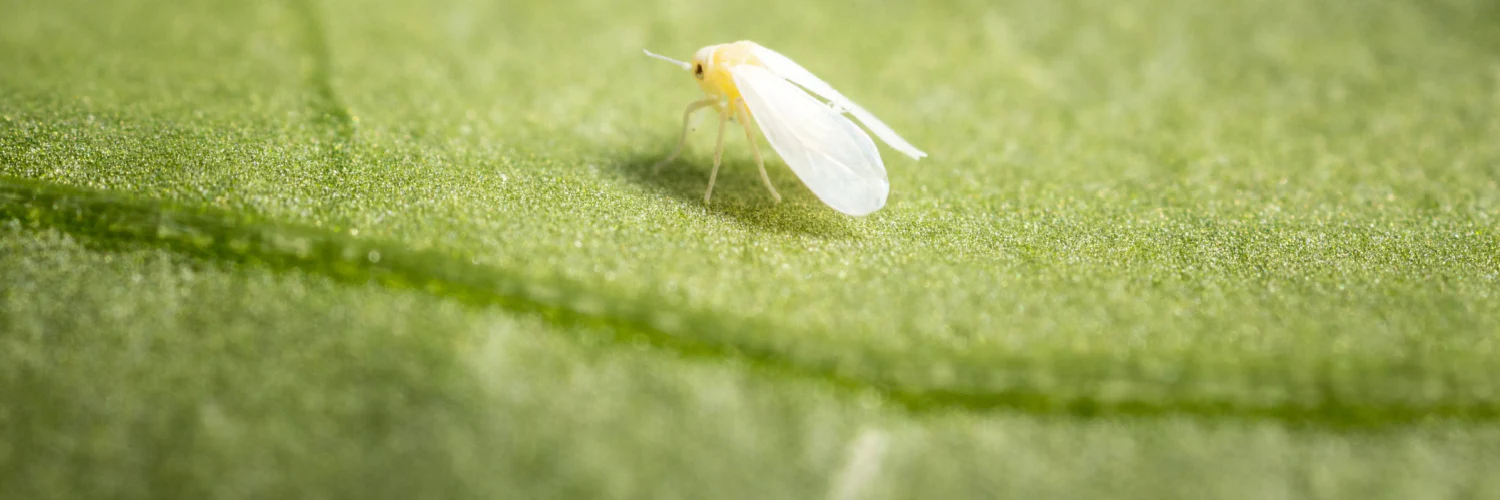
Adult whiteflies are tiny – about 1.5mm long – with white waxy wings and a yellow body. They cluster on the undersides of leaves, typically near the growing tips of young growth, and fly in a small cloud when the plant is disturbed. The nymphs (immature stages) are flat, pale green or yellowish oval scales, also on leaf undersides, that are easy to overlook until populations become dense. Eggs are very small and usually visible as tiny white or pale yellow dots in circular clusters on leaf undersides.
Distinguishing whitefly from other pests is important for choosing the right control. Scale insects are similar in appearance but do not fly. Mealybugs have a waxy covering and are found in different locations. Aphids are typically green or black and larger. If small white insects fly up from the plant when you touch it, it is whitefly.
How whitefly damages plants
Whitefly feeds by inserting its mouthparts into plant tissue and extracting sap. Heavy infestations weaken plants, causing yellowing leaves, stunted growth and reduced vigour. The more significant damage in many cases is the honeydew that whitefly excretes as it feeds – a sticky substance that coats leaves and provides the growing medium for sooty mould, a black fungal growth that reduces the plant’s ability to photosynthesise. Sooty mould is not directly harmful but indicates a significant whitefly problem and compounds the damage done by the insects themselves.
In the UK, whitefly rarely kills established outdoor plants outright, though heavy infestations on brassicas, tomatoes and fuchsias can significantly reduce yields and plant health. In greenhouses, where the combination of warmth, shelter from natural predators and high plant density creates ideal conditions, populations can escalate to damaging levels much more quickly.
Greenhouse vs outdoor whitefly
The distinction matters practically because glasshouse whitefly is controllable with biological methods that do not work as effectively against cabbage whitefly. If you are dealing with whitefly on outdoor brassicas – the white cloud that erupts from kale or Brussels sprouts when touched – physical and organic controls are more appropriate than the biological approach.
Biological control
For glasshouse whitefly specifically, the parasitic wasp Encarsia formosa is the most effective control available and is widely used by commercial growers. The tiny female wasps lay their eggs inside whitefly nymphs, which then turn black as the wasp larva develops and kills the host. Encarsia is available by mail order from biological control suppliers and works best when introduced early before populations reach high levels.
Encarsia requires temperatures above 18°C to be effective, which makes it suitable for greenhouse use from May to September but not for outdoor or winter greenhouse use. Introduce when you first notice whitefly rather than waiting until populations are established – the wasp takes several weeks to reduce populations and is not a quick fix. Do not use chemical insecticides in the same area as Encarsia, as these kill the beneficial wasps as well as the pest.
Another biological option is the predatory beetle Delphastus catalinae, which feeds on whitefly eggs and nymphs and tolerates slightly lower temperatures than Encarsia. Using both together provides more comprehensive control. Both are available from UK biological control suppliers and can be ordered online.
Physical and organic controls
Yellow sticky traps are the most useful immediate physical control for both greenhouse and outdoor whitefly. Adults are strongly attracted to the colour yellow and become trapped on the adhesive surface. Position traps at plant height among affected plants, replacing when full. Traps do not eliminate an infestation but significantly reduce adult populations and provide a useful indicator of population levels. They are harmless to beneficial insects except those that are also attracted to yellow, so position them carefully away from flowering plants where possible.
Insecticidal soap sprays (based on potassium soap or soft soap) are effective against whitefly nymphs and adults when the spray directly contacts them. Apply thoroughly to the undersides of leaves where whitefly congregates – coverage is critical. Repeat every five to seven days as the spray has no residual action and does not affect eggs. Neem oil sprays work similarly and have some additional repellent effect. Both are approved for organic use and are relatively safe for beneficial insects when applied carefully and allowed to dry before pollinators visit the plants.
Physical removal – wiping leaf undersides with a damp cloth to remove nymphs and eggs – is tedious but effective on small infestations or high-value plants. Vacuuming adults from plants using a small handheld vacuum on the lowest setting before spraying reduces adult populations and improves the effectiveness of subsequent spray treatments.
Chemical control
Several chemical insecticides are approved for whitefly control in UK gardens. Pyrethrum-based sprays are the least persistent option and break down quickly in sunlight, reducing the risk to beneficial insects. Apply in the evening when pollinators are not active. Thiacloprid-based products provide longer-lasting systemic control but should be used cautiously given the ongoing concerns about neonicotinoid impacts on pollinators – avoid use on flowering plants or near areas frequented by bees.
Chemical resistance is a significant issue with whitefly – populations exposed repeatedly to the same chemical can develop resistance within a few generations. Rotating between chemical classes and combining with physical and biological methods reduces the risk of resistance developing and is more effective than relying on any single product.
Preventing reinfestation
Whitefly populations build rapidly from very small numbers, so early detection and intervention is the most effective strategy. Inspect the undersides of leaves regularly on susceptible plants – tomatoes, fuchsias, brassicas and any plants previously affected – from May onwards. A few adults caught early is far easier to deal with than an established infestation discovered in August.
In the greenhouse, thorough cleaning between seasons removes overwintering eggs and pupae from crevices in the structure, pots and staging. Remove all plant debris, wash down the structure with a disinfectant solution and leave empty for at least two weeks if possible. This breaks the breeding cycle and reduces the population that carries over from one season to the next.
Avoid importing whitefly on new plants – inspect any bought-in plants carefully before introducing them to the greenhouse or placing them near susceptible plants. This is particularly important for tomatoes and fuchsias bought in from garden centres in spring, which frequently carry light infestations. Quarantining new plants for a week or two before placing them with the main collection is good practice generally and catches problems before they spread, much as the same approach helps prevent the spread of other pests like vine weevil when buying in new container plants.
Never spray insecticides on plants in flower during daylight hours. Even organic sprays like pyrethrum and insecticidal soap can harm bees and other pollinators if they contact them directly. Always spray in the evening after pollinators have stopped flying, and avoid spraying flowers directly. This is particularly important for tomatoes, which are self-pollinating but still visited by bees.
Share on socials: