At a glance
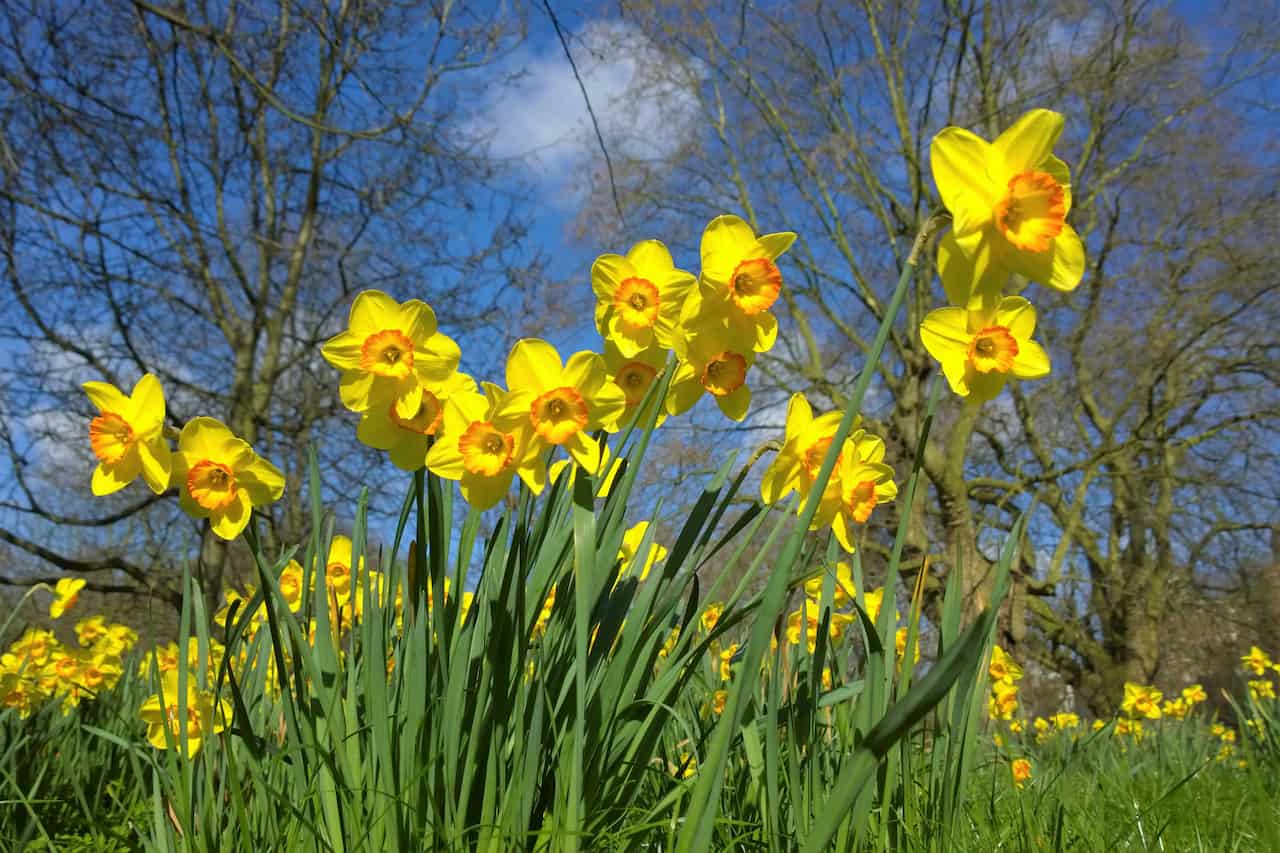
Daffodils are the most reliably performing spring bulbs available to UK gardeners. Unlike tulips, which can be temperamental repeaters and are vulnerable to squirrel predation, daffodils are rodent-proof – their bulbs contain alkaloids that make them unpalatable to mice and squirrels – naturalise readily in grass and under trees, multiply over time and return faithfully each spring with very little care. A thoughtfully chosen collection of varieties can produce flowers from January or February through to late April or May, covering the lean weeks of early spring when little else is in flower.
The range available extends far beyond the familiar large yellow trumpet types associated with roadsides and parks. The divisions recognised in the official daffodil classification cover everything from tiny species types just 10cm tall through to large-flowered doubles with peony-like blooms, white poeticus varieties with their distinctive tiny red-rimmed cups and extraordinary fragrance, split-corona types, and pink-cupped hybrids. Understanding what is available is the first step to building a collection that delivers colour across a far longer season than a single variety could ever provide.
Daffodils are geophytes – plants that store energy in underground bulbs and use it to power growth and flowering in spring. Each bulb planted in autumn contains the embryonic flower, leaves and food reserves for the following spring. After flowering, the leaves continue to photosynthesise until they die back in June or July, transferring energy back to the bulb and to the offset bulblets forming alongside it. This post-flowering period determines next year’s performance. The great advantage daffodils have over tulips is that their alkaloid content – primarily lycorine – makes them poisonous to rodents, meaning planted bulbs are left completely undisturbed by the mice and squirrels that destroy tulip and crocus plantings.
Choosing varieties for succession
The daffodil season in the UK spans approximately three months, from the first very early varieties in January to the late poeticus types finishing in early May. Planting across at least three different flowering periods extends a two to three week single-variety display into a sequence running from early February through to late April.
Very early (Jan-Feb): Rijnveld’s Early Sensation can flower in January or early February in mild years, producing classic yellow trumpets on short sturdy stems. It is the most reliable January-February daffodil for UK conditions and provides the first meaningful colour of the year – often the first bulb of any kind to flower after winter.
Early (Feb-Mar): Tete-a-Tete is the most widely grown miniature daffodil in the UK and one of the most reliable daffodils of any size for containers and the front of borders. It produces two or three small yellow flowers per stem at 15-20cm and naturalises readily, increasing over time. February Gold is a small cyclamineus hybrid with reflexed (swept-back) petals and a golden yellow trumpet, producing its flowers from late February. Both are outstanding long-term plants that produce generous offsets and improve with each passing year. Jetfire is a similar cyclamineus type with yellow petals and an orange-tipped trumpet, extremely reliable.
Mid-season (Mar-Apr): Ice Follies is a large white-perianth, cream-cup daffodil and one of the best-selling daffodils in the world for good reason – it is robust, long-lived, free-flowering and naturalises exceptionally well in both grass and borders. Carlton produces soft yellow large-cupped flowers of equal reliability. Dutch Master is the classic all-yellow large trumpet – the archetypal daffodil – vigorous and widely available. Salome offers a departure from the yellow palette: white petals with a cup that opens cream and deepens to a distinctive peachy-pink as the flower ages.
Late (Apr-May): Thalia is an outstanding pure white triandrus hybrid, producing two or three nodding flowers per stem in April with a delicacy that suits white and pale planting schemes. It naturalises well and is one of the best white daffodils for any situation. Pheasant’s Eye (Narcissus poeticus var. recurvus) is the latest of all commonly grown daffodils, producing white flowers with a tiny red-rimmed cup and an extraordinarily sweet, strong fragrance in late April and May. It naturalises superbly under deciduous trees.
Planting – borders, grass and containers
Daffodil bulbs should be planted as early in autumn as possible – September is ideal, October is fine, November at the latest. Unlike tulips, daffodils benefit from an early start and begin developing roots before the soil cools significantly. An early-planted bulb has a head start on the season and typically produces stronger first-year flowers than one planted in late October. If bulbs cannot be planted immediately, store them in a cool, dry, well-ventilated place – never in a sealed bag or in a warm shed where they will dry out or rot.
Plant at a depth of approximately three times the height of the bulb measured from the base of the bulb to the soil surface. For a standard large daffodil bulb this means 15-20cm, and for miniature varieties 8-10cm. Deeper planting – up to 25cm for large bulbs in light soils – produces more stable clumps and improves repeat flowering. Place bulbs flat end down, pointed tip upward.
Daffodils are unfussy about soil type in comparison to tulips. They grow in most well-drained garden soils, in partial shade under deciduous trees, in reasonably heavy clay and in light sandy soils. A handful of bonemeal in the base of each hole benefits poor soils but is not necessary in average garden soil. The one non-negotiable is the same as for all bulbs: the soil must not be persistently waterlogged. Bulbs sitting in wet ground through winter will rot.
Naturalising in grass
Growing daffodils naturalised in grass under trees or across a meadow area is one of the most low-maintenance and long-lasting garden approaches. Once established, a naturalised planting requires no attention beyond leaving the grass unmown until the foliage has died back. In most UK gardens this means not cutting the relevant area between February and mid to late June – a constraint worth considering before establishing a large naturalised planting, as it affects how other areas can be accessed and maintained.
The best situations are under deciduous trees, where dappled spring light suits the bulbs and the summer shade – when they are dormant – is irrelevant. An orchard, a group of mature fruit or ornamental trees, or a woodland garden edge are ideal. Open grass areas also work well, particularly on slopes or banks where a mowing schedule can be adapted without creating access problems elsewhere in the garden.
Smaller-flowered cyclamineus and triandrus types spread more readily in grass than large-flowered hybrids because they produce more offsets relative to their parent bulb size. A colony of February Gold or Tete-a-Tete planted as thirty bulbs can become one hundred or more over ten years without any intervention. Large-flowered varieties such as Dutch Master increase more slowly and may compete less successfully with established turf. For long-term grass plantings, investing in smaller-flowered varieties gives a much better return over a decade than the large-flowered types that look impressive on the bulb packet.
The initial investment in a naturalised planting pays off over decades. Plant densely enough at the start – a sparse planting looks thin for years before building to critical mass. One hundred bulbs spread across ten square metres gives a far better long-term result than thirty bulbs spread over the same area. The native Narcissus pseudonarcissus (the Lenten lily) is an outstanding choice for wildflower meadow planting – smaller, more open in flower than the large hybrids, and a natural fit in traditional meadow grassland.
Aftercare and repeat flowering
Daffodils are among the most self-sufficient garden bulbs, but consistent aftercare produces noticeably better performance over time. The most important rule is identical to tulips: leave the foliage intact until it has died back completely. The leaves feed the bulb after flowering, building the energy reserves needed for the following year. Cutting or tying the foliage before it has turned fully yellow and papery depletes the bulb and leads to declining flower production – specifically, blind bulbs that produce leaves but no flowers. Six weeks after the last flower is the minimum; eight weeks produces better results.
Deadheading: remove spent flower heads as they fade by snapping off the seed pod below the flower but leaving the stem in place. The stem contributes to photosynthesis and to the bulb’s energy reserves – only the old seed pod is removed. In large naturalised plantings in grass, deadheading is impractical and unnecessary for established clumps.
Feeding: a high-potassium liquid fertiliser applied as the flowers fade and continued every two weeks until the foliage begins to yellow improves repeat performance noticeably. Tomato feed is ideal. Established naturalised clumps in grass rarely need supplemental feeding – the grass cycles nutrients sufficiently. Bulbs in containers benefit most from regular feeding as container compost is quickly depleted.
Daffodil foliage and bulbs are toxic – wear gloves when handling. All parts of daffodils contain lycorine and other alkaloids that cause skin irritation in some people and are poisonous if ingested. Wear gloves when planting or handling bulbs, wash hands afterwards and keep bulbs away from children and pets. The same alkaloids that make daffodils rodent-proof also make them potentially harmful if eaten.
Dividing and increasing your stock
Congested daffodil clumps that have built up over five to seven years begin to produce increasing numbers of leaves and declining numbers of flowers. The bulbs have multiplied to the point where individual bulbs are competing for nutrients and space, and none is building sufficient reserves to support flowering reliably. Lifting and dividing restores flowering vigour and can multiply a modest initial planting into a large stock over a decade.
Lift clumps once the foliage has completely died back in July. Work carefully around the clump with a fork to avoid spearing bulbs. Separate the individual bulbs by hand – they usually pull apart easily once lifted. Inspect each bulb: firm, solid bulbs with intact papery tunics will flower reliably; soft, lightweight, shrivelled or damaged bulbs should be discarded. The large main bulbs flower the following year; the smaller offset bulblets can be grown on in a nursery row for a season or two before they reach flowering size.
Replant the large flowering bulbs immediately at the correct spacing for the situation – 10-15cm apart in borders, more densely in containers, scattered naturally in grass. If replanting in the same ground, incorporate some garden compost or a light dressing of general fertiliser to replenish nutrients depleted by years of bulb growth. Naturalised clumps in grass can be left undivided for longer – up to ten years in established plantings – as competition from surrounding grass offsets some of the overcrowding effect.
Common problems
Blind bulbs – producing leaves but no flowers – are the most common problem with established daffodil plantings and almost always have a cultural rather than a disease cause. Overcrowded clumps where competition prevents individual bulbs building sufficient energy reserves are the most frequent reason. Premature removal of foliage in previous years is the second cause. Drought during May and June – when the bulbs are most actively building reserves – is the third. Lift and divide congested clumps, leave foliage until fully dead, and water during dry spells in May and June. Blind bulbs recover over one to two seasons once the cause is addressed.
Narcissus fly (Merodon equestris) is the most significant insect pest of daffodils in UK gardens. Despite its name, it is a hoverfly – a bumblebee mimic that lays single eggs near the base of dying daffodil foliage in May and June. The hatched larva tunnels into the bulb through the base plate and hollows it out from within. Affected bulbs feel soft when pressed and are usually entirely destroyed. Firming the soil around the base of the dying foliage in late May and June – pressing soil back over the bulb neck area as the leaves die down – discourages females from finding the entry point. There is no insecticide treatment available to UK gardeners and the problem is difficult to prevent entirely in a garden setting, but it rarely affects more than a small proportion of bulbs in a well-established planting.
All daffodil parts are toxic to humans and animals. The alkaloids – primarily lycorine – cause nausea and vomiting if ingested and can cause skin irritation and eye irritation on contact, a condition known as daffodil picker’s rash that affects commercial bulb handlers. The sap from cut stems also causes problems when mixed with other cut flowers – if combining daffodils with other flowers in a vase, condition them separately in water for several hours first before adding to an arrangement, as the sap is toxic to other stems.
Share on socials: