At a glance
Choosing a cordless combi drill in 2026 means navigating a market where premium 18V brushless tools from the four major brands – Makita, DeWalt, Milwaukee and Bosch – are all genuinely excellent and yet meaningfully different in ways that matter for specific users. The days when any of these brands produced a clearly inferior product are largely gone. The differences now come down to torque output, body size and weight, battery ecosystem compatibility, clutch precision and – for trade users – long-term support and motor warranty. Getting these decisions right before buying saves money and frustration; getting them wrong means spending more than necessary or living day-to-day with a tool that is poorly matched to the work it needs to do.
We tested all four drills reviewed individually on this site back to back across timber drilling, masonry work, screwdriving and steel drilling over a four-week period on a live construction project. This comparison draws on those full individual reviews to give a direct ranking and clear scenario-based recommendations for different buyer profiles. All four drills are available at similar price points body-only, making ecosystem compatibility and intended use the decisive factors for most buyers rather than headline specifications alone. Alongside a quality combi drill, most tradespeople also carry a dedicated cordless impact driver for fastening work – check that whichever platform you choose here lines up with your impact driver choice to avoid splitting battery ecosystems unnecessarily and doubling your battery investment.
How we tested. Each drill was assessed across six criteria: drilling power (timber, masonry, steel), screwdriving control (clutch precision, depth consistency), battery runtime, build quality and ergonomics, ease of use and value for money. All assessments were conducted body-only with matched battery capacities where possible to ensure a fair comparison of drill performance independent of battery differences. Full individual reviews for each drill are linked from each ranked entry below, and contain detailed test results and scores for each criterion.
Quick verdict summary
All 4 combi drills ranked
The DeWalt DCD999 takes the top spot on the strength of its class-leading 95Nm torque, unique three-speed gearbox and FLEXVOLT Advantage technology that delivers additional power beyond standard 20V MAX when paired with a FLEXVOLT battery. For trade users who need maximum capability from a single cordless drill – heavy masonry, large-diameter timber, sustained and repetitive structural work – no other 18-20V combi drill in this test matches it. The three-speed gearbox is a genuine differentiator that makes a practical difference for steel drilling and high-speed work that the two-speed alternatives in this comparison cannot replicate.
The trade-offs are size and the premium battery cost. At 209mm and requiring FLEXVOLT batteries for peak performance, it is the largest and heaviest tool in this test and the most expensive when batteries are included in the total cost. For domestic DIY users, the power is considerably more than required and the investment is difficult to justify. For demanding trade use, it is the right tool for the job.
As an Amazon Associate I earn from qualifying purchases.
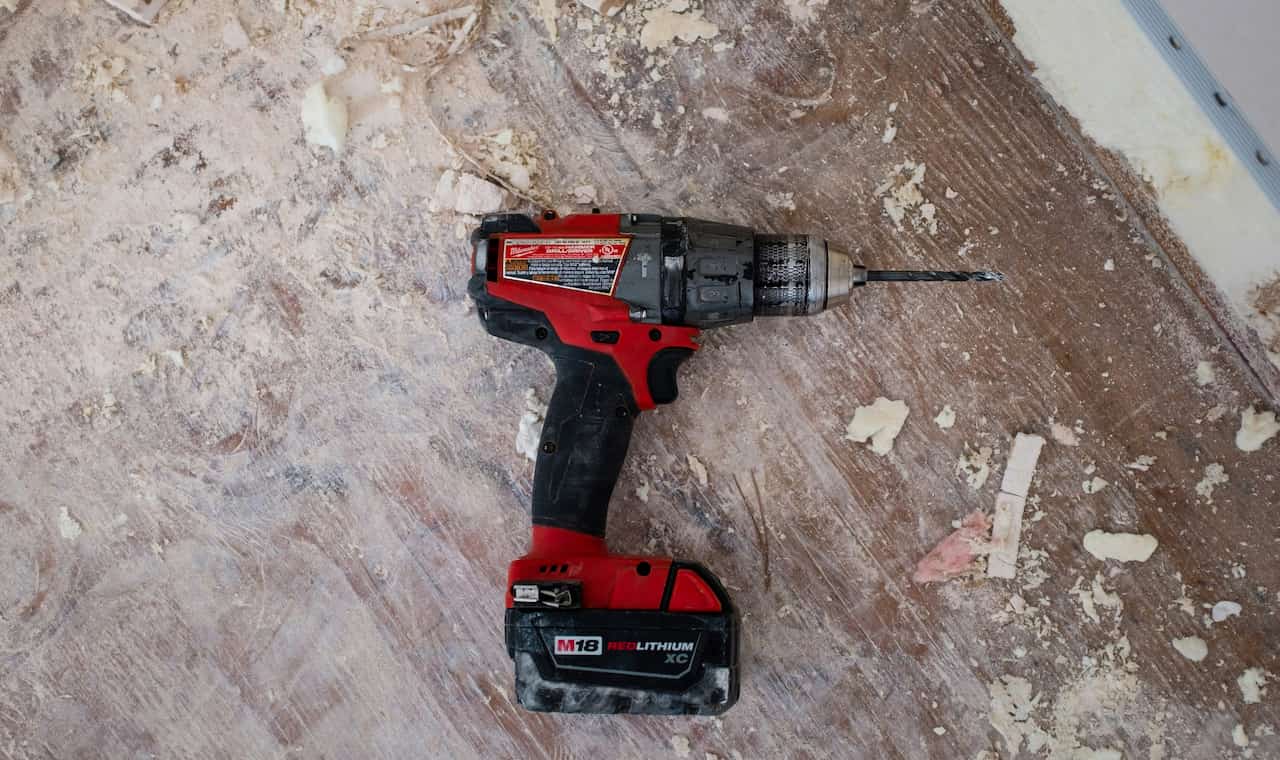
The Milwaukee M18 BLPD2 finishes narrowly second on the combined strength of its POWERSTATE motor consistency, 85Nm torque and market-leading 5-year motor warranty. For trade users who prioritise long-term tool reliability over headline power numbers, the Milwaukee’s combination of durable and well-sealed motor, deep M18 ecosystem and best-in-class warranty makes a compelling case that becomes progressively stronger the longer the tool is in daily service. The balanced 198mm body sits comfortably between the compact DHP484 and the full-size DCD999 in everyday use.
The primary limitation is battery cost for those new to the M18 platform – HIGH OUTPUT batteries to match the POWERSTATE motor’s capabilities represent a significant additional investment on top of the body price. For existing M18 users this consideration disappears entirely, and for that group the BLPD2 is arguably the most compelling choice in this comparison.
As an Amazon Associate I earn from qualifying purchases.
The Makita DHP484 earns third place through its compact 187mm body, excellent 21-position clutch and the depth of the LXT ecosystem. For users whose work involves overhead drilling, tight cabinet spaces or prolonged periods where weight and size affect working comfort and precision, the DHP484’s compact form factor is a meaningful and practical advantage over the larger Milwaukee and DeWalt. The LXT platform with 250+ compatible tools is the largest cordless ecosystem in this comparison – a significant factor for anyone planning a full cordless toolkit from a single platform. The 54Nm torque is the lowest of the four drills, but for the majority of residential and light trade tasks this is never a limiting factor in real use.
As an Amazon Associate I earn from qualifying purchases.
The Bosch GSB 18V-55 finishes fourth overall in a strong field but wins the value category outright at £110 body-only, and its 25-position clutch makes it the most precise screwdriving drill in this comparison – a clear lead ahead of all three rivals. For joiners, cabinet fitters and anyone doing high-volume precision screwdriving where driving screws to exactly the right depth repeatedly matters to the quality of the finished work, this is not a trivial advantage and places the Bosch ahead of significantly more expensive alternatives for that specific application. The LED ring light around the chuck provides the most effective work illumination in this test, casting light evenly around the bit contact point without shadow.
As an Amazon Associate I earn from qualifying purchases.
Head to head comparison
| Model | Max torque | Speeds | Clutch | Body length | Score |
|---|---|---|---|---|---|
| DeWalt DCD999 | 95 Nm | 3-speed | 15 | 209mm | 4.6 / 5 |
| Milwaukee M18 BLPD2 | 85 Nm | 2-speed | 20 | 198mm | 4.5 / 5 |
| Makita DHP484 | 54 Nm | 2-speed | 21 | 187mm | 4.3 / 5 |
| Bosch GSB 18V-55 | 55 Nm | 2-speed | 25 | 185mm | 4.2 / 5 |
What to look for when buying
Torque is the most discussed specification but rarely the most important factor for typical domestic use. All four drills reviewed here have more torque than the majority of UK DIY tasks require – driving screws, drilling pilot holes, fixing to masonry with standard fixings. Where torque genuinely matters is sustained heavy masonry, large-diameter holes in hardwood and repeated structural drilling. If these are your regular applications, prioritise the DCD999 or BLPD2 and don’t compromise on torque to save money. For cabinetry, joinery and mixed domestic DIY, any of the four will handle the work without difficulty and the extra torque of the premium options will rarely be called upon.
Battery ecosystem compatibility is frequently the most important factor in practice for anyone adding a drill to an existing tool kit. If you already own two or more tools from one battery platform, the financial case for staying in that ecosystem is strong and usually decisive. The body-only drill price is substantially lower than a kitted version, and additional batteries from the same brand are immediately usable across all existing tools without any additional investment. Switching platforms to get a marginally better spec means buying into a new battery system from scratch – a cost that in this category almost always outweighs any performance gain from switching brand.
The buying guide points below cover the four key specification differences that matter most when narrowing down the choice. Clutch positions, body size, motor warranty and battery premium all affect real-world usability in ways that headline torque figures alone do not capture and which matter differently depending on the type of work the drill will primarily be used for.
- Clutch positions matter for precision work. 25 positions (Bosch) gives finer control than 15 positions (DeWalt). For screwdriving-heavy work like cabinet fitting, this is a practical advantage that translates directly into fewer stripped screws and more consistent depth.
- Body size affects daily fatigue. The difference between 185mm and 209mm matters over a full day of overhead or confined-space work. If this describes your use case, weight the compact options (Makita, Bosch) more heavily than their torque figures alone suggest.
- Motor warranties vary significantly. Milwaukee’s 5-year registered motor warranty is market-leading. Standard warranties on most cordless tools are 3 years on the tool and less on the motor – Milwaukee’s commitment is a genuine differentiator for trade users calculating long-term cost of ownership.
- FLEXVOLT batteries add cost. The DeWalt DCD999’s headline 95Nm performance requires FLEXVOLT batteries, which are significantly more expensive than standard 20V MAX packs. On standard batteries the performance gap versus the Milwaukee narrows considerably and the DCD999’s price premium becomes harder to justify.
Final verdict and recommendations
For maximum trade power: DeWalt DCD999. The 95Nm torque, three-speed gearbox and FLEXVOLT Advantage are the class leaders and nothing else in this comparison touches them when paired with a FLEXVOLT battery. Budget for FLEXVOLT batteries to get the full performance benefit – on standard 20V MAX batteries the headline torque is not fully achieved.
For long-term trade reliability: Milwaukee M18 BLPD2. The POWERSTATE motor consistency, 5-year registered warranty and 85Nm torque make it the best choice for heavy daily use where tool longevity and sustained performance across years of hard trade use matters as much as peak output on day one.
For compact and lightweight use: Makita DHP484. The 187mm body, 21-position clutch and breadth of the LXT ecosystem make it the best compact brushless combi drill in this test for overhead work, tight spaces and applications where the weight of a full-size drill accumulates into fatigue over a long working day.
For screwdriving precision and value: Bosch GSB 18V-55. The 25-position clutch and £110 body-only price make it the strongest single choice for joinery, cabinet work and anyone whose priority is screwdriving control and overall value over raw drilling power. At this price point, matched against drills costing 60% more, it holds its own convincingly in precision-focused applications.
All four drills in this comparison are genuinely excellent – the ranking reflects differences in power output, body size and value rather than meaningful quality gaps between the brands. The DeWalt DCD999 leads on raw drilling capability; the Milwaukee M18 BLPD2 on long-term reliability and warranty commitment; the Makita DHP484 on compact everyday usability; and the Bosch GSB 18V-55 on screwdriving precision and accessible price. Choose based on your existing battery ecosystem first, then your specific primary use case, and you will not go wrong with any of the four.
As an Amazon Associate I earn from qualifying purchases. Prices correct at time of publishing.
Share on socials: