At a glance
The DeWalt DCD778 is the compact brushless drill driver in DeWalt’s 18V XR range – the drill driver only version sitting just below the DCD796 combi drill in the lineup. At 64Nm it produces the highest torque of any drill driver only model in our comparison series, giving it a meaningful edge over both the Bosch GSR 18V-55 at 55Nm and the Milwaukee M18 BLDD2 at 60Nm on demanding tasks. For buyers who already own a hammer drill or SDS and want the best possible dedicated drill driver to pair with it, the DCD778 makes a compelling case.
It is not, however, the right first drill for most UK homeowners. In a country where almost every internal wall is masonry, a drill without hammer function forces you to reach for a second tool every time you want to hang a shelf or fix a bracket. If that describes your situation, our best cordless drills UK guide recommends the DCD796 as the better starting point – it adds hammer capability for a modest premium and shares the same motor electronics as the DCD778, meaning timber and driving performance is identical between the two.
Overview and first impressions
The DCD778 shares its body and dimensions with the DCD796 – 180mm length, the same yellow and black XR livery, the same grip geometry and the same solid build quality throughout. The only meaningful external difference is the two-mode selector (drill and driver only, no hammer) versus the three-mode selector on the DCD796. At 1.5kg with a 2.0Ah battery it is fractionally lighter than the DCD796 due to the absence of the hammer mechanism, which makes itself felt during sustained overhead work.
Build quality is excellent throughout. The 13mm chuck runs true with no perceptible wobble, the 15-setting clutch clicks cleanly through its full range without any mushiness in the middle positions, and the LED work light illuminates the work area well without washing out in bright daylight. The grip angle feels natural across a wide range of task types and the forward/reverse switch sits in an easy thumb position on either side of the body. The belt clip is included as standard, which is a detail that budget alternatives often omit.
The variable speed trigger deserves particular mention. At low speeds it gives very precise control for starting screws in awkward positions without skating across the surface, and the two-speed gearbox means you can run slow and high-torque for driving or fast for drilling without losing that tactile feedback. First impressions are of a well-engineered tool that does exactly what it sets out to do.
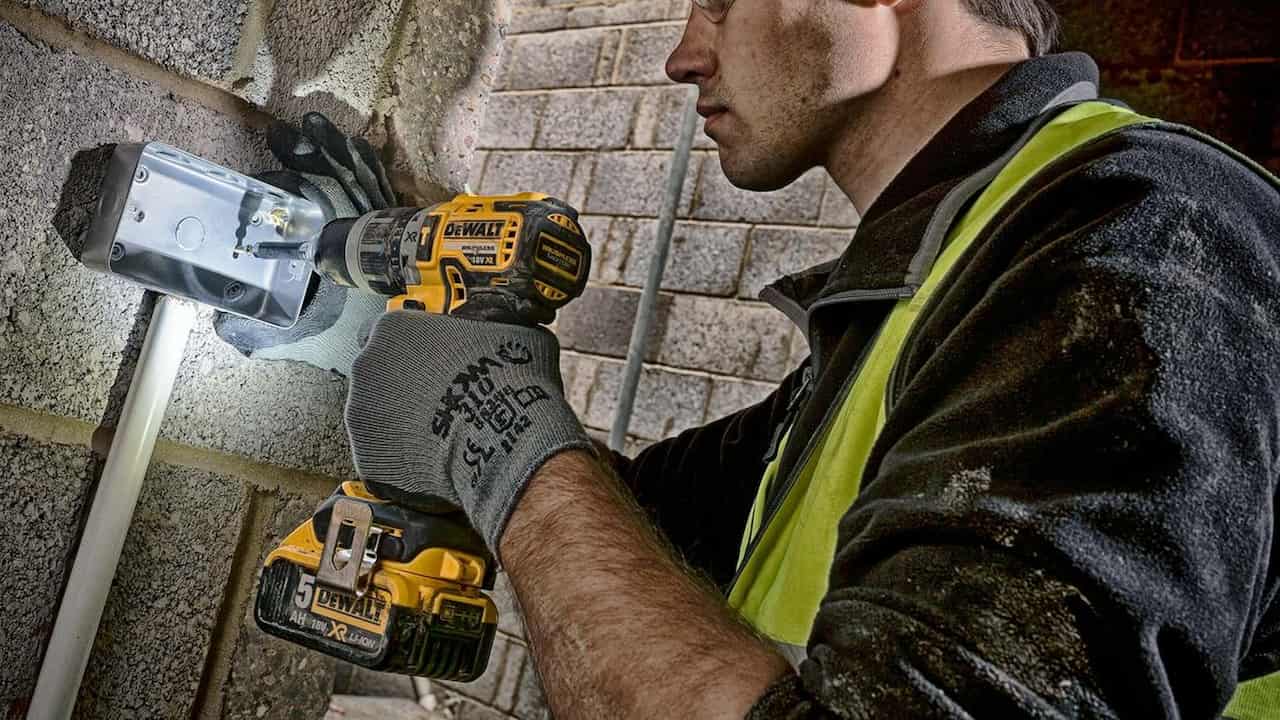
The DCD778 has no hammer function. For fixing to brick, block or concrete walls you will need either a separate SDS or hammer drill alongside it. In a UK home where masonry fixing is a routine task, this is a real limitation worth thinking through carefully before purchase. If there is any chance you will need to drill into walls regularly, the DCD796 removes that constraint at a modest premium.
Specifications and scores
How it performed in our tests
We tested the DCD778 across the same range of tasks used throughout our drill review series – driving screws of varying lengths into softwood and hardwood, drilling holes with twist bits and auger bits through timber, and general flat-pack assembly. The headline finding is consistent with what 64Nm suggests: this drill handles all of it confidently and without the hesitation that shows up in lower-torque alternatives under load.
In softwood the DCD778 drives 80mm screws to flush in a single smooth pass with no clutch engagement needed. In hardwood it works harder but never stalls, and the 15-position clutch gives enough range to protect both the screw head and the workpiece on delicate chipboard assembly. The 25mm auger test through 90mm structural timber completed cleanly without the motor temperature rising noticeably – a sign of a well-sized motor working within its comfortable range rather than at its ceiling.
The DCD778 and DCD796 share the same motor and electronics. In timber drilling and screw driving the two drills produce identical results – the DCD778 is not a reduced-performance version of the DCD796. The only practical difference is the absence of hammer mode. If you already own a separate SDS or hammer drill for masonry work, the DCD778 makes complete sense as a dedicated drill driver and saves the premium over the DCD796.
Battery system and runtime
The DCD778 runs on the DeWalt 18V XR platform, which is the most widely stocked cordless battery system in the UK. XR batteries are available at B&Q, Screwfix, Toolstation and Amazon as standard stock items – not something you need to order online and wait for. That matters in practice: if a battery fails mid-project, a replacement is usually 20 minutes away.
The brushless motor makes efficient use of battery charge. With a 2.0Ah battery the DCD778 handles a comfortable morning of mixed domestic tasks before needing a charge. With a 5.0Ah battery you can realistically work through a full day of screw driving and timber drilling without interruption. Charge times with the standard XR charger are approximately 30 minutes for a 2.0Ah pack and 60 minutes for a 5.0Ah, which is competitive across the class. The platform covers over 200 compatible tools, so any batteries you buy here work across the full DeWalt XR range including the DCD796 if you ever add it later.
Performance and limitations
The DCD778’s performance in timber is genuinely class-leading for a drill driver only model. At 64Nm it pulls ahead of both the Bosch GSR 18V-55 at 55Nm and the Milwaukee M18 BLDD2 at 60Nm in demanding applications, and that torque advantage shows on long screws into dense hardwood and large diameter auger work. The limitation is simply the absence of hammer function – and in a UK context that is a real-world constraint rather than a technical footnote.
For the right buyer – a joiner, cabinet maker, or homeowner who already has hammer drilling covered by an SDS or combi drill – the DCD778 is the natural choice in this price bracket. The 64Nm torque handles demanding timber work without complaint, the 1.5kg weight is noticeably easier to manage over extended use than heavier alternatives, and the DeWalt XR platform ensures batteries and chargers are always available close to hand.
- 64Nm – highest torque in the drill driver class
- Identical timber performance to the DCD796
- Excellent build quality and ergonomics
- DeWalt XR – most widely stocked UK platform
- Lower price than DCD796
- No hammer function – cannot drill masonry
- DCD796 is better value for most UK homeowners
- 3-year warranty vs Milwaukee’s 5 years
- Existing DeWalt XR owners adding a drill driver
- Those who already own a hammer drill or SDS
- Joinery and woodworking where masonry never needed
- Buyers wanting maximum timber torque at this price
- Most UK homeowners – buy the DCD796 instead
- Anyone who fixes shelves or fittings to masonry walls
- First-time buyers without an existing hammer drill
Final verdict – is it worth it?
The DeWalt DCD778 is a very good drill driver that is slightly overshadowed by the DCD796 for most UK buyers, but earns a clear recommendation in specific circumstances. If you already own an SDS or hammer drill for masonry and want the best dedicated drill driver money can buy at this price, the DCD778 delivers: 64Nm is the highest torque in the drill driver only class, the build quality is excellent throughout and the DeWalt XR platform is the most convenient battery ecosystem available in the UK.
Where the advice shifts is for anyone buying their first or only drill. The extra cost of the DCD796 buys you hammer function, and in a UK home that matters every time you want to fix something to a wall. The DCD778’s 64Nm advantage over the DCD796 in timber is real but modest in practice – the DCD796 is no slouch in wood, and the additional versatility of hammer mode is worth more to a typical homeowner than that torque margin. As with every tool purchase, the right answer depends entirely on what you already own and what you actually need to do.
The battery platform is worth one more mention in the context of the buying decision. If you already own any DeWalt XR tools – an impact driver, a circular saw, a random orbital sander – the DCD778 slots straight in with no additional battery investment required. For that buyer, the decision is simpler: it is the best dedicated drill driver on the XR platform, and the price saving over the DCD796 is a straightforward win when hammer drilling is already covered.
The strongest drill driver only option in our UK comparison. Excellent build, 64Nm torque and the full DeWalt XR platform behind it. The right choice if you already own a hammer drill – for everyone else, buy the DCD796 combi instead.
Share on socials: