At a glance
Put the DCS570N against a piece of 3/4-inch ply with a 5Ah battery and it cuts without drama or hesitation. That is where the review starts, because it is where the tool starts: doing the job. A joiner used it to trim oak doors. A builder tested it on LVL. The saw did not care what the material was. Fast, clean, confident cuts across timber, sheet goods, and engineered lumber alike.
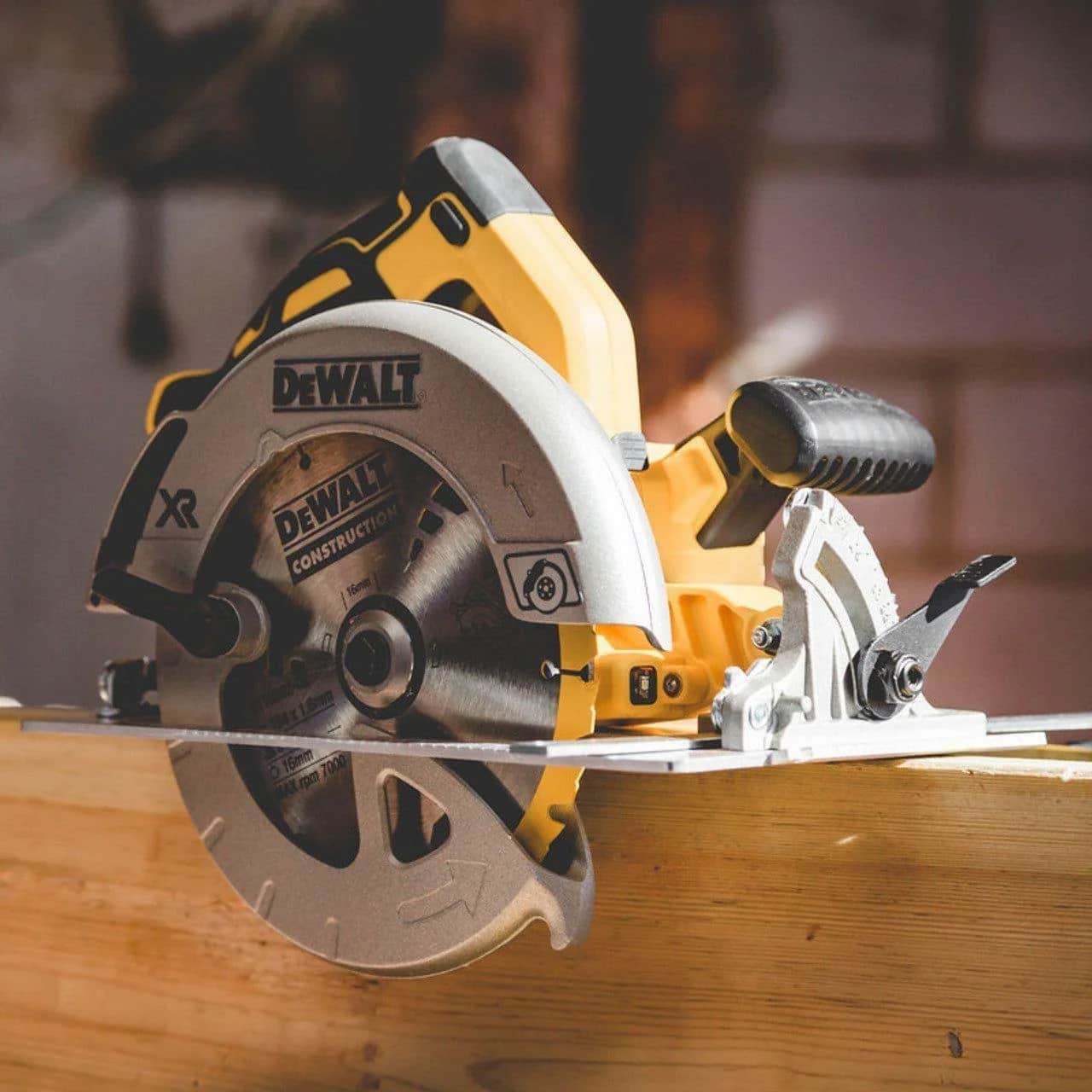
The DCS570N is DeWalt’s core 18V XR circular saw for full-depth cutting. It sits above the 165mm DCS565N and below the 54V FlexVolt DCS578N. The 184mm blade gives a maximum cutting depth of 64mm at 90 degrees and 42.1mm at 45 degrees, which covers standard UK construction timber and sheet goods without running out of capacity. It weighs 4.0kg body-only, heavier than the compact 165mm model but noticeably lighter than many large corded saws. Several UK users who came to it from old corded machines described it as lighter than expected. That perception depends on what you are comparing it to, but it is a fair observation for anyone replacing a heavy corded workhorse.
Overview and first impressions
The first impression on the tool is the build. The aluminium base plate is solid underfoot, slides cleanly across material, and does not flex under load. The overmold on the main grip sits comfortably in the hand with or without gloves. The front pommel handle is offset slightly to reduce wrist strain during long rip cuts. Lever adjustments for depth and bevel are firm and positive without being difficult to move. Nothing on this tool feels cheap or provisional.
Blade orientation is on the right, which puts the motor body between the operator and the cut line when working right-handed. Some users do not notice this and some do. One UK buyer specifically noted he would have preferred the opposite orientation. It does not impair function, but a left-blade saw would give a right-handed user a clearer natural sightline. The bevel scale on the foot is railed and indented, which means it remains readable even when coated with a film of sawdust. The sightline on the shoe was measured at 1/16 inch off on the big side during independent testing, meaning cuts land fractionally wider than the marked line. Worth noting if precision matters, easily compensated for once you know it.
The bevel adjustment runs to 57 degrees on the left and 48 degrees on the right, with positive detents at 22.5 and 45 degrees. Those detents are a genuine quality-of-life feature. Flipping to 45 degrees for an angled cut requires one motion: loosen the lever, push to the stop, tighten. No checking, no fiddling. For anyone making repeated bevel cuts, those stops save real time across a session.
Specifications and scores
How it performed in our tests
The electronic motor brake stops the blade within a fraction of a second of releasing the trigger. The speed of it is notable if you have only used saws with slower mechanical brakes. Plan cuts you will not need to stop partway through. The blade brake engages fully when the trigger releases, which means the blade is stationary in the kerf. Restarting with the blade wedged is difficult. The solution is to think a cut through before starting it, which is good practice regardless.
In independent testing, a ten-foot rip of 2×12 inch softwood took an average of 46 seconds. A crosscut of a six by twelve inch softwood header came in at 6.4 seconds. The saw passed through laminated veneer lumber without hesitation. LVL is dense, glued, layered material that many cordless saws struggle with at depth. This one did not struggle. In rough 2×6, plywood up to 3/4 inch, and pressure-treated timber at 45 degrees, performance was consistent. The bevel detents made the angle changes quick, the saw held speed, and the cuts came out clean.
Blade upgrade worth considering. The included 24-tooth blade handles framing and rough timber. Upgrade to a 40-tooth for cleaner cross-cuts in softwood, or a 48-tooth for plywood and OSB. The motor has the power for a high-tooth blade through dense material. The limiting variable is the blade, not the saw.
Battery system and runtime
DeWalt rates the DCS570N at approximately 100 cuts through 200mm by 50mm softwood with a 5.0Ah battery. Independent testing measured 242 linear feet of 3/4-inch plywood per charge, which sits below the class leaders at around 300 feet. The gap is real. For casual or intermittent cutting it makes no difference. For a full day on site, it matters. Use a 5Ah battery as the minimum, a 6Ah if you have one, and cycle two batteries with a fast charger on heavy days. A 2Ah battery will cause noticeable RPM sag under load in thick timber. Small batteries and demanding cuts do not sit well together.
The DCS570N accepts FlexVolt batteries at 18V, which opens access to larger capacity packs. It also sits within a 250-plus tool ecosystem, meaning every 18V XR battery in the toolkit works in this saw. UK buyers researching this tool will find extensive US reviews under the name DCS570 20V MAX: the two are the same saw sold under different voltage naming conventions used by DeWalt in different markets. For carpenters and joiners who are already committed to the DeWalt 18V XR platform, that interchangeability is the most compelling case for this saw over any competitor. The cutting performance is there regardless, but the ecosystem argument closes the decision for most.
Performance and limitations
The tool is sold body-only in the UK as the DCS570N-XJ, with no battery or charger included. It ships with a 24-tooth construction TCT blade, a blade wrench, a rip fence, and a dust extraction port. The blade wrench is stowed behind the battery slot, which means you cannot drop it without first removing the battery. A small detail that prevents the annoyance of a missing wrench at the wrong moment. The rip fence is included but many buyers do not know it comes in the box.
The dust extraction port uses DeWalt’s AirLock bayonet fitting, which locks the hose securely rather than relying on a friction fit. For site work in occupied buildings, or anywhere dust control matters under COSHH requirements, this is a practical reason to prefer DeWalt over systems with generic port connections. The integrated dust blower clears the cut line continuously even without an extractor attached, which keeps visibility good in dusty conditions. Both systems work together when an extractor is connected.
The aluminium blade guard is a cut-away design, meaning it lifts clear of the blade during cutting to give a direct view of the cut line, then covers the blade when the saw is set down. Aluminium rather than plastic means it takes the knocks of site work without cracking. The LED work light sits forward of the blade to illuminate the cut line without casting a shadow. None of these change the cutting numbers, but on a long day they accumulate.
Blade choice matters more on this saw than some users expect. The included 24-tooth blade is adequate for rough framing and construction timber but not for finish joinery or clean cuts in sheet goods. A 40-tooth blade lifts the quality of cross-cuts in softwood noticeably. A 48-tooth blade handles plywood and OSB cleanly. For hardwood or laminate, 60 teeth or more is the correct choice. The motor has enough power to drive a high-tooth blade through dense material; the blade is the variable, not the saw.
- Corded-equivalent cutting performance
- Bevel detents at 22.5° and 45°: fast, accurate angle changes
- AirLock dust extraction system for COSHH site compliance
- Aluminium base slides cleanly, no drag on material
- Battery life below class leaders (242 vs 300+ linear feet)
- No rafter hook
- Blade on right, sightline for right-handers slightly reduced
- Sightline 1/16 inch off on the big side
- Carpenters and joiners already on 18V XR
- Anyone replacing a corded circular saw on the XR platform
- Site workers needing AirLock dust extraction compliance
- New to DeWalt: body-only needs battery and charger separately
- Light occasional use: 165mm DCS565N is the better choice
- Anyone who needs maximum battery life in class
Final verdict
The DCS570N is not the answer for everyone. A user starting from scratch without a battery or charger is paying for a body that needs two additional purchases before it runs. The 165mm DCS565N is the better choice for lighter work, restricted access, or overhead cutting where weight and bulk matter more than depth capacity. For structural or heavy demolition work, the 54V FlexVolt DCS578N provides more headroom. The DCS570N sits in the middle: full-depth capacity, genuine corded performance, 18V XR platform. That combination serves most UK carpenters, joiners, and construction professionals who already have XR batteries, which is the majority of the market it is aimed at.
The DCS570N delivers corded-equivalent performance on the 18V XR platform. It is not the class leader on battery life, and it is heavier than some alternatives, but the cutting performance is genuine, the build quality is professional, and for anyone already on DeWalt 18V XR, the ecosystem case for this saw is hard to argue against.
Share on socials: