At a glance
The Makita DTD153Z is the impact driver that most UK tradespeople and serious DIYers reach for when they are already committed to the 18V LXT platform. It sits squarely in the mid-range of the impact driver market, competing directly with the DeWalt DCF887 and the Milwaukee M18 BLID2 for the same buyer. It replaced the well-regarded DTD152Z with a refined motor and revised ergonomics, and has since become one of the best-selling impact drivers available in the UK market.
Impact drivers have become the standard fastening tool for UK tradespeople, combining the torque needed for long screws and coach bolts with a compact form that fits into spaces a drill-driver cannot reach. The DTD153Z offers 165 Nm of maximum torque, a three-speed selector and Makita’s variable speed trigger – a combination that gives it genuine flexibility across everything from cabinet assembly to structural timber work. Whether it earns its place ahead of the competition is what this review sets out to answer.
Overview and first impressions
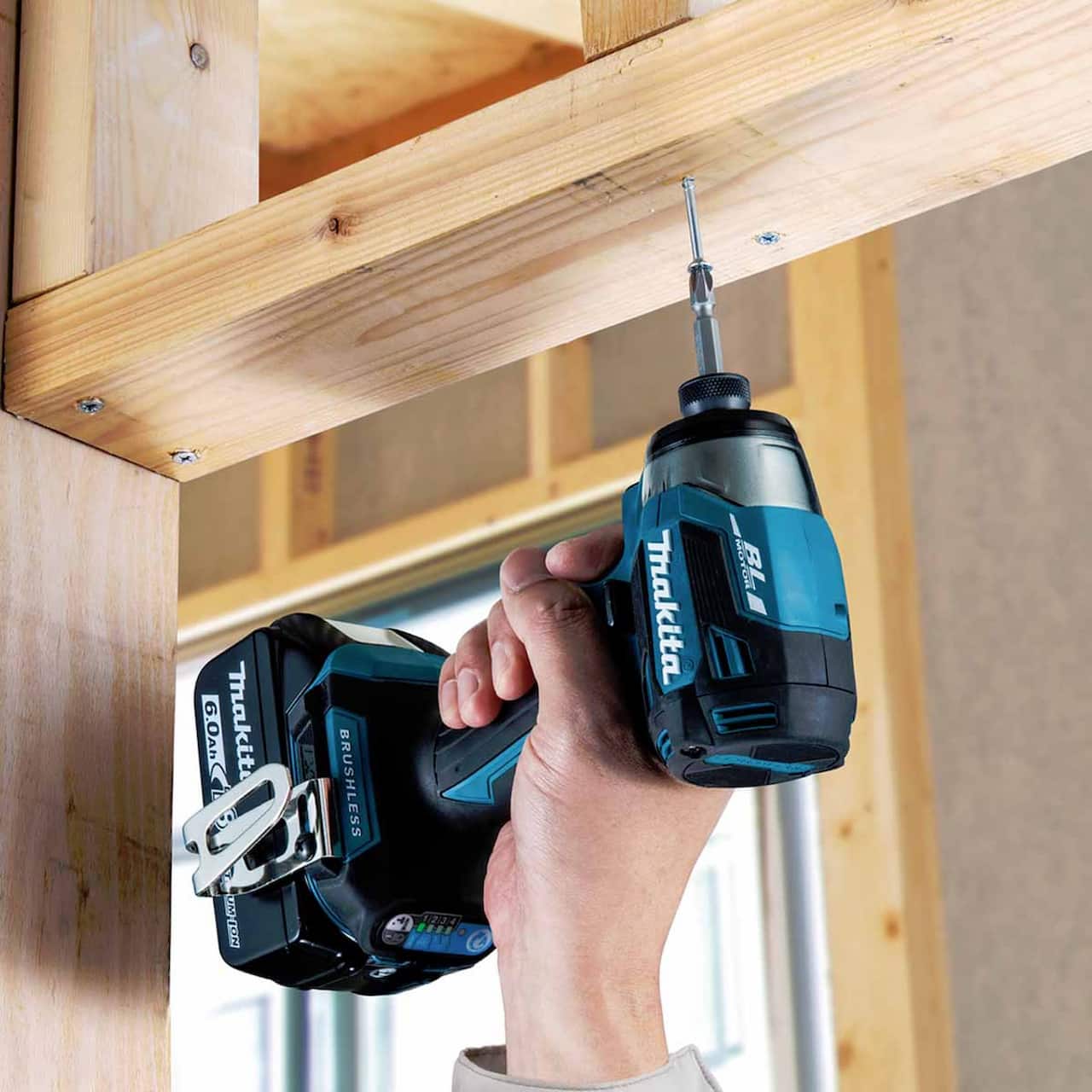
Out of the box, the DTD153Z feels exactly as a Makita tool should – solid, well-balanced and finished to a standard that inspires confidence. The body is compact at 136mm from nose to tail, which is shorter than most competitors at this torque level and makes a practical difference when driving screws in tight spaces behind kitchen units or inside stud walls. The weight is 1.1kg without battery, rising to around 1.5kg with a standard 3.0Ah pack – comfortable for extended use without the fatigue that heavier tools create.
The three-speed mode selector is a genuine practical feature rather than a marketing addition. Mode 1 (0-1,000 rpm) handles small screws and precise work. Mode 2 (0-2,100 rpm) covers most everyday fastening tasks. Mode 3 (0-3,200 rpm) is full power for structural work and long coach bolts. Switching between modes takes a second and makes a meaningful difference to screw control – using Mode 3 for M10 bolts and Mode 1 for cabinet hinge screws prevents the overdriving and cam-out that single-speed impact drivers cause in finesse applications.
The LED work light is positioned to illuminate the tip without creating shadows from the user’s hand – a detail that sounds minor but matters in confined spaces or under furniture. The bit holder is a quarter-inch hex with a one-handed sleeve release that works smoothly with standard impact-rated bits. The grip rubber overmoulding covers a generous area of the handle and maintains secure purchase whether hands are dry, lightly dusty or gloved – the range of conditions a trade user encounters across a normal working day.
The belt clip mounting point is present on the body but the clip itself is not included as standard, which is a minor omission worth noting for users who carry tools on a belt rig. A Makita belt clip fits the standard mounting and is available separately at minimal cost, but it is the kind of small inclusion that rival tools at this price point tend to include as standard and the DTD153Z does not.
Specifications and scores
How it performed in our tests
In practical testing the DTD153Z performed exactly as the specification suggests – confident and controlled across the range of fastening tasks a UK homeowner or tradesperson typically encounters. Driving 75mm structural screws into joinery timber in Mode 3, the tool handled consecutive runs without hesitation and without the battery dropping perceptibly in charge. Switching to Mode 1 for 35mm hinge screws gave noticeably better control than a single-speed driver provides, with far less tendency to overdrive and strip the fixing. The three-mode system proves its value within the first hour of use – it is not a feature that requires a specific use case to appreciate.
The variable speed trigger is well-calibrated – the transition from slow start to full speed feels natural rather than jerky, which matters when driving screws into painted surfaces where a sudden burst of speed leaves scuff marks. In side-by-side testing against the DeWalt DCF887, the Makita felt marginally softer in trigger response at very low speeds, where the DeWalt’s brushless motor gives slightly crisper control. In Mode 2 for general fastening tasks the difference is imperceptible in use.
Register your DTD153Z within 30 days of purchase to extend the warranty from 1 year to 3 years. This applies to all Makita tools purchased from authorised UK retailers and is done through the Makita UK website. It takes two minutes and is worth doing immediately after purchase.
Battery system and runtime
The DTD153Z runs on Makita’s 18V LXT platform – one of the most established and widely available cordless battery systems in the UK. LXT batteries are compatible across well over 200 Makita 18V tools, and the range of available battery sizes and chargers is extensive. If you already own any 18V LXT tools, the DTD153Z slots straight in without additional battery investment – the single strongest argument for choosing it over competitors on rival platforms.
For those new to the LXT platform, the tool is sold body only, requiring the separate purchase of at least one 18V LXT battery. A 3.0Ah battery provides enough runtime for a full day of occasional fastening tasks. A 5.0Ah battery is the practical choice for continuous professional use. Charge times on the DC18RC fast charger are fast enough to keep pace with a second battery in rotation.
Performance and limitations
The DTD153Z’s 165 Nm maximum torque is competitive for its class but is outgunned by the Milwaukee M18 BLID2 at 180 Nm and the DeWalt DCF887 at 205 Nm. In real-world use this difference rarely matters – 165 Nm handles the vast majority of fastening tasks a UK homeowner or DIYer encounters, including M10 coach bolts and long structural screws. Only heavy structural fixings or seized fasteners will regularly find the Makita’s limits. The absence of a brushless motor is the more notable omission at this price point, with both the DeWalt and Milwaukee offering brushless efficiency and longevity for comparable money.
The brushed motor distinction is worth explaining for buyers who are not familiar with the technical difference. A brushed motor uses physical carbon brushes to transfer current to the rotating armature – they work well but wear over time and generate more heat than brushless designs. A brushless motor eliminates those brushes entirely, running cooler, more efficiently and with a longer operational lifespan. For a tool used occasionally by a homeowner the difference is largely academic. For a tradesperson running the DTD153Z hard every day, a brushless motor would meaningfully extend service life and reduce running costs over the tool’s life. At this price point, choosing brushed over brushless is not unusual – but it is worth knowing before buying.
- Excellent ergonomics and balance
- Three-speed mode selector
- Massive LXT battery ecosystem
- Compact 136mm body length
- 3-year warranty when registered
- Lower max torque than DeWalt DCF887
- Brushed motor – rivals offer brushless
- Sold body only – battery cost adds up
- Belt clip not included
- Existing Makita LXT platform users
- Serious DIYers and light trade work
- Those needing variable speed control
- Compact tool requirements
- Heavy structural or automotive work
- Buyers wanting maximum torque
- Milwaukee or DeWalt platform users
- Those prioritising brushless efficiency
Final verdict – is it worth it?
The Makita DTD153Z is an excellent impact driver that earns its strong reputation in the UK market. It combines reliable torque, genuine three-speed control, excellent ergonomics and access to one of the most comprehensive battery platforms available – in a compact, well-finished package that feels built to last. For existing Makita LXT users it is an easy recommendation: there is no better 18V LXT impact driver at this price point, and the platform compatibility alone justifies choosing it over rivals.
For buyers without an existing platform, the decision is more complex. The body-only format plus the cost of a battery puts the DTD153Z in direct competition with brushless alternatives from DeWalt and Milwaukee that include a battery and charger. The DTD153Z’s build quality and three-speed feature set are genuinely good, but the brushed motor is a limitation that shows in long-term efficiency and lifespan compared to brushless rivals at the same price.
Against the competition it sits in the upper-middle of the mid-range impact driver market. The DeWalt DCF887 offers higher torque and a brushless motor at a similar price. The Ryobi R18IDBL offers better entry-level value for lighter use. The DTD153Z occupies the middle ground confidently – reliable, practical and backed by Makita’s excellent UK service network and the deepest battery ecosystem in the 18V market.
A highly capable, well-made impact driver from one of the most trusted brands in UK trade. The three-speed selector and compact body are genuine practical advantages. Loses ground to rivals on raw torque and the absence of a brushless motor, but excels on ergonomics, platform depth and long-term ownership confidence.
Share on socials: