At a glance
The Hive Active Heating System has been the UK’s best-selling smart thermostat for several years and for good reason. Backed by British Gas, compatible with virtually every UK gas boiler type and supported by one of the largest engineer networks in the country, it hits a sweet spot between capability, ease of use and after-sales support that its competitors have found difficult to match. For most UK homeowners making their first move into smart heating, Hive is the default recommendation – and having tested it extensively, it earns that position.
We tested the Hive Active Heating system on a combi boiler in a three-bedroom semi-detached property over six weeks, covering the full range of the app, the geolocation feature, scheduling and the in-home display. For those considering a full home energy overhaul, pairing Hive with a smart meter gives the most complete picture of your heating costs and consumption in real time.
Overview and first impressions
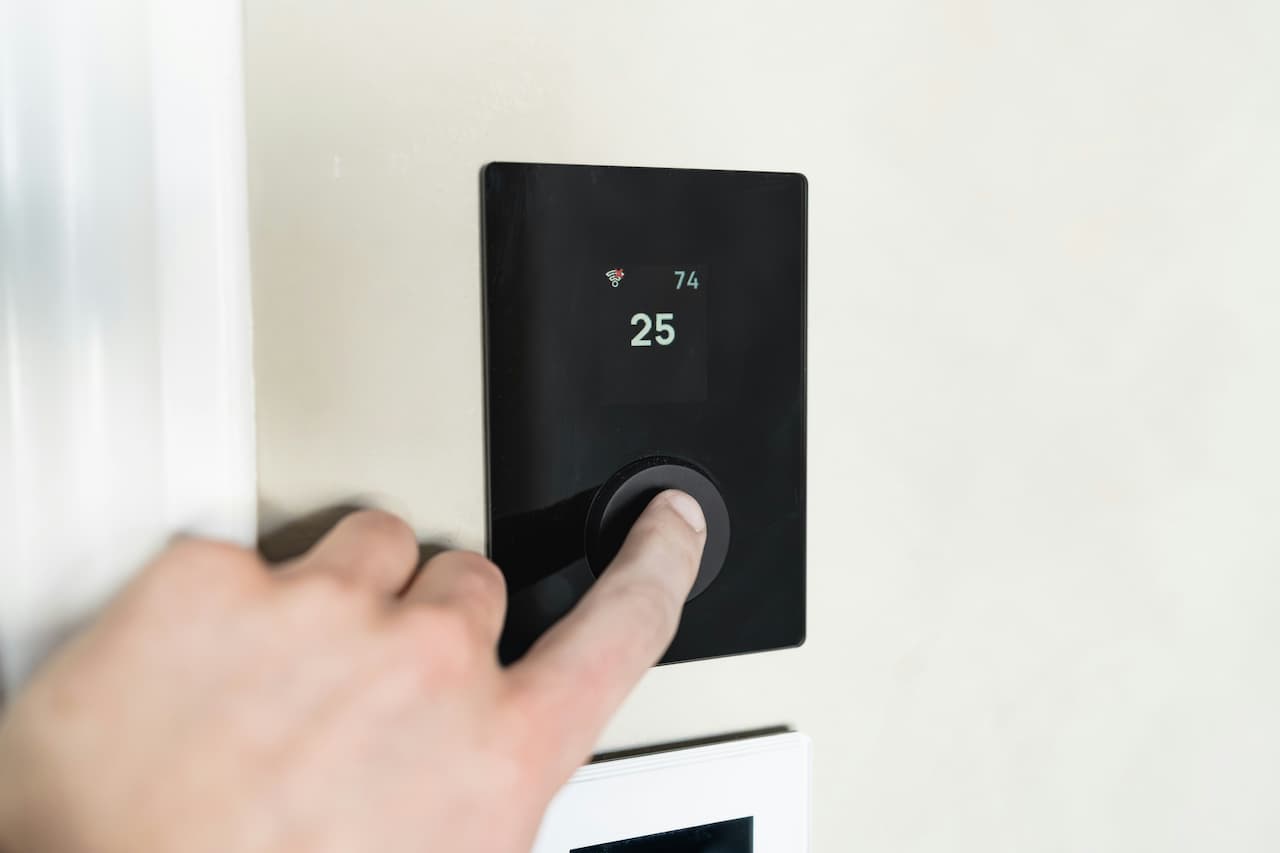
The Hive thermostat itself is a well-built, attractive device. The circular form factor with a clean display and a satisfying physical dial sits comfortably on the wall without looking out of place in a modern or traditional home. Build quality feels premium – there is no flex in the casing, the dial turns smoothly and the display is crisp and easy to read from across a room. The hub unit, which connects to your router and acts as the bridge between the thermostat and the Hive app, is small enough to tuck behind a router without taking up significant space.
Installation is the first test of any smart thermostat and Hive passes it well. The wiring is colour-coded and clearly labelled, the app walks you through the process step by step, and British Gas provides a professional installation option if self-install feels daunting. For a standard combi boiler with a conventional programmer, the self-install takes around 45 minutes and requires no specialist knowledge beyond basic comfort with removing a faceplate and connecting wires. The included wiring guide covers the most common UK boiler configurations clearly, and the Hive compatibility checker online identifies in advance whether your system needs any additional components before you start.
The system uses your home broadband via the hub rather than connecting directly to your WiFi network, which has a practical advantage – the thermostat continues to work as a standard programmable thermostat even if the internet connection drops, which is not always true of WiFi-direct smart thermostats.
Check compatibility before buying. While Hive works with the vast majority of UK gas boilers, some older or non-standard systems require an adapter or professional assessment before installation. Use the Hive compatibility checker at hivehome.com before purchasing if you have an unusual boiler setup.
Specifications and scores
How it performed in our tests
Over six weeks of testing, the Hive system performed reliably without a single dropout or connectivity failure. The app responded to commands within two to three seconds consistently – switching the heating on remotely while away from home, adjusting the target temperature and checking the current status all worked exactly as expected every time. This reliability matters more than almost any other metric for a smart thermostat – a system that fails to turn the heating on when you are on your way home in January is worse than no smart thermostat at all. The six-week test window spanned both mild and cold periods, giving a representative sample of real UK heating conditions.
The scheduling interface is intuitive. Setting a weekly schedule with different temperature targets for different time periods takes around ten minutes on first setup and requires no prior smart home experience. The Hive app displays the current temperature, target temperature and whether the heating is currently active or in standby on the home screen – all the information you need at a glance without digging into menus.
Enable geolocation for the biggest energy saving. The geolocation feature – which detects when everyone has left home and pauses the heating – is the single most impactful energy saving feature in the system. Set it up for every household member’s phone and you can expect a noticeable reduction in heating energy use without any manual intervention required.
App and remote control
The Hive app is one of the strongest aspects of the system. The interface is clean and well-organised with the most used functions – current temperature, target temperature and heating status – all on the home screen. The weekly schedule editor uses a visual timeline that makes it easy to see and adjust your heating programme at a glance. Unlike some smart home apps that bury the most useful functions in sub-menus, Hive has clearly prioritised the tasks users perform most often. Changing the target temperature, checking whether the heating is currently on, and boosting the heating for a set period are all achievable in two or three taps from the home screen.
Hive’s ecosystem extends beyond just heating – the same hub and app support Hive smart plugs, bulbs, sensors and cameras – making it a reasonable foundation for a broader smart home setup. Reducing your heating costs works hand-in-hand with other energy saving measures across the home, and the Hive app gives you a single control point for a growing range of devices if you choose to expand the system over time.
Connectivity and hub setup
The Hive system uses a dedicated hub rather than connecting the thermostat directly to your WiFi router. This is an important distinction from some competitors. The hub plugs into a spare port on your router and communicates with the thermostat using a Zigbee radio signal. In practical terms this means the thermostat has a robust, low-interference connection that does not compete with the WiFi traffic on your network – and it continues to run its programmed schedule even if your broadband drops entirely.
The hub itself is compact enough to sit behind most routers without taking up meaningful space. Setup involves connecting it to your router, downloading the Hive app, and following the in-app pairing sequence. On a standard home network this takes under ten minutes. The thermostat pairs to the hub automatically, and the app connects to the hub via the internet. The three-point chain – app to internet to hub to thermostat – sounds complex but in practice is completely transparent during normal use. During six weeks of testing the connection was seamless throughout, with no manual reconnection ever required.
Performance and limitations
The Hive system is not without its limitations. The lack of self-learning – where the thermostat builds a heating schedule automatically from your behaviour – means it requires manual setup compared to the Google Nest Learning Thermostat. For households with variable schedules who want the thermostat to adapt automatically, Nest has an advantage here. That said, many users find that setting a schedule once takes only ten minutes and then rarely needs revisiting, which reduces the practical impact of this limitation considerably.
The optional subscription for advanced features is a minor irritation. While the core smart thermostat functionality works fully without a subscription, some useful features – including the heating history analysis – are gated behind the Hive subscription plan at around £3 per month. This is worth factoring into the total cost of ownership comparison against competitors.
- Works with virtually all UK boiler types
- Excellent app – clean, fast and reliable
- Geolocation genuinely saves energy
- British Gas installer network and support
- Works without internet via schedule
- No self-learning capability
- Some features need subscription
- Requires hub – not WiFi direct
- Single zone only in standard config
- First-time smart thermostat buyers
- Households with regular routines
- Anyone wanting UK-based support
- Those wanting self-learning
- Multi-zone heating requirements
- Deep Google ecosystem users
Final verdict – is it worth it?
The Hive Active Heating System earns its position as the UK’s best-selling smart thermostat. It is not the most technically sophisticated option on the market – Google Nest’s self-learning and Drayton Wiser’s multi-zone capability are both more advanced in their respective areas – but Hive succeeds by being excellent at everything that matters most: reliable connectivity, a well-designed app, broad boiler compatibility and strong after-sales support.
The geolocation feature alone justifies a significant portion of the purchase price. In a household of two adults with consistent commuting patterns, the automatic heating adjustment can realistically save £50-100 per year without any manual intervention. Combined with better scheduling discipline that the app naturally encourages, the Hive system typically pays for itself within two to three heating seasons. It is also worth noting that the British Gas engineer network means that if anything does go wrong, getting a qualified person to look at the installation is considerably easier than with some niche smart thermostat brands that rely entirely on self-support.
If you are managing your home energy costs more broadly, combining Hive with good insulation – particularly cavity wall insulation if your property is suitable – delivers significantly better results than either measure alone. The thermostat controls when your home heats; the insulation controls how quickly it loses that heat. Together they address both sides of the equation and represent the most cost-effective combination of measures available to most UK homeowners. For existing British Gas customers the Hive installation option also offers a straightforward, low-hassle path to professional fitting with no additional research or sourcing required.
The Hive Active Heating System is the best all-round smart thermostat for UK homes in 2026. Reliable, well-supported and genuinely easy to use, it delivers meaningful energy savings through better scheduling and geolocation without requiring any technical expertise to set up or use. The go-to recommendation for anyone upgrading from a basic programmer.
Share on socials: