At a glance
Load the second battery and feel the weight. With two 5Ah LXT batteries in, the DHS782ZJ sits somewhere between 6 and 7 kilograms in your hand. If that weight is acceptable for the work you do, every other spec about the DHS782ZJ moves in your favour.
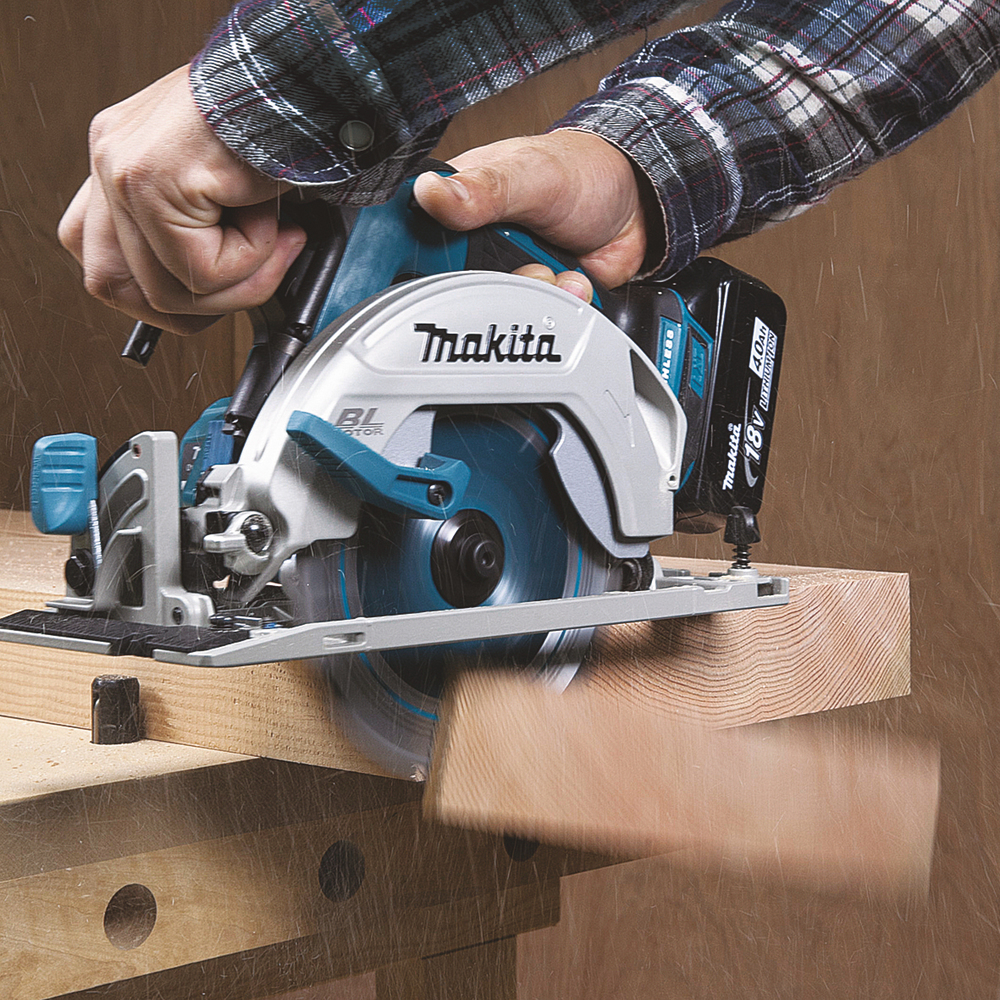
The DHS782ZJ is Makita’s 190mm cordless circular saw powered by two 18V LXT batteries running in series. Two batteries in series doubles the voltage: the saw runs at 36V. At 6,000rpm no-load and with a brushless motor designed to the full 36V specification, the DHS782ZJ makes Makita’s claim of corded-equivalent power directly. The 190mm blade cuts to 62.5mm at 90 degrees and 44.5mm at 45 degrees. The bevel runs to 48 degrees with a positive detent at 45. For a professional already invested in the Makita 18V LXT ecosystem, this saw does not start a new platform. It is the point at which two existing batteries become 36 volts of cordless power.
Overview and first impressions
The same batteries in your 18V LXT drill, combi, jigsaw, impact driver, or leaf blower are the batteries for this saw. Nothing changes. No new charger, no new battery format, no new ecosystem cost. You take two batteries that already exist in the toolkit, load them both into the DHS782ZJ, and the motor is running at 36V. For a professional with multiple 18V LXT batteries already, the cost of entry into the DHS782ZJ is the saw body only. That is a different calculation from buying into a separate 36V or 40V battery platform.
Makita’s ADT (Automatic Torque Drive Technology) operates across the 36V platform the same way it does on the 18V range: it adjusts both speed and torque in response to load. On an easy cut through softwood at 90 degrees, the motor runs well below maximum to conserve battery. When the blade hits resistance, a denser section, a deeper angle, or a knot, ADT detects the demand and increases both the speed and torque to hold the cut. The result is that neither battery wears down at the same rate as it would running flat-out on every cut. This matters more with two batteries, because the cycling regime becomes two batteries recovering in rotation rather than one constant drain.
Specifications and scores
How it performed in our tests
At 6,000rpm, the DHS782ZJ is running faster than any corded Makita 190mm saw. The corded HS7601J runs at 5,200rpm. The cordless twin-battery model runs at 6,000. Higher RPM on a 190mm blade means more tooth impact per second, which translates directly to faster through-cut times and less feed pressure required. In practice, you are not pushing this saw through timber the way you would push a slower-spinning motor through the same cut. The blade is removing material fast enough that the saw wants to move forward on its own. You steer it more than you force it.
The DHS782ZJ fits directly onto Makita guide rails without any adapter. No adapter means no additional purchase, no fitting time, no alignment check on the adapter itself before a precision cut. You put the saw on the rail and cut. On guide rail, the DHS782ZJ becomes a precision track-saw equivalent for sheet goods. The 190mm blade at 62.5mm depth, running on a Makita guide rail, cuts sheet material with the accuracy of a dedicated plunge saw on the same system. This is direct out of the box at no additional cost beyond the guide rail itself.
Battery system and runtime
The tool body alone, without the twin-battery housing attached, weighs 3.7kg. Attach the housing that carries both batteries and the body weight rises to 4.8 to 5.1kg before a single battery is installed. Add two 5Ah LXT batteries and the complete working configuration comes to approximately 6.3 to 6.6kg. That is only slightly lighter than a full-size corded 190mm saw, and heavier than any single-battery 18V cordless alternative. For overhead cutting or extended work on a ladder, the total weight accumulates over a session. For ground-level and bench work where the saw rests on the workpiece between cuts, the weight is less of a concern because you are not constantly carrying it. On a guide rail, the weight distributes differently still because the rail carries part of the load and you are guiding rather than supporting.
The twin-battery configuration sits at the back and top of the tool, behind the main handle. The mass is rearward, which keeps the nose of the saw lighter and gives it a front-light handling characteristic. Despite the total weight, the saw tracks forward without the nose-heavy tendency that causes fatigue on long rip cuts. You are guiding rather than fighting it.
Battery management changes with a twin-battery saw. A professional running the DHS782ZJ through a full working day needs to plan with four batteries rather than two: while one pair is in the saw, the second pair is on a dual-port charger. The Makita DC18RD twin-port charger handles two batteries simultaneously, which makes the cycling workable. When one pair runs low, swap immediately and put the spent pair on to charge. The cycle works cleanly if the battery rotation is maintained. Where it breaks down is if charging infrastructure is insufficient for the number of saws running simultaneously, since each saw now draws from two charger slots instead of one.
Performance and limitations
If the motor is being driven beyond its operating envelope, a warning lamp illuminates before damage occurs. On dense hardwood near maximum cut depth, or pushing feed rate aggressively through wide rip cuts, the lamp activates as an early warning. Stop, complete the current pass, allow 30 to 60 seconds of free-run or cooling, and the next cut proceeds normally. This is not a flaw in the saw. It is the tool communicating what it is experiencing, which is better than a tool that silently overheats and fails.
Both the base plate and the blade guard are die-cast magnesium. On saws where only the base is magnesium and the guard is aluminium or plastic, the guard is typically the component that cracks when the saw is set down hard or clips a surface edge. A magnesium guard survives site abuse without deforming. The base plate slides cleanly on workpiece surfaces and provides the dimensional stability needed for precision cut depth adjustment from 0 to 62.5mm. XPT protection seals the motor and electronics against dust and water ingress that accumulates in real site conditions. This is not waterproofing, but it extends the working life of the motor significantly in dusty or damp environments.
Twin LED lights illuminate the cutting area with pre-glow (activating when the trigger safety is pressed, before the motor starts) and afterglow (brief illumination after the trigger releases). The pre-glow function means you confirm the blade is aligned with the cut line before any movement, which is the correct order of operations on precision work.
The soft start function brings the motor to full speed gradually rather than at full torque from rest. On cut initiation, this prevents the saw from grabbing or pulling sideways at the start of the kerf, which is the moment when blade alignment is most likely to drift from the marked line. Combined with the spindle lock for one-wrench blade changes, these are the details that accumulate into a saw that is professionally configured rather than speced to a retail price.
The DHS782ZJ comes with a Makpac Type 4 carry case. The saw is sold body-only without battery or charger, so the case is a practical inclusion for storage and transport. The Makpac system is Makita’s stackable connector case format. Type 4 is the largest and fits the full-size saw body. For professionals who transport tools in Makpac stacks, the DHS782ZJ integrates into that system on day one. The case is not a selling point in isolation, but for anyone already running multiple Makpac cases it removes a storage and transport decision immediately.
The 190mm blade bore is 30mm, with a 20mm adapter ring for compatibility with 20mm bore blades. The 30mm bore is the European standard for professional 190mm circular saw blades, which means the full range of professional thin-kerf and specialist blades is available for this saw directly, without adapters. The included 24-tooth TCT blade handles construction timber and general site work. An upgrade to a 40-tooth blade improves the finish on softwood crosscuts noticeably, and a 48-tooth or higher blade handles plywood and sheet goods with minimal tear-out. Anyone already running a corded 190mm Makita on site has a blade library that transfers without any adapter or modification.
At 93 dB(A) sound pressure and 104 dB(A) sound power, the DHS782ZJ is genuinely loud. Above 85 dB(A) sustained, hearing protection is required by UK workplace regulations. At 93 dB(A), this is not a saw you use without ear defenders regardless of how long the session is. The sound power figure of 104 dB(A) is the total acoustic power the tool radiates, which matters for enclosed indoor spaces where sound bounces and builds. Both hearing protection and a well-ventilated workspace are practical requirements, not optional precautions.
On a guide rail with sheet goods at 62.5mm, the DHS782ZJ takes one pass. The cut line is exact, the pressure required to push the saw forward is low, and the 6,000rpm blade exits the kerf leaving a clean edge. This is the work that the DHS782ZJ was built for, and it does it without the cable management of a corded saw and without the battery limitations of a single 18V pack. For site professionals who cut sheet goods on a rail as a daily part of the job, removing the cable is the practical reason to step up to this saw over the corded alternative. You move the rail, load the panel, and cut. No extension lead to chase across the site, no cable to keep clear of the blade.
- 36V from existing LXT batteries: no new system or charger
- Direct guide rail fit: no adaptor required
- Magnesium base plate AND blade guard
- XPT dust and water protection
- Makpac Type 4 carry case included
- 6.3-6.6kg in working configuration: heavy for overhead work
- Requires two batteries simultaneously to operate
- Body only: no battery, charger, or blade included
- 93 dB(A): hearing protection mandatory
- Makita 18V LXT professionals needing 36V power
- Contractors using guide rails regularly on site
- Anyone replacing a corded 190mm saw with cordless
- Users with only one 18V LXT battery
- Overhead or confined access work
- Finish carpenters needing a lighter precision saw
Final verdict
Who it is not for: anyone primarily doing overhead or ladder work where 6-plus kilograms on the end of one arm becomes a problem after an hour. Anyone who owns only one 18V LXT battery (the saw requires two to run). Finish carpenters and furniture makers where fine joinery and lighter handling matter more than raw depth and power. Anyone without an existing LXT ecosystem who would be starting from scratch with body, two batteries, and a charger, at a significant combined cost.
Who it is for: Makita 18V LXT professionals who already have the batteries and need a cordless 190mm saw capable of replacing a corded machine on site. Contractors who work regularly on guide rails and need direct compatibility without adapters. Anyone cutting demanding structural material in volume where 36V power is the difference between one pass and two. The DHS782ZJ is not the saw for everyone. For the professional it is aimed at, it is a substantial and capable tool.
The DHS782ZJ is built for Makita LXT professionals who have run out of what 18V can do and need the next step without changing their battery system. The 36V power from two existing batteries, direct guide rail compatibility, and full magnesium construction give it the professional specification the platform promises. The weight in use, over 6kg with two batteries loaded, is the genuine trade-off. For site cutting on a guide rail, that weight is carried by the rail. For sustained overhead work, it is not.
Share on socials: