At a glance
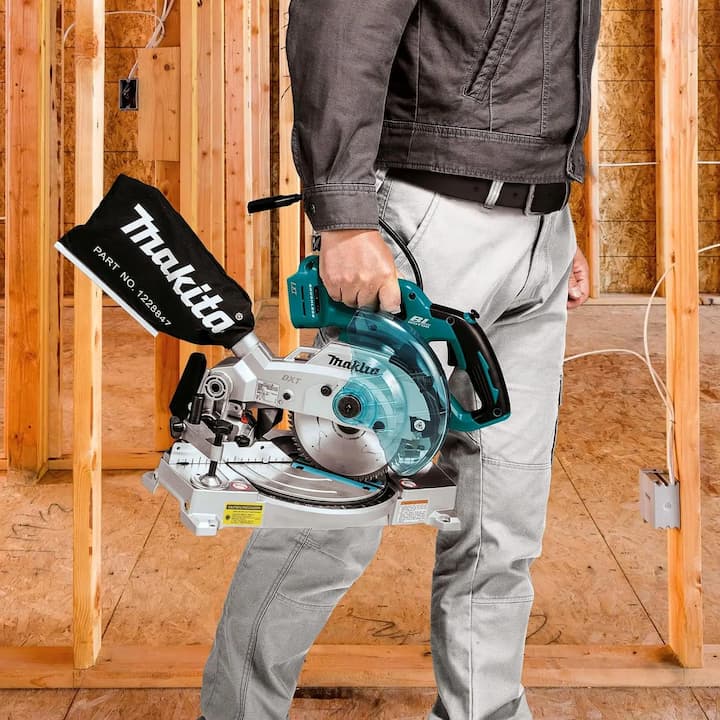
Cut a run of skirting one handed, carried the whole saw upstairs with the other, and that’s really the point of the Makita DLS600Z. No sliding rail at all. The head only drops straight down rather than pulling forward first, and that single decision is what makes the rest of the saw possible. Every bigger cordless mitre saw in Makita’s range carries a sliding mechanism, extra rails, extra weight. This one gives that up entirely, and in exchange gets a blade small enough and a mechanism simple enough to run on a single battery at around six and a half kilos rather than the double digit weight of its sliding siblings.
A 165mm blade sounds small next to the 190mm and bigger blades on other saws in this range, and the capacity numbers on paper back that up. What isn’t obvious from a spec sheet is a 3 stage gear reduction system doing real work, stepping the motor’s output down through three stages rather than one to squeeze genuine cutting capacity out of a blade this size rather than relying on a bigger blade to do the job by brute force. That’s why this saw punches above its blade size instead of feeling underpowered the way a smaller blade alone might suggest.
Overview and first impressions
A genuine double bevel, 46 degrees left and right, is more than most saws this compact offer, and it solves a specific problem: double mitres on skirting or coving that would otherwise mean flipping the workpiece over and cutting from the other side, hoping the two cuts line up. With bevel available both ways, that flip disappears. Most compact saws in this bracket only tilt one way and treat the other side as an afterthought. This one doesn’t.
Specifications and scores
Blade diameter 165mm, bore 20mm, a 64 tooth standard blade for general timber. No load speed 5,000rpm with Automatic Torque Drive, shifting the motor’s speed and torque automatically to match what the material is asking for rather than running one fixed setting regardless of load. Cutting capacity 92 x 46mm square, dropping to 65 x 46mm at a 45 degree mitre. Mitre range 52 degrees left and right, with positive stops at 0, 15, 22.5, 31.6 and 45 degrees rather than a smooth unmarked scale, so the angles used most often lock in firmly. Noise runs to 90dB(A) sound pressure and 97dB(A) sound power, with vibration rated at 2.5 metres per second squared, low enough that longer sessions don’t become fatiguing. Net weight sits around 6.3 to 6.6kg depending on the battery fitted, light enough to carry one handed. Standard equipment covers the blade itself, a dust bag, two hex wrenches, a triangular rule, a vertical vice and a sub fence for extra support on vertical or left bevel cuts. A separate aluminium blade with a negative rake angle exists for anyone cutting trim in mixed materials, worth having since the standard wood blade can grab and bind rather than cutting cleanly through aluminium. Soft start, an electric brake, a two stage safety switch against accidental starts, and a spindle lock for straightforward blade changes round out the build. There’s a trench cutting facility too, a depth stop that lets the blade be locked at a set height short of full depth for grooving or rebating work, plunged in and locked the same way a router’s depth stop works rather than cutting all the way through.
How it performed in our tests
No sliding function at all is the real ceiling on this saw, not the 165mm blade by itself. Anything wider than the stated capacity has to be turned over and finished from the other side rather than sliding the head forward to reach across it. That’s a genuine limitation for anyone expecting to cut wide boards. It’s also exactly the trade that makes the saw this light and this compact in the first place, and for skirting, architrave, coving and general trim work, the capacity is more than enough. Whether this saw disappoints comes down almost entirely to what someone expected before buying it. Wanted a compact trim saw, this delivers. Expected a small saw that does everything a bigger saw does, that was never what this was built for.
The laser is a Class 2M unit, factory calibrated, which matters because the line is set once at the factory rather than needing checking or adjusting once it arrives, unlike some laser guides that drift and need realigning over time. Paired with an LED work light on its own separate switch for lighting the cut area in poor light, this is two genuinely different tools doing two different jobs, one for marking the line, one for seeing the workpiece, rather than one feature doing both badly.
Check the depth stop before starting a trench cut. Plunge to the required depth first and lock the stop there, the same way a router’s depth stop works, rather than expecting a marked scale to set it for you.
Battery system and runtime
This saw runs on the standard 18V LXT range, but the largest capacity packs, the BL1890 and BL18120 slide batteries, don’t physically fit the battery port on this specific compact saw. Anyone already invested in Makita’s biggest batteries for other tools needs a smaller pack, up to 6Ah, specifically for this one rather than assuming every LXT battery in the toolbox will drop straight on. Worth checking before ordering rather than discovering it on delivery day.
Performance and limitations
A dust bag comes standard and does the basic job, but the more useful thing to know is what actually happens trying to do better than a bag on a cordless mitre saw this size. There’s no genuinely good compact cordless dust extractor that pairs well with a saw like this. Decent proper extraction means either a mains unit, which defeats the point of going cordless in the first place, or a serious cordless extractor running into hundreds of pounds. Bluetooth activated extractors exist and solve the problem of the two not being wired together, but they rely on remembering to switch the extractor on before starting the cut, exactly the kind of thing that gets forgotten halfway through a job. The dust port itself is a standard size and connects to an ordinary shop vac without needing anything Makita branded, which is the more realistic option for most buyers than a purpose bought cordless extractor.
- Light enough to carry one handed
- Double bevel both ways avoids workpiece flipping
- Factory calibrated laser needs no adjustment
- Runs on the standard Makita LXT battery pool
- No sliding rail, wide boards need turning
- Largest LXT batteries do not physically fit
- Decent cordless dust extraction is still limited
- Batteries and charger sold separately from the bare unit
- Skirting, architrave and general trim work
- Anyone wanting a saw light enough to carry one handed
- Double mitres where a flip and re-cut is a hassle
- Anyone already on the Makita LXT platform
- Regularly cutting wide boards
- Anyone wanting to reuse their biggest LXT batteries
- Anyone expecting a small saw to do a big saw’s job
- Wanting a proper cordless extraction setup out of the box
Final verdict: is it worth it?
Weighed against what it gives up to stay this light and this simple, the trade holds up. No sliding rail means wider boards need turning and cutting twice, worth knowing before assuming it will handle everything a bigger saw would. The double bevel earns its place, saving a workpiece flip on every double mitre. Dust collection through a bag alone is the usual compromise every saw this size makes, and a standard shop vac closes that gap better than a dedicated cordless extractor would right now. For skirting, architrave and trim work, carried around a job one handed rather than lugged in two trips, this earns its place.
A genuinely light, one handed mitre saw that earns its place doing skirting and trim, on the clear understanding it is not built to replace a full size sliding saw.
Share on socials: