At a glance
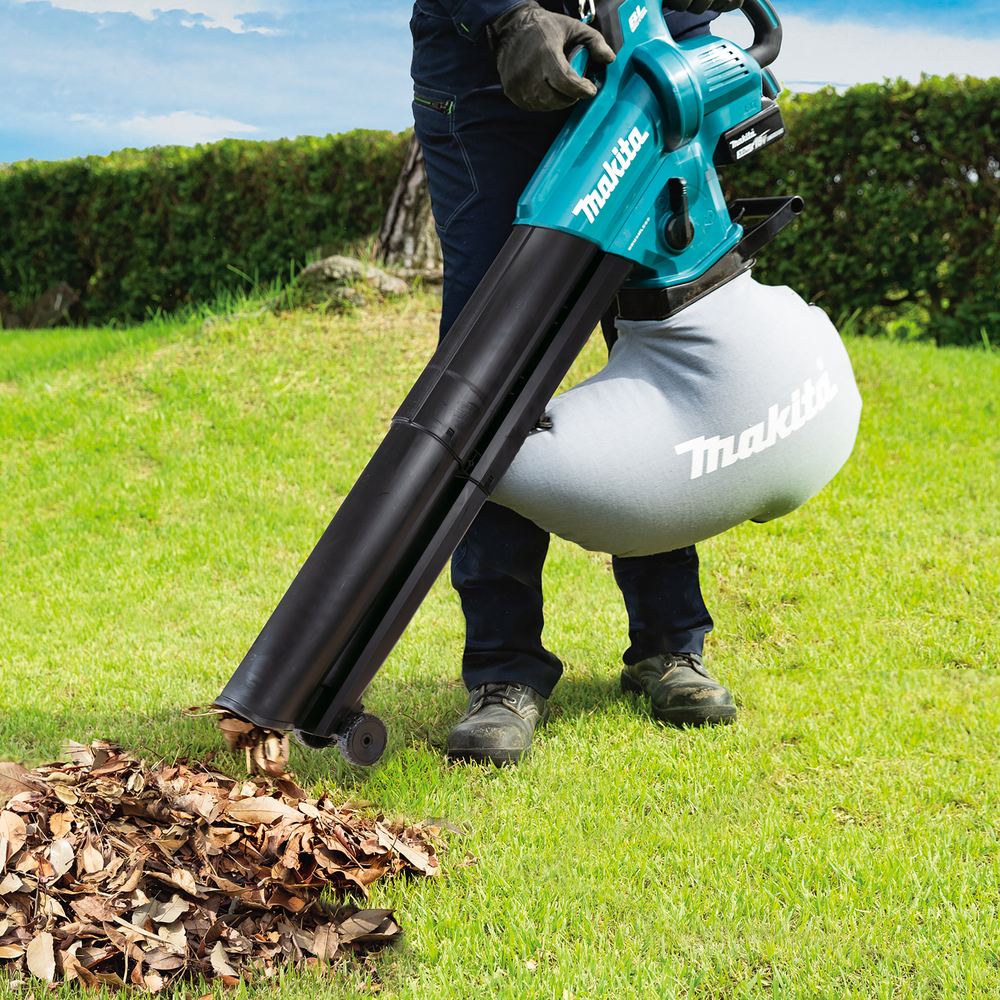
The Makita DUB187Z occupies the premium end of the cordless leaf blower market in the UK. It uses Makita’s dual 18V LXT battery system – two standard 18V batteries working together to deliver 36V equivalent power – which makes it compatible with the enormous Makita LXT battery platform that many tradespeople and serious gardeners already own. The body-only pricing reflects this flexibility but means factoring in battery costs if you are not already in the Makita ecosystem.
What you get for that investment is the most powerful cordless leaf blower in our test group. We tested the DUB187Z over a full autumn season alongside its main competitors to find out whether that power advantage translates into meaningfully better results in a real UK garden. Read our best cordless leaf blowers UK comparison for the full five-way ranking.
Overview and first impressions
The Makita DUB187Z makes an immediate impression of quality. The build is professional-grade – this is a tool designed for tradespeople and serious gardeners, not casual domestic use – and the materials and finish reflect that. The two battery slots accept standard 18V LXT batteries with a reassuring click and the dual battery indicator gives a clear read on remaining charge during use.
The weight is the most significant practical consideration. At 2.9kg body-only the DUB187Z is relatively light, but with two 5Ah batteries fitted it reaches 5.2kg – the heaviest in our test group. After 20-25 minutes of continuous use this weight becomes noticeable. For most UK gardeners clearing leaves in sessions rather than marathon runs this is manageable, but it is worth being aware of before buying.
The dual battery configuration is more intuitive than it sounds. Both batteries load into clearly labelled slots with positive engagement clicks, and the two charge indicators sit side by side on the tool body giving an at-a-glance read of combined remaining capacity. Swapping from body-only to a fully powered blower takes under thirty seconds once you have the batteries to hand – and for any Makita LXT user with a standard drill and impact driver battery set, those batteries are already compatible.
The three-speed settings plus variable trigger give an excellent range of control – from a gentle low speed for precision work around borders to full power for tackling heavy accumulations. The flat nozzle design is well thought out and very effective for directing airflow precisely into corners. Anyone moving across from the Ryobi RY36BLX50A will notice the step up in power and build quality immediately.
The DUB187Z is sold body only in most UK listings. Two 18V LXT batteries are required and not included. If you do not already own Makita 18V LXT batteries, factor the cost of a pair of 5Ah batteries into your total comparison against alternatives that include batteries in the box. For existing Makita LXT owners this is a non-issue – your existing batteries are fully compatible.
Specifications and scores
How it performed in our tests
We tested the DUB187Z across seven scenarios designed to replicate the full range of conditions a UK leaf blower faces in autumn. Its performance advantage over the rest of the group is most apparent in exactly the conditions that define a UK autumn – wet leaves, damp mornings and the packed-down accumulations that build up against walls, fences and in corners.
On speed setting 3 the DUB187Z clears damp compacted leaves in a single pass where the Ryobi and Bosch equivalents needed two or three sweeps. The 763 m³/h air volume figure translates into a noticeably wider clearing width with each sweep. On open paving and lawns with dry leaves the performance advantage over mid-range alternatives narrows considerably – at speed setting 2 it is quieter and more controllable whilst still outperforming the competition.
The flat nozzle design is one of the best implementations of this format we tested. It produces a wide, low airstream that gets underneath compacted leaf layers rather than pushing over the top of them – the difference in how it moves accumulated leaves is immediately apparent versus a rounded nozzle blower. At low speed the control it provides around borders and gravel areas without disturbing substrate is genuinely superior to anything else in this test.
Use speed setting 2 for most UK garden tasks. The DUB187Z’s full power on speed 3 is genuinely impressive but rarely necessary for everyday leaf clearance. Speed setting 2 handles most dry and slightly damp leaves efficiently, runs quieter and extends battery life noticeably. Save speed 3 for heavy accumulations of wet leaves where you need the reserve.
Battery system and runtime
The dual 18V LXT system is both the DUB187Z’s greatest strength and its main practical complication. Two batteries means more weight but it also means access to the widest battery ecosystem in the cordless tool market. Every Makita LXT tool shares the same batteries – a significant practical advantage for anyone who uses Makita tools regularly across garden maintenance and workshop tasks.
Runtime with two 5Ah batteries is approximately 38-42 minutes in mixed use – a full autumn session for most medium UK gardens. With two 3Ah batteries the runtime drops to 22-25 minutes, which is still sufficient for smaller gardens and saves considerable weight in use. The cold weather tolerance of Makita LXT batteries is above average, maintaining consistent performance in the damp morning conditions that are common during peak autumn leaf clearance season.
Performance and limitations
The Makita’s performance profile excels precisely where mid-range alternatives struggle. Damp compacted leaves, tight corners, heavy late-season accumulations – these are where the additional power is most apparent and most valuable. For a large garden with substantial deciduous tree coverage and heavy autumn leaf fall, the performance advantage justifies the cost difference over the Ryobi or Bosch alternatives.
The weight is the clearest limitation in practical use. At 5.2kg with two 5Ah batteries, this is a noticeably heavier tool than any rival in this test. After 25-30 minutes of one-handed use the arm fatigue is real – the shoulder strap option becomes relevant rather than optional for sustained sessions. For shorter clearing tasks the weight is less of an issue, but gardeners who make multiple passes through large gardens will feel the difference by the end of a session.
- Most powerful cordless leaf blower in our UK test group
- Handles wet and compacted leaves better than any rival tested
- 3 speed settings plus variable trigger – excellent control range
- Compatible with entire Makita 18V LXT battery platform
- Professional-grade build quality
- Flat nozzle design excellent for corners and precision work
- Sold body only – batteries are an additional cost
- 5.2kg with two 5Ah batteries – heaviest in our test group
- Most expensive option when batteries are factored in
- Dual battery system adds complexity for occasional users
- Overkill for small UK gardens where mid-range options are sufficient
- Existing Makita LXT tool owners with compatible batteries
- Large garden owners with heavy annual leaf fall
- Anyone regularly dealing with wet and compacted leaf accumulations
- Those who value build quality and longevity over initial cost
- Small garden owners who don’t need maximum power
- Budget-conscious buyers – mid-range alternatives offer good value
- Those who find heavier tools difficult to manage
- Anyone not in the Makita LXT ecosystem without other Makita tools
Final verdict – is it worth it?
The Makita DUB187Z is the most capable cordless leaf blower we tested and earns its premium position with genuine performance advantages that are most apparent in the wet and challenging conditions that define a UK autumn. The body-only pricing is the main practical complication – for existing Makita LXT owners it is an easy recommendation, for everyone else the total outlay with batteries needs to be weighed against the performance benefit.
For a large garden with heavy leaf fall and a pre-existing Makita tool collection, the DUB187Z is the clear choice. For smaller gardens or those without existing Makita batteries, the EGO LB5804E offers comparable performance with a battery included in the price and a simpler single-battery setup.
The honest summary is this: if you already own Makita LXT tools, add this to your collection without hesitation. If you are starting from scratch, factor the full battery cost in and compare the total against the EGO before committing. The performance difference between the two is most apparent on heavy wet leaves and large mature trees – for a typical medium suburban garden the gap narrows considerably.
The Makita DUB187Z is the most powerful cordless leaf blower in our test and the right choice for anyone already in the Makita LXT ecosystem or with a large garden and serious seasonal leaf clearance requirements. Build quality is excellent, performance is class-leading in wet conditions, and the three-speed control system gives versatility that cheaper alternatives cannot match. For the right buyer, the premium is fully justified.
Share on socials: