At a glance
Most pressure washers leave their hose lying about somewhere, coiled over a hook or trailing across the shed floor until you trip on it. The Nilfisk Core 140 was the first one I’d used where the hose disappears entirely into the body of the machine, and that single detail is most of why I bought it.
It runs 140 bar and up to 465 litres an hour through a long-life metal pump rather than the plastic ones cheaper machines use, with an 8 metre hose that winds into an internal reel and a lance that rotates to reach awkward angles without twisting the cable. The question was whether the tidy design held up once it was actually doing the cleaning.
Overview and first impressions
There’s more to screw together here than most pressure washers ask of you. The wheel mounts, the front foot, the lance holder, the hose reel handle and the main handle all need fixing on with a screwdriver, and several smaller trims and covers clip into place afterwards. None of it is difficult, the instructions are picture based and easy enough to follow step by step, but it took closer to twenty minutes rather than the ten I’d expected, mostly because there are simply more individual parts to deal with.
Once it’s together, the tidiness pays off properly. The hose winds fully into the front-mounted reel so there’s no loop of it left dangling anywhere, the lance clips onto an onboard holder, and the nozzles and detergent bottle all sit in moulded housings at the back so nothing goes missing between jobs. Printed straight onto the body of the machine are suggestions for which nozzle to use where, gentle for bikes, paintwork and cars, rough for wheelbarrows, brickwork and tools, which is a genuinely useful touch I haven’t seen done this plainly before.
The one design compromise is that the handle doesn’t fold down or telescope, so however neatly everything else packs away, the machine itself takes up the same footprint in the shed whether you’re using it or not.
Stand back on uneven, gritty concrete. On an old aggregate path with loose grit worked into the surface, the rough setting blasted small stones and debris up into a fine spray that landed on me and everything nearby. Worth testing a small patch first and keeping your distance until you know how a rough surface is going to react.
Specifications and scores
How it performed in our tests
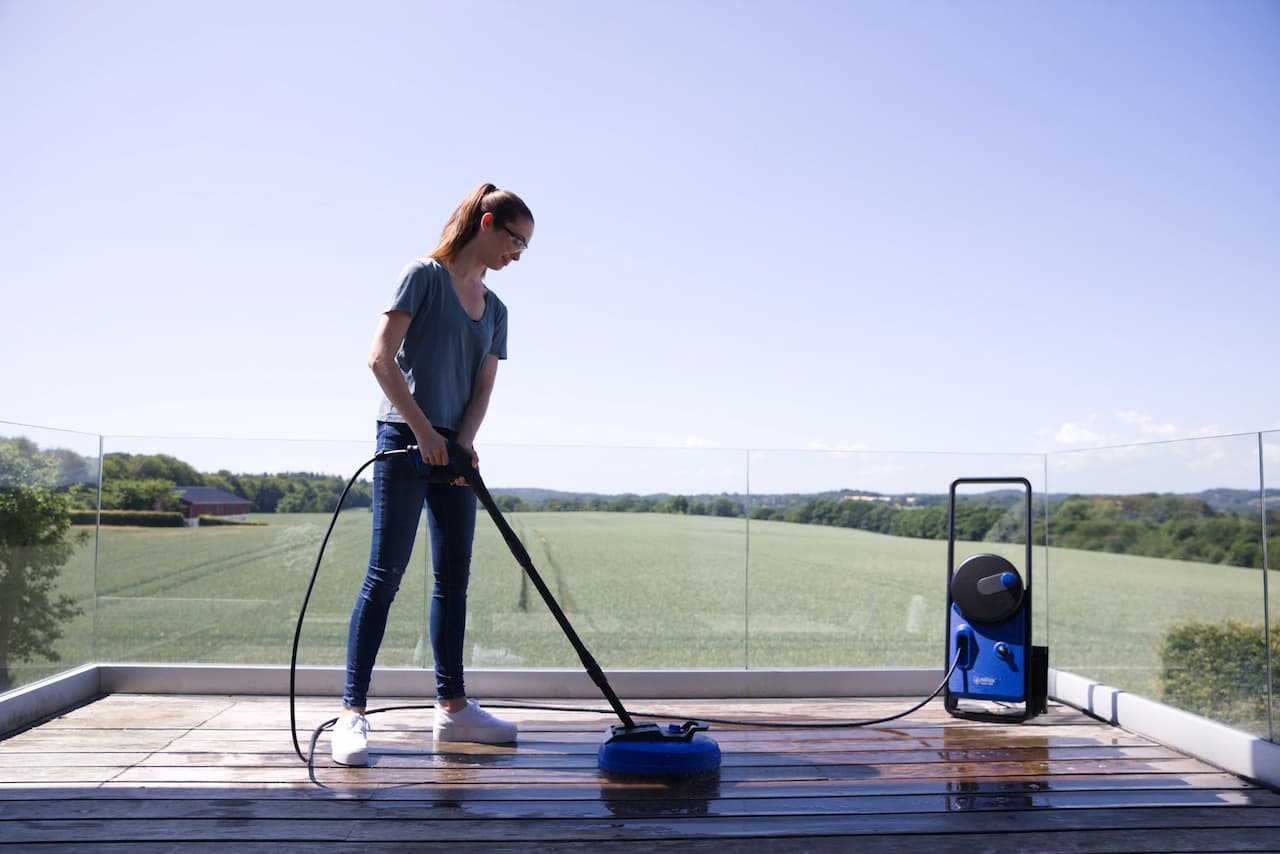
The patio slabs by the back door had two winters of grime worked into them, and on the rough setting the Core 140 had them looking properly clean within about forty minutes, working in overlapping passes rather than trying to do it in one go. The rotating lance head genuinely helped here, since I could angle the spray fan to get under the lip of each slab without twisting my wrist or letting the cable wind itself around my legs.
On the car I used the gentle nozzle with the detergent sprayer first, left it to sit for a couple of minutes, then rinsed on the same setting. It got the bodywork properly clean without any worry about the paint, and the rough nozzle made short work of the wheels and arches afterwards, where the extra bite didn’t matter.
Garden furniture and a set of hand tools that had been sat in the shed all winter both came up well on the gentle setting, which matched the suggestion printed right on the machine. The one job that didn’t go entirely to plan was an old aggregate path out the side of the house, where the rough setting kicked up more loose grit than I expected, more on that below.
Use the printed nozzle guide on the body as your starting point. Gentle for bikes, paintwork and cars, rough for wheelbarrows, brickwork and tools, then adjust by eye once you see how the surface in front of you actually responds.
Settings and attachments
Power is adjusted through a touch dial on the body rather than a twist on the lance itself, with the gentle and rough nozzles clicking onto the gun to change the spray pattern. Switching between the two takes a couple of seconds since you’re swapping a nozzle rather than just rotating something in your hand, but the housings hold them so firmly that I’ve never fumbled one onto the ground.
The rotating lance is the feature that gets the least attention but earns the most use. Being able to angle the spray fan vertically and horizontally without twisting the cable makes a real difference under furniture legs, along skirting at the base of walls, and anywhere else a fixed lance would force you into an awkward stance.
- Gentle nozzle, wide spray angle
- Rough nozzle for stubborn grime
- Detergent sprayer bottle
- Onboard lance holder and internal hose reel
- Dedicated patio cleaner attachment
- Auto brush attachment
- Replacement hose-tap adapters
- Microfibre towel and other click-fit extras
Performance and limitations
What stands out most after a full season with it is how little fuss it asks for. The internal reel means I’m never untangling hose before a job, the rotating lance reaches the spots a fixed one wouldn’t, and the metal pump has shown no sign of strain even after long sessions on the patio. For anything from bikes and garden furniture to cars and general hard standing, it’s done everything I’ve asked of it without complaint.
The hose connector on the back of the unit caught the ground more than once when I tipped the machine onto its wheels to move it across the same uneven aggregate path that gave the rough setting trouble earlier. It’s not a flaw exactly, more a reminder that the design assumes reasonably even ground both to work on and to wheel itself across.
Worth checking before you buy: the supplied hose-tap connector is a single fixed size, and depending on your existing outdoor tap fitting you may need a separate adapter to get going. It’s a small thing, but one that can hold up your first clean if you don’t have one already to hand.
- Hose disappears entirely into an internal reel
- Rotating lance reaches awkward angles easily
- Metal pump rather than plastic, no strain under long use
- Nozzle guide printed directly on the machine
- More parts to assemble than most pressure washers
- Handle doesn’t fold down, fixed storage footprint
- Hose connector catches the ground on rough terrain
- Fixed hose-tap connector may need a separate adapter
- Anyone who hates dealing with a loose, trailing hose
- Cars, garden furniture, smooth patios and paths
- Anyone who wants jobs sorted without thinking too hard about settings
- Anyone with mainly loose, uneven aggregate paths
- Anyone needing the storage footprint to shrink for a small shed
- Anyone whose outdoor tap fitting doesn’t match the standard connector
Final verdict
The Nilfisk Core 140 has done exactly what I hoped it would: cleaned cars, furniture, tools and patios well, and made tidying up afterwards genuinely quick rather than a chore in itself. The internal hose reel and rotating lance are the two features that have actually changed how I use a pressure washer, not just nice extras on the spec sheet.
If your hard standing is mostly smooth concrete, block paving or decking, this handles all of it without fuss and rewards you every time you put it away. If your main battle is a loose aggregate path or gravel drive, go in carefully on the rough setting and expect more spray-back than you’d get on a smoother surface.
It comes with a two year warranty as standard, which is reassuring given the metal pump is the part doing the hardest work, and after a full season I’ve got no reason to doubt it’ll see out many more.
A genuinely well thought out pressure washer where the internal hose reel and rotating lance solve real, everyday irritations. Held back slightly by a fiddlier assembly and a setup that prefers smooth ground over loose, uneven surfaces.
Share on socials: