At a glance
The Ryobi R18SDS-0 occupies a specific and honest position in the SDS Plus market: it is the most affordable 18V SDS Plus drill from a major brand, priced at roughly half what you would pay for a DeWalt DCH273 or Bosch GBH 18V-26 body only. Its 1.5J impact energy is lower than any of its direct trade-brand competitors, its motor is brushed rather than brushless, and it is clearly aimed at the domestic DIY market rather than daily trade use. None of this is a criticism – these are design choices that reflect a deliberate price point and a specific target user. The question for our test was whether the R18SDS-0 delivers acceptable SDS Plus performance for domestic use at that significantly lower price, and whether the ONE+ battery platform advantage over budget no-name alternatives makes it the sensible choice for Ryobi users.
We tested the R18SDS-0 on the same masonry task set used for the DeWalt DCH273 and Bosch GBH 18V-26 reviews – standard brick, medium-density blockwork, mortar removal and light chiselling. Testing the three drills side by side made the differences in impact energy immediately apparent in the harder materials, but also confirmed that in standard brick – the material most UK DIYers will be drilling most often – the Ryobi performs more competently than its specifications suggest.
Overview and first impressions
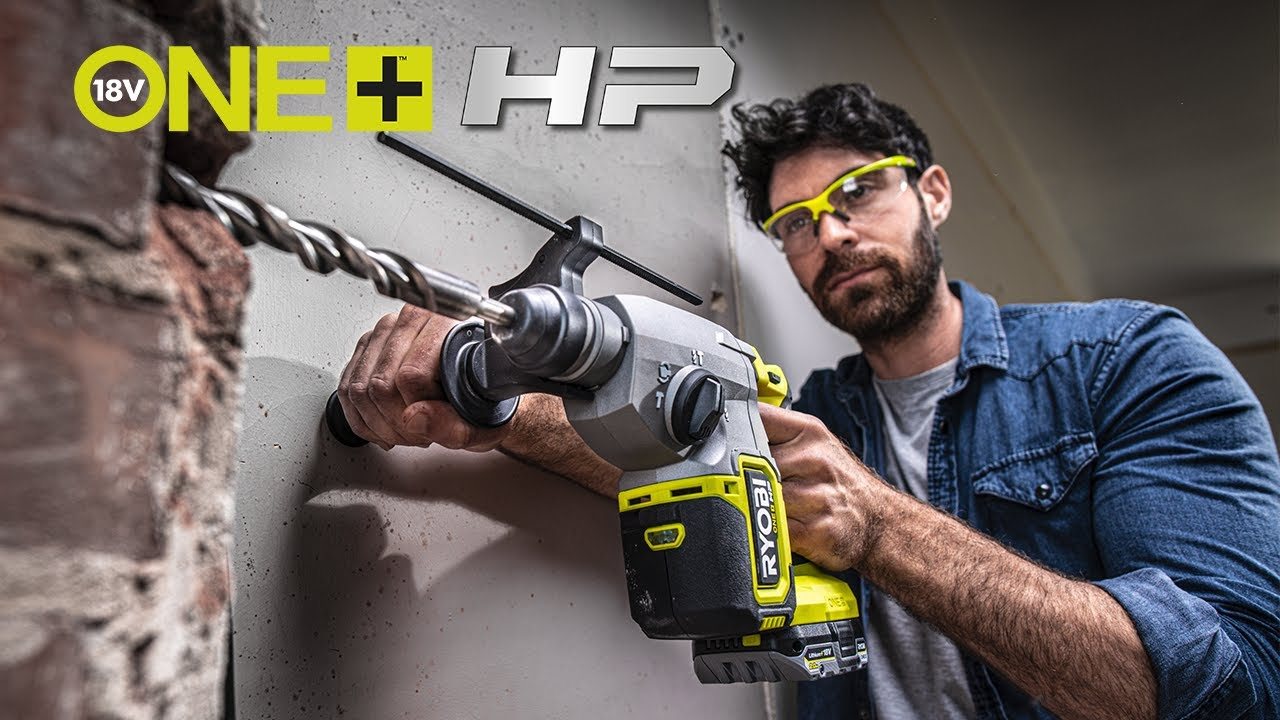
The R18SDS-0 is lighter than the DeWalt and Bosch alternatives at 2.2kg body only – the brushed motor and lighter hammer mechanism contribute to a compact, manageable form factor that will appeal to users doing occasional overhead work or drilling in confined spaces. The green Ryobi housing feels adequate for domestic use without the robustness of Bosch Professional or DeWalt XR build quality, which is to be expected at this price. It is a tool that has been designed to a budget and it shows in the materials, but nothing feels dangerously cheap or unreliable.
The three-mode collar is less positive in feel than the DeWalt or Bosch equivalents – there is a slightly vague transition between modes that requires a firmer twist and more deliberate checking to confirm the selected mode. It stays in position during drilling, which is the important thing, but the tactile feedback is not as reassuring as the higher-end tools. The SDS bit change mechanism is standard and reliable. There is no LED worklight, which is not a significant omission at this price point but worth noting for anyone planning to use the tool in awkward darker locations.
The R18SDS-0 is body only – but existing ONE+ users already have batteries. Ryobi’s ONE+ 18V battery platform covers over 100 tools. If you already own any Ryobi ONE+ tools, your existing batteries will work with the R18SDS-0 and the effective cost of adding an SDS drill to your toolkit is just the body price. This is the strongest argument for choosing it over budget no-brand alternatives.
Specifications and scores
How it performed in testing
In standard UK house brick – the red or yellow-stock facing brick used in the vast majority of domestic properties – the R18SDS-0 performed meaningfully better than its 1.5J specification suggests. Holes for standard rawlplug fixings came in quickly and cleanly and the drill handled repeated fixing work in brick without drama. The 1.5J impact energy is sufficient for this application and the brushed motor, while less efficient than the brushless alternatives, delivers adequate power for the lighter masonry that makes up most domestic DIY work. A homeowner hanging shelves, fitting curtain poles, mounting a TV bracket or fixing garden structures to brick walls will find the R18SDS-0 entirely capable.
Medium-density blockwork was where the energy limitation became more apparent. The R18SDS-0 required noticeably more forward pressure and took longer through denser block than the DCH273 or GBH 18V-26 – approximately 40-50% more time per hole in our comparative testing. This is not a failing for a tool at this price point, but it confirms that the R18SDS-0 is a domestic fixing tool rather than a general construction tool. For a plumber or electrician first-fixing through blockwork walls all day, the 1.5J would become genuinely limiting. For a homeowner who picks up the drill for an afternoon of fixing work, it performs the job adequately.
Chisel mode for mortar removal worked at a slow but functional pace. The tool removed mortar, but the low impact energy meant that progress was slow enough to test patience on anything more than a few bricks of repointing. For light chiselling and occasional mortar work it is serviceable. For any meaningful volume of masonry chiselling, the 2.1J or 2.6J alternatives are the correct tools.
Battery and runtime
The R18SDS-0 runs on Ryobi’s 18V ONE+ platform, which is the largest single-voltage battery ecosystem available to domestic users in the UK. The ONE+ platform covers over 100 tools at very competitive prices – combi drills, jigsaws, impact drivers, circular saws, hedge trimmers, string trimmers, lawn mowers and many more all share the same batteries. For a homeowner building a cordless toolkit over time, the ONE+ platform offers excellent value for money across the range.
Performance and limitations
The R18SDS-0’s performance limitations are predictable and honest. The 1.5J impact energy is 28% lower than the DeWalt DCH273’s 2.1J and 42% lower than the Bosch GBH 18V-26’s 2.6J. In the hardest materials those differences show clearly. In standard brick they matter much less. The brushed motor will also wear faster than brushless alternatives and will deliver gradually reducing performance over its service life as the brushes wear – for a domestic user who drills perhaps a few dozen holes a year, this is unlikely to become a practical issue within a reasonable ownership period, but it is worth understanding.
Where the R18SDS-0 competes strongly is on value within the ONE+ platform. At around £75 body only, an existing ONE+ user effectively adds SDS Plus capability to their toolkit for the cost of a good quality set of SDS bits. That is a compelling proposition for the DIYer who needs to drill the occasional masonry hole but cannot justify the price of a DeWalt or Bosch tool for infrequent use.
- Genuinely affordable at ~£75 body only
- Fully compatible with ONE+ platform across 100+ tools
- Light at 2.2kg – comfortable for overhead work
- Adequate for standard brick fixing – the main domestic use case
- 1.5J energy struggles in dense blockwork and concrete
- Brushed motor less efficient and durable than brushless alternatives
- Mode selector less positive than DeWalt or Bosch equivalents
- Not suitable for sustained trade use or heavy masonry work
- Ryobi ONE+ users who want SDS capability at minimal extra cost
- Homeowners doing occasional masonry work in standard brick
- Budget-conscious buyers for whom SDS is an occasional need
- Any trade or professional use – 1.5J is not enough for daily work
- Users regularly drilling into dense blockwork or concrete
- DeWalt XR or Bosch Professional users – battery incompatibility
Final verdict – is it worth it?
The Ryobi R18SDS-0 earns its score by being honest about what it is and who it is for. It is not a competition for the DeWalt DCH273 or Bosch GBH 18V-26 – it does not pretend to be and should not be evaluated against them directly. Compared to its actual competition – cheap no-brand SDS drills of similar price – the R18SDS-0 offers meaningfully better build quality, the backing of Ryobi’s warranty and parts support, and the substantial advantage of ONE+ battery compatibility across a large and growing platform.
For an existing Ryobi ONE+ user who occasionally needs to drill masonry and has no intention of building a trade toolkit, the R18SDS-0 is a sensible and cost-effective choice. The performance in standard brick is adequate for domestic fixing work and the ONE+ batteries you already own will power it without any additional expenditure. The limitations in harder materials are real but irrelevant for the primary use case.
For anyone expecting trade-level performance or working in harder construction materials regularly, the budget needs to stretch to the DeWalt DCH273 or Bosch GBH 18V-26. The 1.5J impact energy is a genuine limitation in those scenarios and no amount of value for money offsets the frustration of a tool that is genuinely underpowered for the work in front of it.
A decent domestic SDS drill at a genuinely affordable price. Perfectly capable in standard brick and an excellent value-add for existing Ryobi ONE+ users. Falls short of the trade-level alternatives in harder materials but is not trying to compete with them. Buy it if you are a Ryobi ONE+ user who drills masonry occasionally. Choose the DeWalt or Bosch if you need real performance.
Share on socials: