At a glance
There is a version of this saw that has been sitting in a shed for three winters with fuel in the tank, and that version will not start. That is not the saw’s fault. The MS 170 has a reputation in some circles as a difficult starter and I understand where it comes from, because I left mine with old mix in it the first winter I owned it and spent an afternoon in March pulling the cord before my neighbour told me what I’d done. Drained it, cleaned the carburettor, fresh 50:1, and it started on the second pull. It has started on the second pull or better every time since, as long as the fuel is fresh. That is the single most important thing to know before buying a petrol chainsaw at this level.
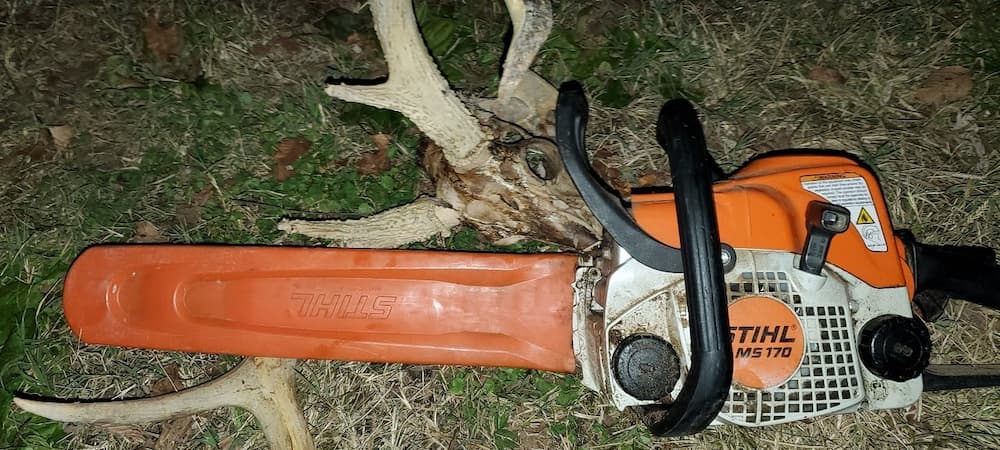
The MS 170 is Stihl’s entry-level petrol chainsaw, 30.1 cc, 1.2 kW, available with a 30 or 35 centimetre bar depending on which version you pick up and where from. It is no longer on the main Stihl UK website as a current model, having been replaced by the MS 182 C-BE, but it is still available as new-old-stock from Stihl dealers and from Amazon UK, and plenty of people are still buying it. The reasons are straightforward: it is light, it starts reliably when maintained correctly, and it is a Stihl. Those three things together at the entry-level price point are worth something.
Overview and first impressions
It weighs 3.9 kg without bar, chain, or fuel; 4.1 kg with bar and chain and no fuel. On a full morning of pruning and clearance that is something you notice in a good way. For comparison, my everyday saw is considerably heavier and by midday I know about it. The MS 170 is the one I reach for when there is two or three hours of lighter work and I do not want to be carrying more than I need to. It is also the saw I handed to my daughter when she started on the plot, partly for the weight and partly because the single-lever master control, which puts stop, start, choke, and throttle on one lever, means there is one thing to learn rather than several.
The bar length choices are either 30cm or 35cm. In practice this is the choice between a saw that handles everything up to about 25cm in a single pass, and one that gives a little more headroom. For domestic use, cutting up fallen branches, clearing storm damage, processing firewood from trees that come down rather than trees you fell deliberately, 30cm covers most of it. The 35cm version exists if you know you will be pushing harder. The recommended maximum bar for this saw is 35cm, and that is the limit to treat seriously. Bar and chain pitch is 3/8″ Picco, which matters when you come to replace the chain.
It comes with a carrying case, which is a practical addition at this level and one I use more than I expected to for moving the saw between the plot and the garage.
Old fuel is the most common cause of starting problems. The MS 170 starts reliably on fresh 50:1 mix. The carburettor is not owner-adjustable. Leaving ethanol-laced pump petrol in the tank over winter degrades seals and blocks the carburettor. Use fresh fuel every session and run the saw dry before storage.
Specifications and scores
How it cut and what I learned early on
The first summer I used it properly, after the carburettor episode had been sorted, I worked through a hawthorn that had come down across the back path, trunk at the thickest somewhere around nine inches, and a series of branches in the six to eight inch range. The saw cut the lot with no drama. Hawthorn is dense and hard and not particularly forgiving, and the MS 170 was not fast but it was consistent and it did not bog. The chain was sharp because I had sharpened it before starting, and that matters more with this saw than with a more powerful one. A dull chain and a 30.1 cc engine is a frustrating combination. A sharp chain and the same engine is a good afternoon’s work.
The ElastoStart system, a rubber spring in the pull-start mechanism that absorbs the jerk of the starting pull, is one of the features I did not think I would notice but I do. Over a morning of stopping and restarting, the difference in wrist and elbow fatigue is real. The compensator carburettor adjusts the fuel-air mix automatically as the air filter becomes clogged, which in practice means the engine does not start running noticeably rich or losing power the way older carburettors do. The 2-MIX engine uses 1-in-4 channel technology and Stihl claim up to 20% fuel saving over equivalent non-2-MIX engines in the same class, with exhaust emissions reduced by up to 50%. The sound level is 100 dB(A) at the operator’s ear and 111 dB(A) sound power. That is a petrol chainsaw. You wear ear protection. Vibration at the handles is 5.2 m/s² on the left and 5.5 m/s² on the right, with the anti-vibration system using spring damping between the engine and the handles.
Chain sharpness matters more than engine size. With a dull chain the MS 170 labours noticeably. With a sharp chain it handles its rated diameter range well. Sharpen before each session or whenever the saw starts requiring more pressure to cut.
How it runs: fuel, oil and starting
The Ematic chain lubrication system feeds the chain automatically and uses up to 50% less oil than a conventional oiling system. The oil tank takes 145 ml and the fuel tank takes 250 ml; in mixed work the oil tends to run lower relative to fuel than you would expect from a conventional setup, which means checking the oil level separately rather than assuming both run out together.
The 50:1 mix is 50 parts fresh petrol, minimum 90 RON, to 1 part two-stroke oil. Stihl makes their own two-stroke oil and their MotoMix pre-mix, and I use both depending on what is to hand. The reason to use quality oil rather than whatever is cheapest is not snobbery: ethanol in standard pump petrol attacks the rubber components in the fuel system over time and degrades in the tank faster than alkylate fuel. The carburettor on the MS 170 is not adjustable by the owner; it is factory-set. A contaminated carburettor needs a dealer visit. Use correct fuel from day one and the carburettor lasts. Leave old ethanol-laced mix in the tank over winter and the carburettor needs cleaning or replacing. Running the saw dry at the end of each session leaves no fuel in the system to degrade. Do this consistently and the saw will start reliably next time, whether that is next week or next spring.
Performance and limitations
The MS 170 cuts cleanly through timber up to about 10 to 12 inches in a single pass. At 14 inches it starts to work harder. The two-sided cut technique handles more than the bar length suggests, but there is a practical limit and the saw tells you when you are past it by the change in engine note. Let it cut at its own pace. Forcing the bar through a cut that is too large causes the engine to labour, heats the bar, and wears the chain faster than it should. This is a 30.1 cc engine and it is used correctly within its rated range.
The chain tensioner is on the side of the saw and requires a screwdriver, or the combination wrench that comes with it, to adjust. The chain also needs checking more often than on a professional saw; it loosens faster and you want to catch it before it is running loose. The fuel cap is a screw-type requiring a screwdriver or a coin; with gloves on, as most people are when actually working, opening the fuel cap when the tank runs low mid-session is annoying. The plastic housing can crack if the saw is dropped or handled roughly. The oil pump is not adjustable, unlike more expensive Stihl saws where you can increase the oil flow rate for resinous or abrasive wood.
- 3.9 kg bare: notably light for a petrol chainsaw
- Reliable starting with correct fuel and storage
- Single-lever master control: straightforward for new users
- Stihl dealer network for service and parts
- 3-year warranty with MotoMix purchase at point of sale
- Carburettor not owner-adjustable; vulnerable to old fuel
- Chain tensioner and fuel cap require tools (not tool-free)
- Power limited above 12″ single pass
- Not on current Stihl UK lineup (replaced by MS 182 C-BE)
- Domestic users needing a petrol chainsaw for occasional use
- Storm clearance, pruning, firewood under 12″ diameter
- First-time chainsaw users wanting Stihl reliability
- Sustained heavy felling or commercial use
- Regularly cutting above 12″ diameter
- Anyone unwilling to follow the fuel care requirements
Final verdict: is it worth buying?
The honest answer depends on what you are using it for and whether you will maintain it. For the specific use cases it is designed around, light domestic chainsaw work with sessions of two to three hours in the garden rather than a full day in the forest, it is a reliable and capable entry-level saw from a manufacturer with real chainsaw credentials. The Stihl dealer network and the warranty extension to three years with MotoMix purchase are worth knowing about before you buy.
The things I would want to know before buying: the fuel care requirement is real and non-negotiable; if you are not going to use fresh 50:1 mix and run it dry at the end of each season, buy a battery saw instead. The chain tensioner and fuel cap are dated compared to current battery saws and even current Stihl petrol saws. And the saw is no longer in the current Stihl UK lineup, so the MS 182 C-BE is worth looking at as an alternative if you want a current-production Stihl petrol saw at a similar level.
The saw comes with a carrying case, which is a practical addition at this level and one I use more than I expected to. For what it is, an entry-level petrol chainsaw from a serious manufacturer, maintained correctly, used within its rated range, it does what it says. My own has done that reliably for several years. The fuel incident in the first winter was entirely my fault and I have not made the same mistake twice.
A capable entry-level petrol chainsaw for domestic use, provided fuel care is taken seriously. Light, reliable when maintained correctly, and backed by the Stihl dealer network. The limitations are real but they are limitations of the category and the spec level, not defects. Use it within its range and it earns its place.
Share on socials: