At a glance
A shaded garden is not a failed garden. The assumption that useful vegetable growing requires a south-facing plot in full sun is one of the most persistent myths in UK gardening, and it stops a great many people from attempting to grow food in spaces that are genuinely capable of producing worthwhile crops. The key shift is understanding that the most productive approach in shade is not to fight the conditions by attempting full-sun crops in inadequate light – it is to select the crops that are genuinely well-suited to low light and manage the space to get the most from what is available. Leafy crops, salad vegetables and many brassicas do not just tolerate shade – some actively benefit from it, producing more tender, slower-bolting harvests than the same varieties grown in harsh summer sun.
The practical first step with any shaded growing area is to establish what kind of shade it actually is, because the difference between dappled shade under a deciduous tree, deep shade against a north-facing wall and the moving partial shade cast by a fence at different times of day makes an enormous practical difference to what will grow. Understanding your specific shade conditions is more useful than any general advice about what grows in shade, because the variable is wide and the crop options available at each end of the spectrum are very different.
Understanding shade in UK gardens
For vegetable growing, the useful working definitions are partial shade (3-5 hours of direct sun daily, indirect bright light for the rest) and full shade (fewer than 3 hours of direct sun, indirect or no direct light). Partial shade supports a reasonable range of productive crops. Full shade – particularly against a north-facing wall or under a dense evergreen – supports very little edible production beyond herbs and some salad leaves. Knowing which type you are dealing with is the essential starting point, and the only reliable way to find out is to track the light across the space on a clear summer day from morning to evening.
In a UK garden the direction a shaded area faces matters as much as how much shade it receives. A north-facing border shaded by a fence receives little direct sun but typically has reasonable ambient light for much of the day. An east-facing bed shaded by a building gets morning sun – which is cooler and less intense than afternoon sun – and shade through the afternoon. A west-facing spot gets afternoon sun, which is warmer and more useful for many crops than the same total hours of morning sun. The quality of the sun hours matters as well as the quantity, and a single warm afternoon hour in late July carries more growing value for a tomato plant than three cool early-morning hours in the same period.
Mapping exactly how many hours of direct sun a shaded area actually receives across a full summer day is the most useful first step before deciding what to plant. A single clear day in July spent noting when direct sun enters and leaves the space gives you more reliable planning data than any general guidance. Shade also changes through the season – an area heavily shaded by a deciduous tree in July may receive reasonable light in March and April before the tree leafs out, which opens up early-season sowing opportunities that would not be available at the height of summer.
Best vegetables for shaded spots
Leafy crops are consistently the most productive option for shaded UK growing areas. Lettuce and mixed salad leaves are the first choice – they genuinely benefit from partial shade in summer, bolting less readily in the cooler conditions and producing more tender, less bitter leaves than the same varieties grown in full sun. Cut-and-come-again mixes of rocket, mustard leaf, mizuna and spinach sown thickly in a shaded bed provide harvests across most of the year with minimal input. Sowing successionally every three to four weeks from March to August gives a continuous supply and avoids the glut-then-gap cycle that comes from a single large sowing.
Spinach and chard are the next most shade-tolerant crops and among the most productive per square metre in low-light conditions. Rainbow chard in particular is worth growing for its visual value as well as its productivity – the vivid red, yellow and orange stems are genuinely ornamental in a shaded border or container. Kale, cavolo nero and spring cabbage all tolerate partial shade acceptably and provide winter harvests when most other crops are dormant. Radishes, spring onions and beetroot all produce usable crops in three to four hours of sun, though beetroot roots tend to be smaller than in full sun. Climbing French beans and peas manage on less sun than other legumes and are worth trying on a partially shaded wall or fence – they produce a lighter crop than in full sun but will still yield usefully.
Grow microgreens for shade-proof harvests year round. Microgreens – young seedlings of radish, pea, sunflower, kale, mustard and many others – are harvested at 7-14 days when just a few centimetres tall. They need almost no direct sunlight and grow happily on a bright windowsill or in a sheltered shaded corner. A series of small trays sown staggered every week provides a continuous supply of intensely flavoured young greens with no outdoor light requirements at all – the single most reliable food-producing option for a deeply shaded space.
What to avoid growing in shade
Fruiting vegetables without exception need full sun – tomatoes, peppers, aubergines, courgettes, cucumbers, squash and pumpkins all require six or more hours of direct sun daily to produce a worthwhile crop. In shade these plants will grow – often vigorously – but will produce little or no fruit, putting all their energy into leaf growth instead. The same applies to sweetcorn, which additionally needs the warmth that full sun provides at soil level for satisfactory germination and consistent growth. Root crops primarily grown for their swollen roots – parsnips, carrots, celeriac – produce very disappointing yields in shade and are not worth attempting in fewer than five to six hours of direct sun.
Alliums – onions, garlic and shallots – need full sun to develop properly sized bulbs. They will grow and produce usable but small bulbs in partial shade, but the effort-to-yield ratio makes the bed space better used for leafy crops that genuinely thrive in the conditions. Mediterranean herbs – basil, rosemary, thyme, oregano – are full sun plants that perform poorly in shade, producing weaker growth and less of the aromatic oils that make them worth growing. The exception among herbs is mint, which actually prefers a partially shaded, moisture-retentive spot and is one of the few herbs that thrives in north-facing beds.
Maximising yield in low light
Several practical steps improve productivity in shaded growing areas beyond simply choosing the right crops. Light-coloured walls and fences behind beds reflect ambient light back towards the plants – painting a dark north-facing fence white can make a measurable difference to effective light levels for plants growing in front of it. This costs almost nothing and is one of the highest-impact changes available to a gardener working with a difficult north-facing bed. Mirrors are occasionally recommended for the same purpose but are impractical in most UK outdoor situations.
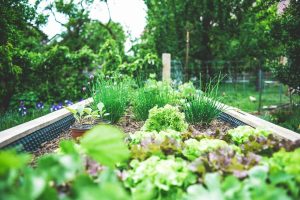
Raised beds in shaded areas should use a very fertile, moisture-retentive compost-rich growing medium. Plants compensate for reduced light by growing more efficiently when soil conditions are ideal, and the productivity gap between a shaded bed in rich soil and the same bed in poor soil is substantial. Incorporating a generous amount of homemade compost into the growing medium each season maintains fertility without additional feeding costs and improves the soil structure year on year. Choosing varieties specifically noted for shade tolerance or reliability in cool conditions – rather than standard catalogue varieties developed for full-sun production – also makes a significant difference. Compact, early-maturing varieties of peas, beans and brassicas tend to perform better in partial shade than long-season maincrop varieties.
Grow bags and containers have the advantage in shaded gardens of being moveable – a container of salad can be shifted to follow the available sun across the garden as the season progresses, making the most of any patches of direct light that the space receives at different times of day or as the sun’s angle changes through the season.
Seasonal shade management
Shade patterns change significantly across the UK growing season in ways that experienced growers use to their advantage. In winter and early spring, when the sun is lower in the sky, areas that receive reasonable summer sun may be heavily shaded by nearby fences, buildings and deciduous trees. The reverse is also true and useful – deciduous trees cast significantly more shade in summer than in spring before they leaf out, meaning a bed shaded in July may be very productive in March and April when cool-season crops are most valuable. An area under a large apple or cherry tree that is unusable for crops in midsummer may be an excellent spot for early peas and spinach in March before the blossom opens.
Understanding the seasonal rhythm of shade in your specific garden also helps with succession planning. The most productive shaded gardens are those managed as genuinely year-round growing spaces rather than left dormant from October to April. Overwintering spinach, hardy salad mixes and kale planted in September continue producing through mild spells all winter, and the light levels in even a heavily shaded UK garden are adequate for maintaining these slow-growing cold-season crops through December and January. Coming back to productive growing in February from an overwintered bed gives a significant head start over starting from scratch in spring.
Shade increases slug pressure significantly. Shaded growing areas are typically damper and cooler than sunny beds, which are exactly the conditions that slug and snail populations thrive in. This is the single biggest pest challenge in shade growing and needs active management rather than the passive approach that often works in drier sunny beds. Use slug pellets, copper tape on container edges, regular evening patrol, or nematode treatments as a consistent seasonal practice rather than a one-off response when damage appears.
Share on socials: