At a glance
Renting does not mean giving up on gardening. The widespread assumption that a rental property precludes any meaningful garden investment is one of the most damaging misconceptions in British gardening culture, and it is almost entirely wrong. The UK’s 4.6 million privately rented households represent millions of potential gardens going uncultivated because tenants assume they are not allowed to do anything – when in fact the vast majority of sensible, reversible garden improvements require no permission and carry no tenancy risk whatsoever. A container garden built up over three years of rental gardening, a collection of quality pots with well-established structural plants in them, a portable raised bed full of productive vegetables – none of this requires permission and all of it moves with you when you leave. The rental period is not time lost from your gardening life; it is time spent actively building a portable, transportable garden that gets better every year.
The key distinction is between permanent alterations that change the property and temporary or portable improvements that do not. The former generally requires landlord permission; the latter generally does not. Understanding where this line sits – and staying comfortably on the right side of it – opens up the full range of container gardening, free-standing structures and portable planting that makes a rental garden genuinely satisfying to develop and maintain over the full length of any tenancy.
Your rights as a tenant gardener
Most UK tenancy agreements include a clause requiring tenants to maintain the garden in good condition – mowing lawns, keeping borders tidy and not allowing the garden to become overgrown or unkempt. Beyond this basic maintenance obligation, the position varies significantly by tenancy agreement. Most agreements do not explicitly prohibit gardening improvements, but many include clauses requiring written permission for any alterations to the property, which typically extends to the garden. The practical starting point is to read your tenancy agreement carefully and identify exactly what it says about the garden.
If the agreement is silent on garden improvements, you are generally on safe ground with non-permanent changes. If it requires permission for alterations, write to your landlord or letting agent explaining clearly what you want to do – most landlords are happy for tenants to improve a garden provided it is left in good condition at the end of the tenancy. Get any agreement in writing, even a brief email confirmation. The key principle throughout is reversibility – anything that can be restored to its previous state before you leave is far less likely to cause deposit disputes than permanent alterations that cannot easily be undone.
Photograph the garden thoroughly before making any changes. A clear photographic record of the garden’s condition at the start of your tenancy and before any improvements is essential protection against deposit disputes. Document the existing state of lawns, borders, any existing plants and hard surfaces in detail. This evidence is the single most useful thing you can have if a deposit deduction is disputed at the end of the tenancy, and it costs nothing to create.
Building a container garden
Containers are the foundation of any rental garden. They require no permission, leave no trace and travel with you when you move. A well-planned container garden on a rented patio can be as visually impressive and productively useful as a planted border, with the significant advantage that every plant in every pot belongs to you. The same design principles that apply to a patio garden apply directly to a rental container collection – large containers, layered planting and year-round structural plants as a permanent framework with seasonal additions around them.
Invest in good-quality containers that will last multiple moves and multiple properties. A large terracotta or fibreglass pot of 50cm diameter or more planted with a structural shrub – bay, olive, standard rosemary, clipped box – provides an instant focal point at any property and is worth far more per year of use than a collection of cheap small pots that crack and fade rapidly. Consider the weight of containers before buying – fibreglass pots weigh a fraction of terracotta at the same size, which matters considerably when moving house. Fabric grow bags are an excellent complementary option for food growing – lightweight, foldable for transport and very effective for tomatoes, potatoes and salad crops. They fold flat for the move, taking up almost no space in a removal van and ready to be pressed back into service the day you arrive at the new property.
Temporary raised beds and structures
Free-standing raised beds that sit on the surface without any ground fixing are generally considered temporary and acceptable in most rental gardens. They do not damage the property and can be removed and taken when you move. Modular raised bed systems that clip or bolt together without requiring fixings into the ground are ideal for this purpose. A raised bed placed on hard standing – paving or decking – with a weed-suppressing membrane between bed and surface leaves no marks on the underlying surface and can be removed completely in an afternoon, leaving the patio exactly as it was found.
On a lawn, a free-standing raised bed will cause the grass beneath to yellow and die where light is excluded. This is easily resolved by removing the bed and overseeding the affected area before the end of the tenancy, but it is worth considering beforehand and potentially worth a brief conversation with the landlord. Free-standing trellis or obelisk structures weighted with container soil for stability provide vertical growing support for climbing vegetables, sweet peas or clematis without leaving any marks on walls or fences – one of the most useful rental-garden solutions available. A freestanding arch or pergola frame over a seating area, similarly weighted, can transform the feel of a rental garden space at modest cost and be taken entirely when you leave.
Food growing in a rental garden
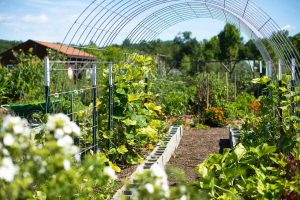
A rental garden is fully capable of supporting a productive food-growing setup using entirely portable methods. Containers, grow bags and free-standing raised beds between them cover every practical food-growing scenario. Cherry tomatoes, herbs, salad, strawberries, courgettes, climbing beans and even dwarf fruit trees all perform well in containers or grow bags without any ground preparation or permanent installation. The food-growing setup that works best in a rental garden is one designed from the outset to be portable – chosen for ease of moving and the ability to be reassembled identically at the next property.
Taking your garden with you
The single best aspect of a container-based rental garden is portability. Every plant in a pot, every grow bag, every free-standing structure belongs to you and moves with you. Perennial plants grown in containers – lavender, herbs, roses in large pots, small fruit trees – become genuinely valuable assets that improve with each year of growth and represent a significant investment that transfers to every subsequent home. The garden you build over two or three years of renting is not lost when you move; it arrives at the next property already established, already producing, already mature enough to make an instant impact. This is one of the most compelling arguments for investing properly in containers and plants even in a short rental – the investment is not tied to the property, it is tied to you.
Annual food crops cannot be taken mid-season, but seed saving costs nothing extra and means each move begins with a ready supply of familiar, proven varieties. Perennial herbs – chives, mint, rosemary, thyme, sage – divide easily at transplanting time and a single large established pot can become several smaller ones for a new home. A well-built container kitchen garden accumulated over two or three years of rental gardening is a genuine and growing asset – a collection of well-chosen plants in quality containers that makes any new property instantly feel more like home from the moment you arrive.
Do not remove any existing plants from the garden without explicit written permission. Established shrubs, hedges and trees are part of the property and removing them – even if you consider them unsightly or in the way – constitutes damage to the property. This is one of the most common causes of deposit disputes in rental properties with gardens. If you want to remove or significantly prune an existing plant, get the landlord’s written agreement first and be clear about what you intend to do.
Share on socials: