At a glance
Your first cordless drill is one of the most useful tools you will ever buy, and also one of the easiest to get wrong. The market is full of drills that look the part but frustrate in practice – underpowered for anything tougher than flat-pack assembly, heavy enough to ache your wrist after ten minutes, or locked into a battery platform you will regret committing to. Getting this right from the start saves money, time and irritation.
We assessed five of the most popular cordless drills available to UK beginners in 2025, focusing on what actually matters for someone new to DIY: ease of use, build quality, power for everyday tasks, and value when bought as part of a kit. Whether you are hanging shelves, assembling furniture, fixing fences or starting a home renovation, one of these will do the job without overcomplicating things.
How we assessed these drills. Each drill was tested across a range of common beginner tasks: driving screws into softwood and hardwood, drilling into brick with a masonry bit, and assembling flat-pack furniture. We weighted ease of use and comfort heavily alongside raw power, since these are the factors that matter most when you are learning.
Quick Verdict Summary
All 5 Beginner Drills Ranked
The DCD778 is the drill we would hand to most UK beginners without hesitation. It sits in an extremely sweet spot between capability and ease of use – compact enough to work in confined spaces, powerful enough for brick with a masonry bit, and light enough at 1.6kg to use comfortably all day. The ergonomics are genuinely good, with a comfortable grip angle and an LED that actually illuminates the work area rather than just the wall next to it.
The XR brushless motor is the real differentiator at this price point. Brushless motors run cooler, last longer, and extract more power from each battery charge than brushed alternatives – which means you get more work done per charge and the drill will last considerably longer. For a beginner who is not sure how often they will use the tool, the durability argument is particularly compelling. The 13-speed clutch gives fine control over screw depth, which prevents the common beginner mistake of driving screws through surfaces.
Bosch’s reputation for build quality is well-earned, and the GSR 18V-55 is a good illustration of why. The housing feels genuinely robust, the chuck runs true with no wobble, and the controls have the kind of satisfying mechanical precision that Bosch drills are known for. If you are someone who finds quality reassuring – who wants a tool that feels like it was engineered rather than assembled – this is your drill.
The 18V brushless motor delivers strong performance, and the two-speed gearbox (0-550 and 0-1,900 rpm) gives useful range from slow-torque screw driving to faster drilling. Weight is competitive at 1.5kg without battery. Our main reservation is value – the GSR 18V-55 costs slightly more than the DCD778 for comparable performance, which is why it ranks second.
The DHP486 is Makita’s flagship combi drill and punches above its beginner billing in terms of raw capability. The 18V brushless motor produces 82Nm of torque, which is enough to tackle most construction tasks a beginner will encounter. It is worth acknowledging that this is slightly more drill than most beginners need – but if you are planning to buy more tools and want to commit to the Makita 18V LXT platform, starting here makes long-term financial sense.
The DHP486 is slightly heavier than its competitors at 1.8kg with battery, which is noticeable during extended use. The clutch has 21 settings plus a drill mode, giving fine control. Makita’s LXT range covers over 300 tools from the same battery, which is the main reason someone might choose this over the DeWalt despite comparable performance at a higher price.
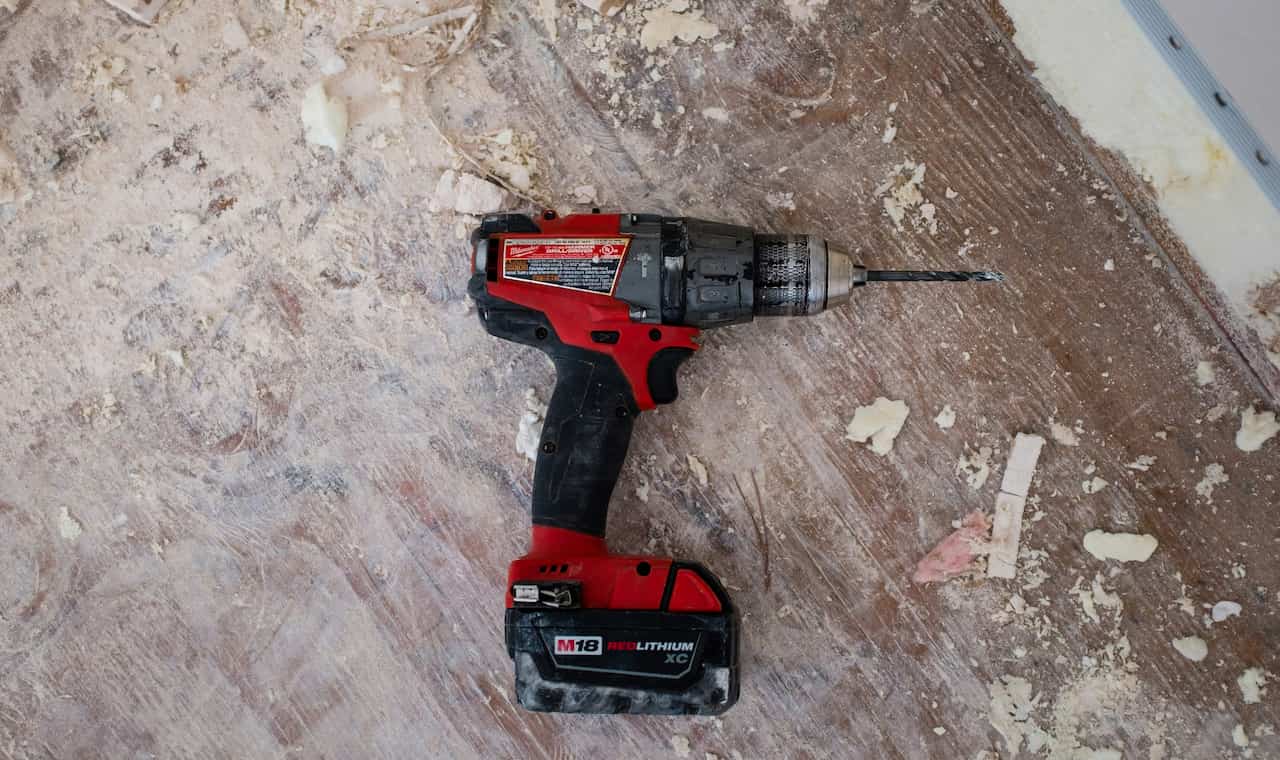
Milwaukee’s M18 BLDD2 is the most powerful drill in this roundup and the most expensive. For a complete beginner who will mostly be hanging pictures and assembling furniture, it is probably too much drill. For someone who anticipates getting into serious DIY – fitting kitchen units, framing garden rooms, heavy construction work – the M18 platform’s depth and the BLDD2’s power will eventually justify the higher entry cost.
The Ryobi RCD18-0 is the right answer to a specific question: what is the best drill for someone who wants to spend as little as possible to get the job done? If your needs are genuinely basic – flat-pack furniture, hanging pictures, the occasional screw into timber – the Ryobi does it. The ONE+ battery platform keeps the cost of adding tools low, and Ryobi’s tool range covers everything a home DIYer typically needs.
Head to Head Comparison
| Model | Motor | Max torque | Weight (no battery) | Kit price | Score |
|---|---|---|---|---|---|
| DeWalt DCD778 | Brushless | 65 Nm | 1.6 kg | ~£120 | 4.5 / 5 |
| Bosch GSR 18V-55 | Brushless | 55 Nm | 1.5 kg | ~£130 | 4.3 / 5 |
| Makita DHP486 | Brushless | 82 Nm | 1.5 kg | ~£135 | 4.2 / 5 |
| Milwaukee M18 BLDD2 | Brushless | 92 Nm | 1.7 kg | ~£155 | 4.1 / 5 |
| Ryobi RCD18-0 | Brushed | 42 Nm | 1.5 kg | ~£75 | 3.8 / 5 |
What to Look for When Buying Your First Drill
The specifications on a drill box can be confusing if you have never bought one before. Torque figures in Nm, speed in rpm, battery capacity in Ah – none of it maps obviously to how well the drill will perform the tasks you actually need to do. Here is what genuinely matters for beginners.
Brushless vs brushed motors. All four of the higher-ranked drills in this test use brushless motors. Brushless motors are more efficient, run cooler, last longer, and deliver more power per battery charge. If your budget allows it, the extra cost of a brushless drill is consistently worth it. The Ryobi’s brushed motor is the main reason it ranks fifth despite competitive ergonomics.
Clutch settings. The clutch controls how much torque the drill applies before it disengages to prevent overdriving screws. More settings give finer control. For beginners who are learning to drive screws to the right depth, a drill with at least 15 clutch settings is helpful. All five drills here have adequate clutch range.
Kit versus body only. All the prices in this guide are approximate kit prices including one or two batteries and a charger. Buying body-only is cheaper upfront but only makes sense if you already own compatible batteries from the same platform. For a first drill, always buy a kit.
Battery capacity. A 2Ah battery is light but runs out faster. A 4Ah or 5Ah battery adds weight but gives significantly more work time between charges. For most beginners, a 2Ah battery for lighter tasks and a 4Ah battery for heavier drilling is the ideal combination. Most kit purchases include either one battery (usually 2Ah) or two batteries of mixed capacity – two batteries is always better, so you always have one charging while the other is in use.
Chuck size. All drills here use a 13mm keyless chuck, which accepts all standard drill and screwdriver bits. Keyless chucks tighten by hand without the need for a separate chuck key – easier and faster to change bits. There is no practical reason to consider a 10mm chuck for home DIY.
Do not be tempted by cheap no-brand drills from marketplaces. Sub-£30 drills from unknown brands frequently lack proper torque control, overheat quickly, and fail within months. The saving is not worth the frustration or the safety risk when drilling into masonry. Every drill in this guide is from a reputable brand with proper UK warranty support.
Final Verdict and Recommendations
For most UK beginners: DeWalt DCD778. It gets everything right – power, ergonomics, value, build quality – without overwhelming a new user or asking them to pay for features they will not use for years.
For beginners who prioritise build quality: Bosch GSR 18V-55. If the feel of a tool in your hand matters to you, and you want something that feels engineered to last, the Bosch earns its slightly higher price.
For beginners who plan to build a large tool collection: Makita DHP486. Committing to the LXT platform from day one is smart if you anticipate owning many tools. The depth of the range – over 300 tools from the same battery – means you will never outgrow the platform.
For beginners on a tight budget: Ryobi RCD18-0. Not the most capable drill here, but capable enough for genuine home DIY at a price that leaves money for bits, accessories and the occasional mistake.
The DeWalt DCD778 is the best cordless drill for UK beginners in 2025. It delivers professional-grade performance in a package sized and weighted for comfortable everyday use, at a price that represents genuine value in the context of its quality. It is the drill we would recommend to a friend starting out in DIY without hesitation.
As an Amazon Associate I earn from qualifying purchases. Prices correct at time of publishing.
Share on socials: