At a glance
Lawn pest damage in the UK tends to follow a predictable pattern – yellowing patches in late summer, turf that lifts away from the soil with no root resistance, starlings and crows systematically working across the grass, or neat conical piles of soil appearing overnight. Each symptom points to a specific cause, and treating the wrong cause with the wrong product is what most frustrated gardeners end up doing. Getting the identification right first is not optional – it is the only thing that determines whether the treatment works.
This guide covers the most common lawn pests in UK gardens: chafer grubs and leatherjackets, which cause the most serious structural damage; ants and moles, which are nuisances that rarely kill grass directly; and worm casts, which are often misidentified as pest activity. For each pest there is a clear identification method, a treatment approach and a timing guide, because even the correct treatment applied at the wrong time of year will produce no result.
How to Identify Lawn Pest Damage
The first step with any suspected lawn pest problem is the turf lift test. Choose an area of yellowing or thin grass, grip the turf firmly and attempt to lift it. If the turf lifts away cleanly with no root resistance – like lifting a carpet from a floor – the roots have been eaten from below and a soil-dwelling larva is almost certainly responsible. If the turf resists and remains firmly rooted, the problem is more likely to be disease, drought stress or a surface issue rather than underground pest activity.
Chafer Grubs
Chafer grubs are the larvae of chafer beetles – most commonly the garden chafer (Phyllopertha horticola) and the Welsh chafer (Hoplia philanthus). The adult beetles emerge and lay eggs in grass roots in early summer. By August the larvae have hatched and begin feeding on grass roots in earnest, and this is when visible damage appears: yellowing patches that expand rapidly as the larvae work outward from a central point, with the characteristic loose, detached turf that lifts away cleanly when pulled.
The secondary damage from chafer grubs is often worse than the direct root feeding. Badgers, foxes, crows and magpies detect the larvae and excavate the turf to reach them, leaving it shredded and rolled back. A lawn that looked merely patchy in September can be completely destroyed by October if predator activity is high. The only reliable way to determine whether chafer grubs are responsible is to dig a small test hole 10cm deep in an affected area – the larvae are distinctive: white, curved, C-shaped grubs up to 2cm long with a brown head and visible orange legs.
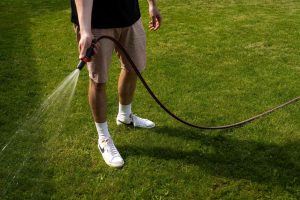
The nematode treatment window is narrow – do not miss it. Heterorhabditis bacteriophora nematodes for chafer grubs must be applied when soil temperature is above 12°C, ideally in August before the larvae move deep into the soil. They require watering in thoroughly and need the soil to remain moist for at least two weeks after application. Nematodes applied in October, when soil temperature has dropped, will produce no measurable effect.
Leatherjackets
Leatherjackets are the larvae of crane flies (daddy-long-legs), which lay their eggs in grass in late summer. The grey-brown, legless grubs hatch in autumn and feed on grass roots through the winter and into spring, causing yellowing patches that are most visible in October to March. The damage pattern is similar to chafer grub damage but the timing is different – if yellowing patches appear in late autumn and winter rather than August-September, leatherjackets are the more likely cause.
A simple overnight test helps confirm leatherjacket presence. Soak an affected patch thoroughly, cover it with black plastic sheeting and leave overnight. Leatherjackets will migrate toward the surface by morning and can be found beneath the sheeting when it is lifted. On heavily infested areas, hundreds may be visible. The biological control nematode Steinernema feltiae is effective against leatherjackets and should be applied in September when the young larvae are close to the surface and soil temperature is still adequate – above 10°C.
Ants, Moles and Worm Casts
Ants cause lawn damage by excavating soil beneath the grass to build their colonies, creating sandy patches where the grass dies from root disturbance. The damage is more unsightly than fatal – ant colonies in a lawn rarely kill grass across a wide area – but in a well-maintained lawn the bare sandy patches and spoil mounds are conspicuous. Ant treatments for lawns are primarily contact powders applied directly to the nest entrance. Watering the area first encourages ant activity to the surface and makes treatment more effective.
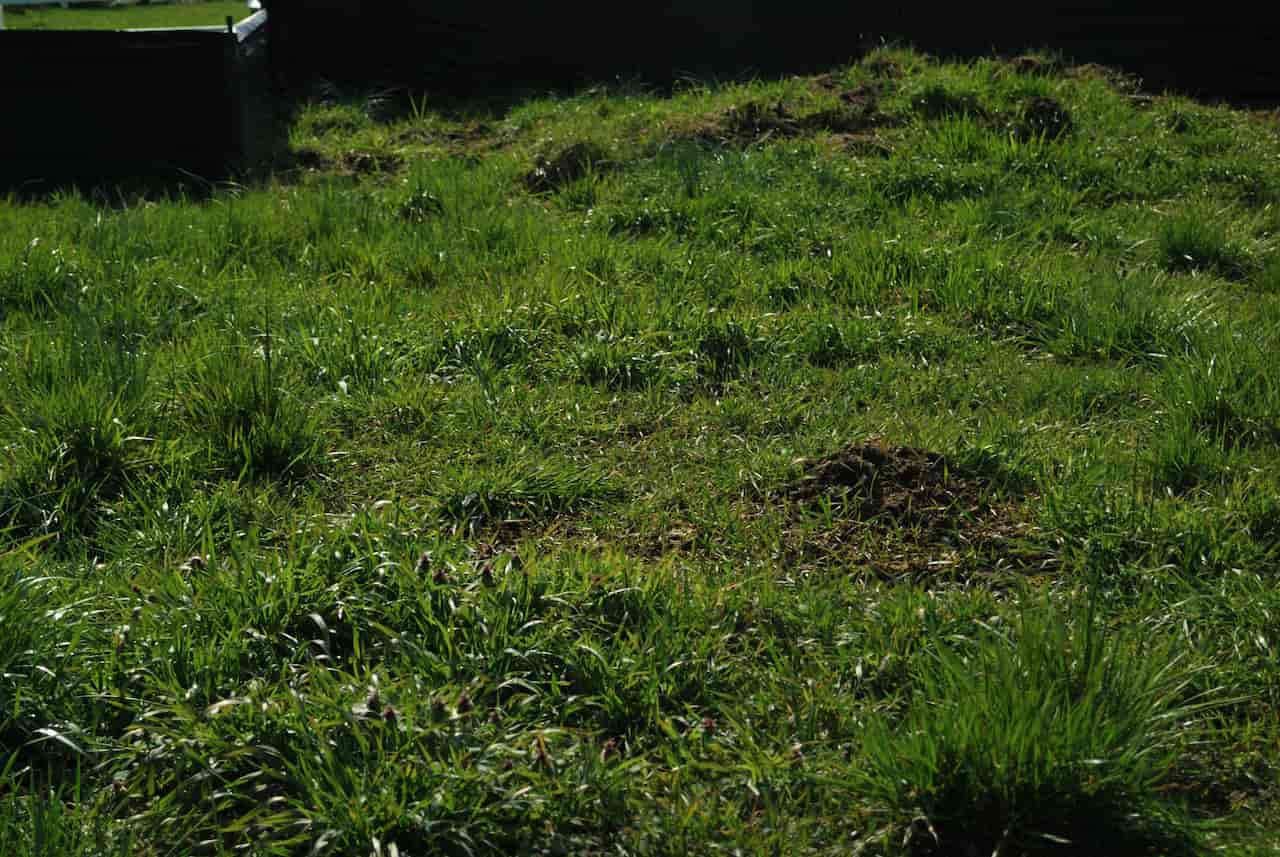
Moles are less common in urban gardens than in rural settings but cause significant surface disruption when they are present. They do not eat grass roots – their tunnels simply undermine the turf from below, leaving it hollow and uneven. The mounds themselves are not the tunnels; the actual runs are the raised ridges between mounds. Moles are protected from cruel treatment under UK law and the most reliable approaches are either professional trapping or deterrents such as underground vibration stakes, though these have variable results.
Treatment Options Compared
The available treatments for chafer grubs and leatherjackets in the UK are now almost exclusively biological – the chemical treatments that were previously available, including thiacloprid-based products, were withdrawn from the UK market. This leaves biological control with nematodes as the primary active treatment option, alongside physical management and lawn repair.
Nematodes have strict storage and application requirements. They are live organisms supplied refrigerated and must be used promptly after purchase. They cannot be applied through a standard hosepipe without dilution, require specific application rates and must be watered in immediately. Failing any of these conditions renders them ineffective regardless of how well timed the application is.
Prevention and Long-Term Management
A healthy, dense lawn is significantly more resistant to pest damage than a thin, stressed one. Chafer beetles preferentially lay eggs in sparse, sunny, sandy areas rather than dense, shaded or moisture-retentive turf. Regular aeration, appropriate feeding and maintaining a cutting height of 3-4cm through summer all contribute to a lawn structure that makes it harder for pests to establish at damaging levels. A lawn that is already stressed by drought or disease before a pest arrives recovers far more slowly than a well-maintained one.
Share on socials: