At a glance
Solar panels have moved from a niche environmental choice to the most cost-effective home energy improvement available to most UK homeowners. Falling installation costs, rising electricity prices and the availability of the Smart Export Guarantee – which pays you for surplus electricity exported back to the grid – have transformed the financial case for solar. A typical 4 kilowatt-peak system installed on a south-facing roof now costs around £6,000 to £8,000 fully installed, and with electricity prices where they are, the combination of self-consumption savings and export payments can reduce payback periods to under ten years for well-sited systems. Add a battery, and you can self-consume a significantly higher proportion of what you generate.
The quality of solar advice available in the UK varies enormously. Some installers quote systems that are larger than necessary and steer buyers toward premium options with limited additional benefit. Others understate the importance of roof orientation, shading and structural suitability. This guide gives you the independent grounding you need to assess quotes accurately, understand what you are actually buying, and make the decisions that will determine whether your system performs as well as projected over its 25-year life.
Is solar right for your home?
The most important variable in solar system performance is roof orientation and pitch. A south-facing roof at a pitch of 30-40 degrees is the ideal in the UK, producing around 20% more energy annually than an east or west-facing equivalent. East and west-facing roofs are absolutely viable – they typically produce around 15-20% less than south-facing – and many households find that east-west split installations across two roof planes actually improve self-consumption by spreading generation across more of the day. North-facing roofs are not suitable for solar PV in the UK climate.
Shading is the factor most frequently underestimated in pre-installation surveys. Even partial shading from a chimney stack, a neighbouring tree or a satellite dish can reduce the output of an entire string of panels, not just the shaded panel itself, in a standard string inverter system. If shading is present, microinverters or DC optimisers – which allow each panel to operate independently – are the appropriate solution and are worth the additional cost. A credible installer will shade-survey the roof at different times of day and seasons before quoting, and will flag any shading issues explicitly in their survey report.
Panel types – monocrystalline, polycrystalline and thin-film
The vast majority of residential solar installations in the UK use monocrystalline silicon panels, and for good reason – they offer the best combination of efficiency, space utilisation and longevity currently available at mainstream prices. Polycrystalline panels are slightly less efficient and are now largely being phased out of the UK residential market as monocrystalline prices have fallen to comparable levels. Thin-film panels have a specific role in commercial and building-integrated applications but are rarely the right choice for a standard UK residential roof.
Within the monocrystalline category, half-cut cell technology has become the standard in quality installations. Half-cut panels split each cell into two halves, which reduces resistive losses and improves performance under partial shading conditions. They cost marginally more than standard monocrystalline panels but the performance advantage is genuine and worth having for most UK roof situations. TOPCon and HJT panel technologies represent the current premium tier, offering efficiencies above 22%, and are worth considering where roof space is limited and maximising output per square metre matters.
Costs and system sizes
Solar system size is measured in kilowatt-peak (kWp) – the rated output of the panels under standard test conditions. For most UK homes, a system between 3.5 kWp and 5 kWp is appropriate, with the optimum size dependent on roof space available, annual electricity consumption and the proportion of generation the household can self-consume during daylight hours. Larger systems generate more electricity but also export more to the grid, and the export payment rate is lower than the self-consumption saving rate, so there is a diminishing return beyond a certain system size for households that are not home during the day.
Get at least three quotes and compare like for like. Solar quotes vary enormously in what they include. Check that quotes specify the exact panel model and wattage, the inverter brand and type, the scaffolding arrangement, all electrical work to the consumer unit, MCS certification, and system monitoring. A cheaper quote that omits scaffolding or uses a budget inverter is not comparable to a comprehensive one. The inverter in particular deserves attention – a cheap inverter on a quality panel array limits the whole system’s performance and has a shorter lifespan.
Grants, schemes and the Smart Export Guarantee
There is no direct grant for solar panel installation available to most UK homeowners in 2025. The Feed-in Tariff closed to new applicants in 2019 and has not been replaced with an equivalent subsidy. However, there are two significant financial mechanisms that affect the economics of a solar installation, and one means-tested grant route for eligible low-income households.
The Smart Export Guarantee (SEG) is the primary ongoing financial benefit for solar owners. Under the SEG, energy suppliers with more than 150,000 customers are required to offer a tariff that pays you for every unit of electricity you export to the grid. Rates vary by supplier and tariff type – the best fixed SEG rates at the time of writing sit between 5p and 15p per kWh exported, with some variable rates higher during peak demand periods. The SEG is not a large revenue stream on its own – a typical household exports 30-50% of what their system generates – but it meaningfully improves the overall financial picture and reduces payback periods.
MCS certification is a non-negotiable requirement for both the Smart Export Guarantee and any grant eligibility. MCS (Microgeneration Certification Scheme) is the quality standard for small-scale renewable energy installations, and only installations carried out by MCS-certified installers qualify for these benefits. Always verify that any installer you consider holds current MCS certification before agreeing to a contract – the MCS website maintains a searchable register of certified installers.
The installation process
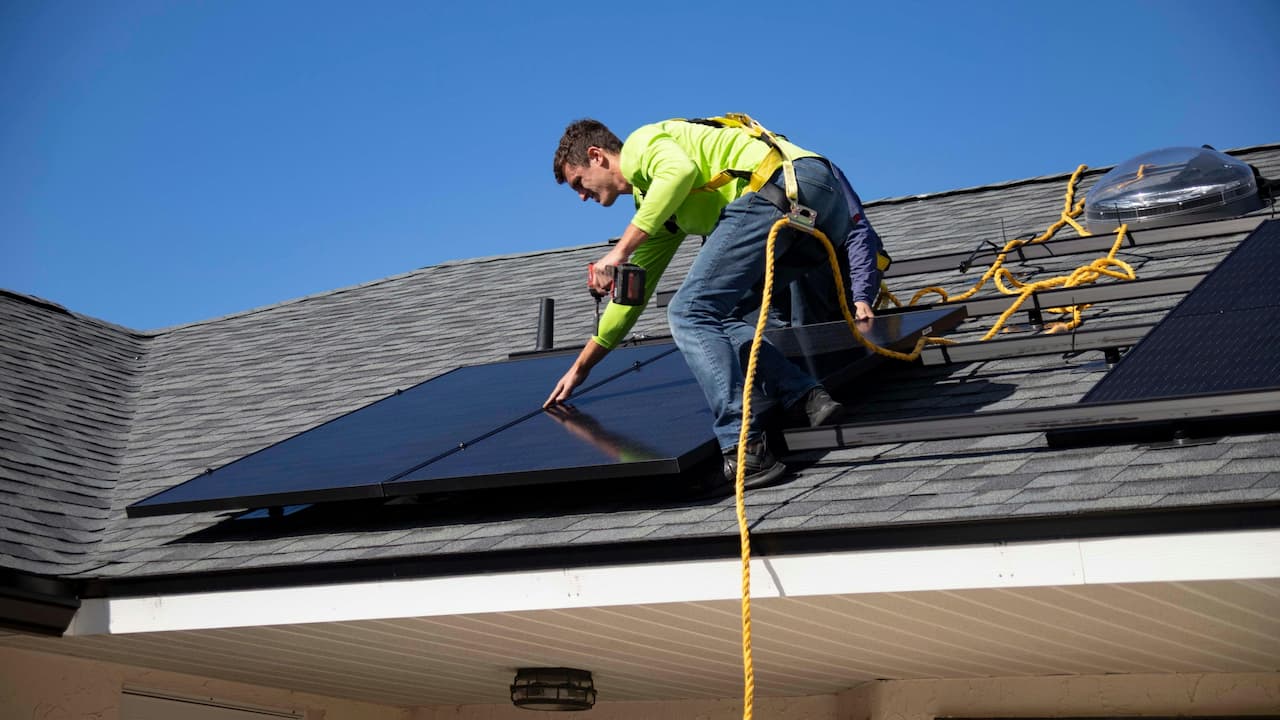
A standard solar installation for a UK home takes one to two days on site for a typical 4 kWp system, though the full process from initial survey to final sign-off takes several weeks. The on-site work involves scaffolding erection, fitting the mounting rails to the roof, installing the panels, running DC cables from the roof to the inverter location (typically the loft or a utility room), installing the inverter and generation meter, connecting to the consumer unit, and commissioning and testing the system. Most reputable installers remove the scaffolding on the same day as installation.
Before installation can begin, the installer must notify the Distribution Network Operator (DNO) – the company that manages the local electricity network – for systems above 3.68 kW. This is a legal requirement and reputable installers handle it on your behalf. It can add two to four weeks to the overall timeline but is rarely a barrier to installation proceeding. Planning permission is not normally required for solar panels on a dwelling in England and Wales under permitted development rights, provided the installation does not protrude more than 200mm from the roof surface and the panels do not face a highway. Listed buildings and properties in conservation areas may require consent – check with your local planning authority if in doubt.
Batteries and maximising your savings
A solar battery stores surplus generation that would otherwise be exported to the grid and makes it available for use in the evening, overnight and on cloudy days. The financial case for battery storage has strengthened considerably as electricity prices have risen, because the saving from using stored solar electricity rather than buying from the grid at peak evening rates is now significantly higher than the export payment you give up. For a household with moderate evening consumption, a 5 kWh battery typically increases self-consumption from around 30% to 55-65%, which at current electricity prices represents a meaningful improvement in annual savings.
The most important factors in battery selection are usable capacity, warranty terms and the quality of the battery management system. Usable capacity is the figure that matters – a 10 kWh battery with 90% depth of discharge delivers 9 kWh of usable storage, while a budget battery with only 70% DoD delivers 7 kWh from the same headline figure. Warranty terms of 10 years with a guaranteed minimum end-of-warranty capacity of 70-80% are the industry standard for reputable brands. The leading residential battery brands in the UK market are Tesla Powerwall, GivEnergy, Growatt and Sonnen – all MCS-certified and well supported by UK installers.
Never agree to a solar installation with a company that cold-calls you or applies pressure to sign on the day. Reputable MCS-certified solar installers do not operate this way. The solar sector has a well-documented history of mis-selling through aggressive sales tactics, particularly targeting older homeowners. Take your time, get multiple quotes, verify MCS certification independently, and never sign a finance agreement the same day you are first approached.
Share on socials: