At a glance
Roses are among the most rewarding plants in the UK garden and also among the most susceptible to problems. The same conditions that make them flourish – warm humid summers, rich soil, dense planting – also favour the fungal diseases and insect pests that can turn a beautiful display into bare stems and spotty leaves by August. Then there are the soil-borne problems that many gardeners encounter without recognising them at all: stem dieback that keeps returning despite pruning, or newly planted roses that sulk and fail to establish despite every care – classic signs of replant disease, one of the most misunderstood rose problems in British gardens.
This guide covers every common rose problem – the three main fungal diseases that cause the most foliage damage, stem dieback and canker, rose replant disease and replant sickness (they are different conditions), and the full range of insect pests from aphids to sawfly larvae. It also covers what the evidence shows about treatment: which approaches are effective, which are largely useless, and what prevention measures genuinely make a difference to how badly roses suffer each year.
Quick reference – all problems at a glance
The table below covers every common rose pest and disease in UK gardens. Severity reflects the potential impact on the plant if left untreated.
Fungal diseases – identification and control
All three of the main rose diseases in the UK are caused by fungi, and all three spread most readily in warm, humid conditions. The critical difference between them is what conditions each one favours: black spot spreads via water splashing on leaf surfaces and thrives in wet summers; powdery mildew paradoxically favours dry soil at the root combined with humid nights; rose rust spreads by airborne spores and is most damaging in springs with cool wet weather followed by warm humid spells. Understanding which conditions favour which disease helps explain why years vary so much – the disease profile in a given season depends heavily on the weather pattern, and why a rose that sailed through one summer may be badly hit the next.
Never compost diseased rose material. Fungal spores from black spot, rust and mildew survive in compost and return to roses when the compost is spread as a mulch. Bin all infected leaves, stems and prunings. This applies to fallen leaves too – raking and disposing of them in autumn genuinely reduces the amount of fungal inoculum available to reinfect plants the following spring.
Stem dieback and canker
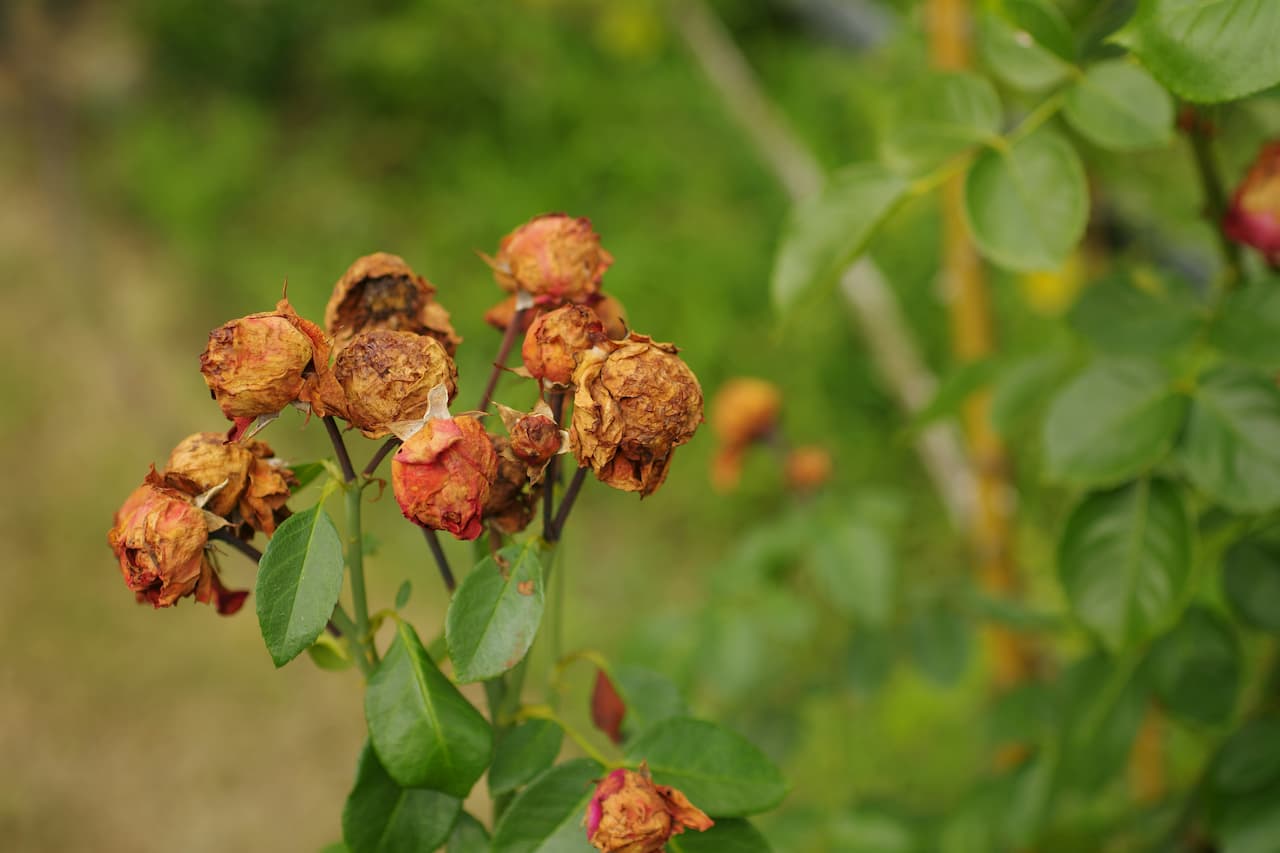
Stem dieback and rose canker are among the most frequently misunderstood rose problems. When a stem dies back section by section, or when brown sunken lesions appear on canes, many gardeners assume something is attacking the plant from outside. In reality, the fungi responsible – various species including Coniothyrium and Botrytis – are primarily opportunists that enter through existing wounds. Pruning cuts made in wet conditions, frost-damaged tissue, mechanical damage from ties or stakes rubbing, and cuts made with unclean tools are the primary entry points. A rose with no open wounds in good condition resists canker fungi effectively. A rose with repeated fresh wounds in damp weather is essentially presenting an open door.
The approach to stem dieback and canker is straightforward once the mechanism is understood. Prune in dry conditions, using clean sharp secateurs disinfected between plants. Cut to an outward-facing bud with a clean angled cut that sheds water away from the bud. When you encounter a stem with visible brown or sunken lesions, cut back to clean, healthy white wood well below the lesion – at least 5cm below any discolouration. If the cut surface shows any brown or discoloured tissue, keep cutting until only clean white wood is visible. Dispose of all removed material. Leaving even a short stub of diseased wood above a pruning cut creates the ideal entry point for further infection. When dieback recurs in the same location year after year, check whether frost is repeatedly killing shoot tips in that spot, or whether a buried section of stem has canker that is continuously reinfecting new growth above it.
Rose replant disease and sickness
Rose replant disease is one of the most practically important rose problems in UK gardens and one of the least well understood. When a new rose is planted into soil that has grown roses before – particularly on the same spot – it often fails to establish properly despite apparently good planting. Growth is weak and stunted, the plant looks sickly, it fails to put on the growth expected in its first season, and it may decline progressively over the following years. The condition is caused by a complex of soil-borne organisms including specific fungi and nematodes that build up in the root zone of established roses over time. New roses are particularly susceptible because they lack the established root system to grow through or compensate for the biological pressure in the soil.
Rose replant sickness is distinct from replant disease, though the two terms are frequently used interchangeably. Replant sickness refers to a broader soil exhaustion effect – the physical and chemical depletion of nutrients, the change in soil structure, and the build-up of allelopathic compounds (growth-inhibiting substances released by rose roots) that makes rose-tired soil less suitable for new plants. A rose bed that has grown roses for 20 years will show elements of both conditions: the specific pathogen complex of replant disease combined with the general soil exhaustion of replant sickness. The practical solutions for both conditions overlap considerably.
Mycorrhizal fungi at planting genuinely helps. Products containing mycorrhizal fungi, applied directly to rose roots at planting time, help new plants establish root networks more quickly and build resilience against soil-borne pressure. They do not cure replant disease but they reduce the impact significantly, particularly where soil replacement is not practical.
Insect pests – identification and control
Rose pests divide into two categories: sap-sucking insects that weaken growth and trigger secondary problems like sooty mould, and leaf-eating insects whose larvae can strip a plant surprisingly fast. The distinction matters for control. Sap-suckers respond well to physical removal and to encouraging natural predators – ladybird larvae, lacewing larvae and hoverfly larvae are highly effective aphid predators and arrive naturally in gardens with good biodiversity. Leaf-eaters are most effectively managed by hand-picking while larvae are small, before populations reach the scale where defoliation is inevitable. By the time a rose has been stripped of foliage, the opportunity to prevent the damage has passed – regular inspection from late spring is the critical habit.
Rose aphids greenfly and related species) cluster on the soft tips of new shoots and around developing buds from spring onwards, piercing tissue to extract sap. Shoot distortion, stunted growth and weakened buds result. The sticky honeydew they excrete provides a growing medium for sooty mould. Heavy infestations are best dealt with by rubbing colonies off by hand or with a strong water jet directed at the undersides of shoots. Natural predators arrive within days if left undisturbed – a colony of aphids spotted one week will often show signs of predator activity the next. Reserve insecticide for genuine infestations that natural predators have failed to bring under control, and avoid spraying open flowers.
Large rose sawfly (Arge pagana and related species) lay eggs on rose stems, with the caterpillar-like larvae feeding on leaves – first leaving a transparent window by eating just the upper leaf layer, then consuming entire leaves as they grow. Large infestations can strip a rose of all foliage very rapidly. The pale green or yellow-white larvae, which may have rows of dark spots, are best removed by hand-picking or by cutting off affected shoots. Check undersides of leaves regularly from late spring. There are usually two generations per year.
Rose leaf-rolling sawfly (Blennocampa phyllocolus) injects a chemical into leaflets that causes them to roll tightly into a cylinder, each containing developing larvae. The damage looks alarming but rarely causes serious harm. If numbers are small, rolled leaflets can be picked off. Where widespread, leave them alone – forcibly unrolling causes more damage than the larvae do, and the infestation ends naturally as larvae drop to pupate.
Rose leafhoppers (Edwardsiana rosae) feed on leaf undersides, producing a pale mottled stippling on the upper leaf surface and leaving white cast skins beneath. Damage is primarily cosmetic. Natural predators keep populations manageable in gardens with good biodiversity, and no intervention is usually required.
Seasonal calendar – when each problem strikes
Rose problems follow predictable seasonal patterns, which makes it possible to get ahead of them rather than always reacting after damage appears. The key habit is regular inspection from when growth begins in spring – checking undersides of leaves weekly catches most pest problems before they reach the scale where they become difficult to manage. A sawfly colony spotted when larvae are small is a two-minute hand-picking job; the same colony found a week later when leaves are stripped requires far more effort and leaves lasting cosmetic damage regardless of intervention.
Treatment options compared
Chemical treatments for rose diseases and pests exist, but the evidence for their effectiveness is more limited than product marketing suggests. Fungicides protect uninfected leaf tissue from new infections but cannot cure already-infected leaves – they only deliver value when applied before symptoms appear or at the very first sign of infection, and only if reapplied at the intervals specified on the label. Applying fungicide to leaves already showing black spot does nothing for those leaves. The focus should always be on removing infected material first, then considering whether protective treatment is justified on healthy new growth. For replant disease, there is no chemical treatment – the only reliable approach is soil replacement.
Prevention through the year
Healthy roses are significantly more resistant to both pests and diseases than stressed plants. The conditions most likely to produce severe problems are predictable: dense planting with poor air circulation, drought stress at the root, excess soft growth from over-feeding with nitrogen, failing to remove infected material, and planting new roses into exhausted rose soil without preparation. Addressing these produces a tangible improvement in how roses perform from season to season – often more reliably than any spray programme.
Share on socials: