At a glance
Most climbing plants fail not because of the wrong soil, the wrong aspect, or even the wrong plant. They fail because the support went in too late, or not at all. It is easy to buy the climber, get home, and then start thinking about wires or trellis, which is exactly how you end up drilling into brickwork with a root ball sitting in a bucket and a plant that spends its first season tied loosely to a bamboo cane. The support structure goes in before the plant. Everything else follows from that.
There is a second reason to understand support before anything else. Different climbing plants attach themselves in fundamentally different ways, and the support that works perfectly for one type does almost nothing for another. A wisteria needs something to twine around. A clematis needs something fine enough for a leaf stalk to coil around. A rambling rose cannot attach itself at all. And Virginia creeper needs no support whatsoever once its adhesive pads have gripped the wall. Matching the support to the attachment type is the starting point.
How climbing plants attach themselves
There are five main ways climbing plants attach themselves, and they are not interchangeable when it comes to what support they need and how much ongoing attention they require.
Twiners wrap their stems around a support as they grow. They need something slim enough for the stem to coil around and cannot grip a wide surface directly. A smooth post on its own is useless unless it is slender, which is why wisteria trained on a wall needs horizontal wires rather than just a post to lean against. Twiners will find their own way to a support if one is within reach but need directing in the right direction early on.
Tendril climbers use modified leaf stems or shoot extensions that coil around whatever they touch. Sweet peas, passion flowers, and grapevines climb this way. They are good at working into trellis and mesh but need the support to be thin enough to coil around. A broad plank offers nothing; a finger-width of wire or timber works well.
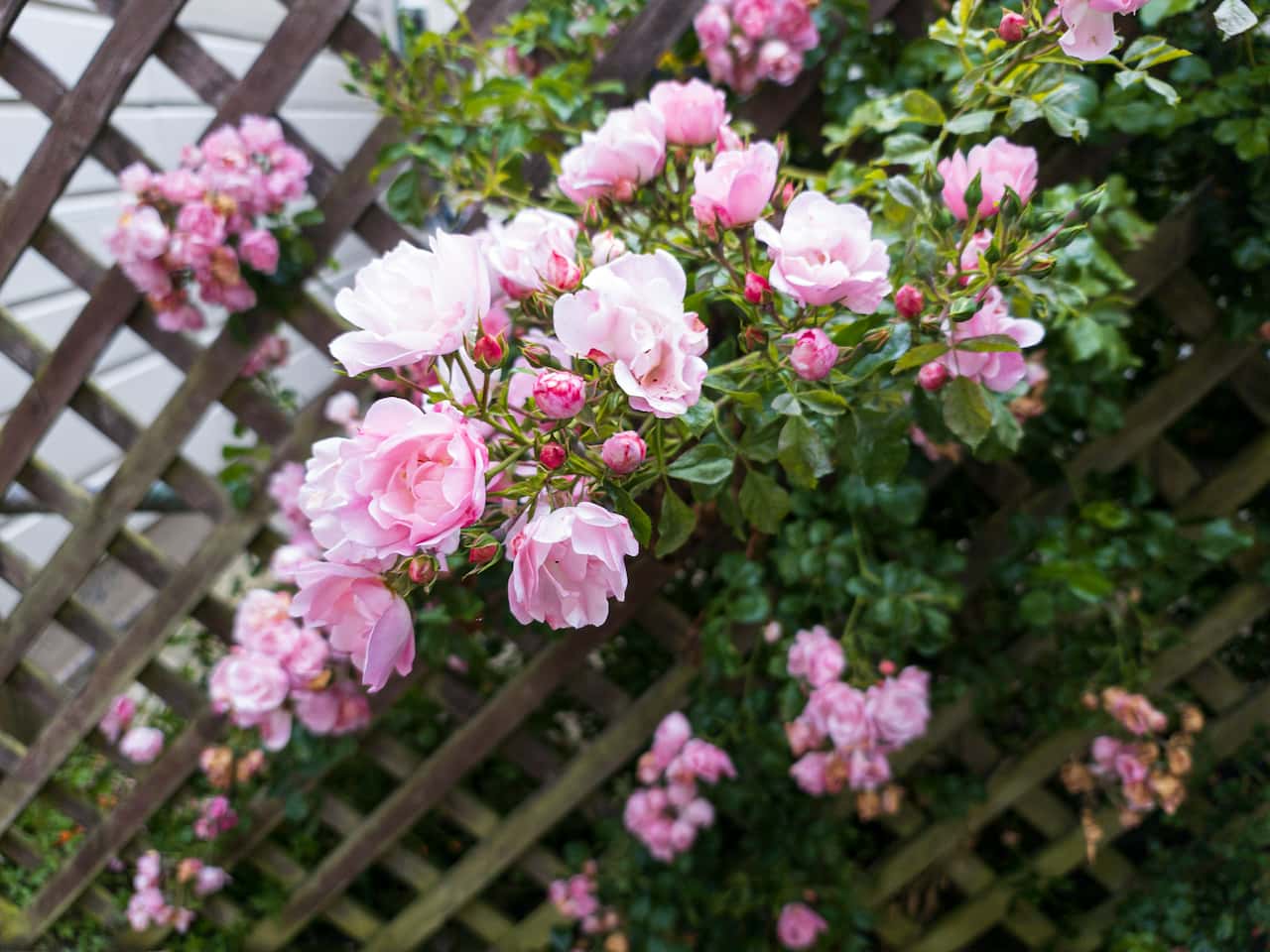
Scramblers have no attachment mechanism at all. Climbing roses and rambling roses lean through and over other plants or structures, held partly by their own weight and partly by thorns and rough stems that catch. They need manual tying at every stage and will flop completely away from any support without it. Of all the common climbers, scramblers require the most ongoing attention.
Self-clinging climbers with adhesive pads, like Virginia creeper and Boston ivy, grip almost any surface and harden as they dry. Once established they need no wires or trellis and will cover a plain rendered wall without any intervention. Self-clinging climbers with aerial roots, like ivy and climbing hydrangea, produce tiny root-like structures that grip rough surfaces. Both types need temporary guidance while young before the pads or roots develop, but no ongoing support after that.
Leaf-stalk twiners, of which clematis is the main example, coil the stalks of their leaves around supports. In practical terms they behave like tendril climbers and do well on mesh, trellis, or wire, but the support must be fine enough for a leaf stalk to wrap around.
Choosing the right support structure
The structure needs to match the weight and eventual size of the plant, the surface it is going against, and the attachment type. A structure that is too light for the plant, the wrong type for the attachment, or inadequately fixed to the wall will fail and is difficult to correct once the plant is established.
Horizontal wire systems on walls are the most durable option for vigorous climbers, particularly wisteria, roses, and honeysuckle. The gap between the wire and the wall is not aesthetic. Air circulation behind the plant prevents moisture building up at the woody base, which causes rot and fungal problems. A trellis or wire system flush against a wall traps moisture and damages both the plant and the masonry. Use stainless steel or hot-dipped galvanised fixings throughout. Ordinary zinc-plated screws corrode quickly and leave rust staining down the wall.
Growing climbers through trees is one of the most natural-looking approaches and suits a wide range of plants. Roses through old apple trees can look spectacular. Clematis through a large shrub or yew hedge looks right in a way that trellis rarely does. The essential rule is to match the vigour of the climber to the size of the host. A very vigorous climber through a small tree will overwhelm it. The climber should reach roughly the same eventual size as the top of the tree.
Wisteria must not grow into gutters, window frames, or under roof tiles. It is genuinely capable of lifting slates, blocking downpipes, and pushing into any gap it finds. Keep the growth clear of the roofline from the first season and check annually.
Fixing wires to walls step by step
The process is straightforward but the details matter. Corners cut here show up years later when a vine eye pulls free and a large section of the plant detaches. The step sequence below applies to masonry walls. For timber fencing, fix to the posts rather than the panels, and use galvanised screw eyes rather than vine eyes with wall plugs.
Never use copper wire on or near ferrous metal fixings because the two metals react and accelerate corrosion. For timber fencing, always fix to the fence posts rather than the panels. Panels flex under load and pull fixings out. Fix the wire to posts and the system will outlast several generations of fence panels.
Tying in and training
Even climbers with their own attachment mechanism generally need directing in the first year or two. Left entirely alone, most climbers concentrate their growth in one direction rather than spreading across the available support. The scramblers, which have no attachment at all, will go nowhere useful without help.
The tying decisions that matter most happen in the first three years. The framework established in that period sets the shape of the plant for its entire life on climbing roses and wisteria especially. Time spent getting it right early saves a great deal of corrective work later, and corrective work on a mature climber often means cutting structural branches out.
I have found that the best time to make a first rough tie-in of new rambling rose canes is mid-summer, well before any proper autumn training. The canes snap at the base in the first gale if they have been left loose all season, and a snapped cane is gone. A rough tie buys the time needed to train them properly.
Support guidance by plant type
Most climbing plants have specific support requirements beyond the general principles. The table below covers the main types grown in UK gardens with what each needs, how much tying is required, and what to watch for.
Clematis varies more than any other common climber. Large-flowered hybrids are modest in vigour and do well on obelisks, trellis panels, or wire mesh on fencing. Group 3 clematis restart from scratch each spring, so their support needs only to provide a structure for new growth to find from low down. The species clematis are a different matter. Clematis montana can reach 10 to 12 metres and must have a large wall, a substantial pergola, or a mature tree to grow through. It will overwhelm a modest arch within three or four years.
Wisteria on a wall needs determined training for the first three to four years to establish a clean fan framework. New growth runs fast and needs tying into the horizontal wires as it goes. If the framework is not created while the plant is young, the result is a tangled mass with growth concentrated at the top and bare wood lower down. Keep wisteria out of gutters, off window frames, and away from roof tiles. It is genuinely capable of prising fixings, lifting slates, and blocking downpipes if it gets into gaps.
Sweet peas need support from the moment of planting out. The tendrils grip each other without something to climb, and the plants tangle into a mat rather than climbing. Pea sticks are the traditional solution: bundles of twiggy hazel or birch pushed into the ground around the plants. They look natural, give multiple gripping points, and are easy to remove and compost at the end of the season.
Seasonal maintenance of support structures
Support structures need checking every year. This is most efficiently done in winter when the plant is dormant and the structure is fully accessible, but there are useful tasks in every season.
In winter, before growth resumes, is the best time to assess the full structure. With deciduous climbers stripped of their leaves, the wires, vine eyes, and trellis are all visible and accessible. A vine eye that was solid last winter may have loosened in the intervening year as the mortar around it aged. Replace any that are suspect before the plant puts on another season of growth and weight.
Ties deserve a special mention. A tie put on three years ago on a vigorous climber will have tightened considerably as the stem behind it thickened. A tie that is cutting into the bark shows as a swollen ridge above the point of pressure. Remove any embedded ties immediately. If girdling has already occurred, cut the stem back to a healthy point below the damage. On most vigorous climbers new growth from lower on the plant will replace it, but losing a main framework branch sets the plant back substantially.
Problems with climbing plant supports
Most support failures follow predictable patterns. Catching them early is far less disruptive than dealing with a plant that has partly or fully detached from the wall.
Common questions
Can you train a climber against a wooden fence? Yes. Fix horizontal wires to the fence posts rather than the panels. Panels flex under load and pull fixings out. Fencing has a finite life of 15 to 20 years for most softwood panels, so consider how you will deal with replacing a panel that has a climbing rose against it. Hinged trellis sections on battens, which fold flat when the panel behind needs replacing, are a practical solution for long-term plantings.
When should the support go in? Before the plant is put in the ground. Getting fixings into a wall without a plant in the way is far easier. For most climbers the rule is: build the support, then plant against it. For self-clinging climbers only, no ongoing structure is needed at all.
Do climbing plants damage walls? Self-clinging climbers with adhesive pads or aerial roots are most often accused of damage, but established self-clinging plants on sound masonry cause very little. The damage occurs at removal, when pads are pulled away and can take surface render or paint with them. Ivy can exploit existing loose pointing but does not cause the underlying failure. Wisteria is the genuine exception: it should be kept clear of gutters, window frames, and any gap in the roofline.
How often should ties be checked? At minimum once a year in autumn. On vigorous climbers that put on substantial growth each year, twice is better. Ties tighten significantly as stems thicken and can go from loose to embedded in a single growing season.
What is the best wire gauge for wisteria? Use 4mm galvanised or stainless steel wire with substantial vine eyes driven firmly into sound mortar. A mature wisteria in full leaf can exert significant weight and wind resistance, and lighter wire systems that suit roses will not hold it long term. Space vine eyes no more than 1.5 metres apart along each wire run.
Share on socials: