At a glance
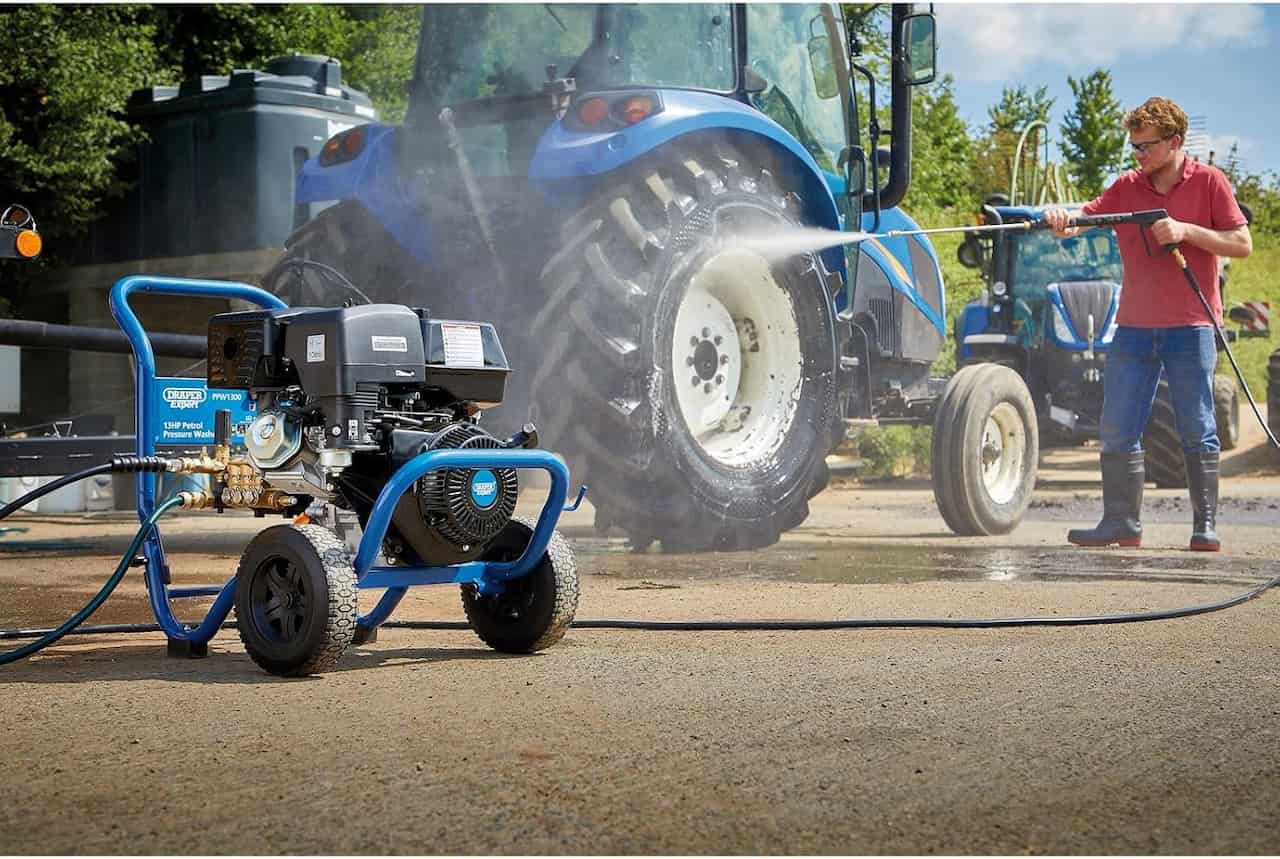
Draper are upfront about what this one isn’t for, and that honesty tells you a lot before you’ve even started it up. The Expert 83819 is built for genuinely heavy-duty work, agricultural, industrial, anywhere with serious ground in dirt and no mains power, and Draper’s own guidance is explicit that the pressure it produces makes it unsuitable for domestic vehicles.
It runs a 389cc 4-stroke engine rated at 13HP, with a working pump pressure of 234 bar and a maximum of 262 bar, at a flow rate of 720 litres an hour. Dry weight is 55kg. The question was whether that genuinely serious specification translates into genuinely serious results once it’s actually running.
Overview and first impressions
This is the heaviest machine I’ve put together for review, and assembly reflects that: the frame, wheels and handle all need fitting properly before anything else happens, and at 55kg dry it’s a two-person job to get it upright and onto its wheels for the first time rather than something to wrestle with alone.
One genuine surprise on unboxing: neither the engine oil nor the pressure pump’s own oil come supplied. The engine takes SAE 15W-40, and the pump itself needs a separate synthetic gear oil to ISO 150, distinct requirements that I hadn’t accounted for and had to sort before it would even run. There’s a step before that too, easy to miss: the pump ships with a plug in place of the oil dipstick, and the manual is explicit that you have to remove the shipping plug and fit the dipstick before adding oil, or you risk damaging the pump outright. Budget time for all of this before delivery day rather than assuming it’s ready to fill with fuel and go.
The manual is also specific about the water supply it needs feeding in: a minimum of 20psi and 19 litres a minute. That’s worth checking against your own tap or supply before you start, since it’s a higher bar than most domestic outdoor taps comfortably provide on their own.
The Triplex brass pump head has a built-in pressure regulator, and the kit comes with a heavy duty spray gun, a metal lance, five nozzles and a 1/4 inch hose adaptor, everything genuinely feels built for repeated, hard use rather than the lighter plastic fittings on smaller machines. The 8m high-pressure hose itself has steel reinforcement running through it, the kind of detail that matters once you’re dragging it across rough ground rather than a smooth patio.
This is explicitly not for washing cars. Draper state plainly that the pressure this produces makes it unsuitable for domestic vehicles. At 234 bar working pressure that’s not an exaggeration, this will strip paint and damage bodywork rather than clean it. Keep it on concrete, stonework and ground-in dirt, not the car.
Specifications and scores
How it performed in our tests
A concrete yard with years of oil and tyre marks worked into it was the obvious first job, and at 234 bar it cut through staining that I’d normally expect to fade rather than properly lift, leaving bare concrete in passes that needed real effort with anything smaller. The flow rate matters here too, 720 litres an hour kept the surface properly wetted rather than the jet outrunning the water the way weaker machines can on a big area.
A run of old paving and a low stone retaining wall both responded well, years of moss and general grime coming away cleanly. The manual’s own advice on nozzle choice held up in practice: start with the lowest pressure nozzle and work up only if you need to, rather than reaching for the most aggressive one out of habit. The nozzle set gave a sensible spread from a tight, aggressive jet for the worst of the staining to a wider fan for general coverage, and switching between them was quick enough not to break the rhythm of a long job.
For the detergent pass on the paving, I used the dedicated chemical nozzle rather than trying to siphon soap through a high-pressure one, which the manual is clear won’t work properly. It also specifically advises against wetting the surface first, since that dilutes the detergent rather than helping it, a habit worth breaking if you’re used to a smaller machine. Standard pressure washer detergent only, the manual rules out chlorine bleach entirely.
I didn’t test it on anything remotely close to a car, in line with Draper’s own warning, and having used it on concrete and stone I can see exactly why. The force behind even the gentlest setting here is genuinely more than anything paintwork should see.
Find the pump’s shipping plug before you go anywhere near the oil bottle. It sits where the dipstick should go, and adding oil without swapping it out first is exactly the kind of mistake that damages the pump rather than just looking silly.
Engine and running costs
The 389cc engine spins at 3350 to 3550 RPM with no load, settling into a steady, heavy-duty drone rather than a quiet hum, hearing protection is genuinely worth having for anything beyond a few minutes. It’s a proper recoil-start petrol engine and behaves like one, a firm pull rather than a token one. The manual is specific about the order things happen in too: water off, start the engine, then turn the water on within 60 seconds, since starting it with the supply already pressurised puts real strain on the starting mechanism. It also wants at least 1.5 metres of clear space on every side once it’s running, with the exhaust facing away from anything you don’t want fumes drifting toward.
Running costs are exactly what you’d expect from something this size: regular engine oil checks, the separate pump oil to keep an eye on too, and the usual air filter and spark plug attention any 4-stroke engine asks for. None of it is unusual for petrol equipment, but it’s worth knowing that this has more to look after than a typical homeowner petrol washer given the dedicated pump lubrication on top of the engine.
The warranty is 12 months for parts and labour, confirmed directly by Draper, consistent with their stated policy that pressure washers and other petrol equipment get a year’s cover rather than the two years given to their power tools. The manual adds a bit more nuance than the product page does: parts cover actually extends to 24 months, and if the machine is ever hired out rather than owned outright, that drops to just 90 days.
Performance and limitations
What this does brilliantly is exactly what Draper built it for: sustained, serious pressure against genuinely stubborn dirt, with no mains power needed anywhere. Concrete, paving and stonework all came up properly, and the flow rate keeps pace with the pressure rather than leaving you waiting for water.
The trade-offs are significant and shouldn’t be glossed over. At 55kg dry this is a two-person machine to move, full stop, and the noise and the dual-oil maintenance routine are real, ongoing considerations rather than one-off inconveniences. This is also explicitly not a car-cleaning tool, and treating it as one risks real damage.
None of that is a flaw so much as an honest reflection of what genuinely heavy-duty equipment asks of you. Buy it for the jobs it’s built for, and the size and the maintenance stop being downsides and start being the reason it can do what smaller machines can’t.
- Genuinely heavy-duty pressure and flow rate
- Brass Triplex pump built for repeated hard use
- Honest about what it isn’t built for
- No mains power needed anywhere
- 55kg dry, genuinely a two-person machine
- Neither oil comes supplied
- Explicitly unsuitable for domestic vehicles
- Only 12 months warranty as standard
- Genuinely heavy, ground-in dirt on concrete and stone
- Agricultural, industrial or trade sites with no mains power
- Anyone comfortable maintaining petrol equipment properly
- Anyone wanting to wash a car with it
- Anyone needing to move it alone regularly
- A typical home patio or driveway routine
Final verdict
This is exactly the machine its specification suggests: genuinely heavy-duty, genuinely powerful, and genuinely honest about where it doesn’t belong. Concrete, paving and stonework all came up properly, and the working pressure here is on another level entirely from anything domestic.
It’s not for a car, and it’s not for someone wanting a quick, light job either. The weight, the dual oils and the noise are real, ongoing parts of owning this, not occasional inconveniences. For the right job, none of that matters against what it actually achieves.
Sort both oils before delivery day, plan to move it with two people, and keep it firmly away from anything with paintwork. Do all three, and this earns its place as proper heavy-duty equipment rather than an oversized inconvenience.
A genuinely heavy-duty petrol pressure washer that delivers serious pressure against serious dirt, honest about being unsuitable for cars or casual use. Held back only by its weight, its noise, and a maintenance routine that asks more than most petrol washers.
Share on socials: