At a glance
Slate is one of the most enduringly popular garden surfacing materials in the UK, valued for its distinctive blue-grey colouring, natural texture, and genuine durability in the wet conditions that British gardens experience year-round. Unlike many decorative aggregates that fade, crack or degrade over time, good quality Welsh or Spanish slate holds its colour, resists frost reliably, and looks better for weathering rather than worse. The three main products – chippings, paving slabs and stepping stones – are related materials but have very different applications, depth requirements and laying methods, and choosing the right product for the right situation makes the difference between a finished garden feature that works well and one that looks good initially but causes practical problems within a season. All three products are available from garden centres, builders merchants and online suppliers throughout the UK, with prices varying significantly between Welsh quarried slate and imported Chinese or Spanish alternatives.
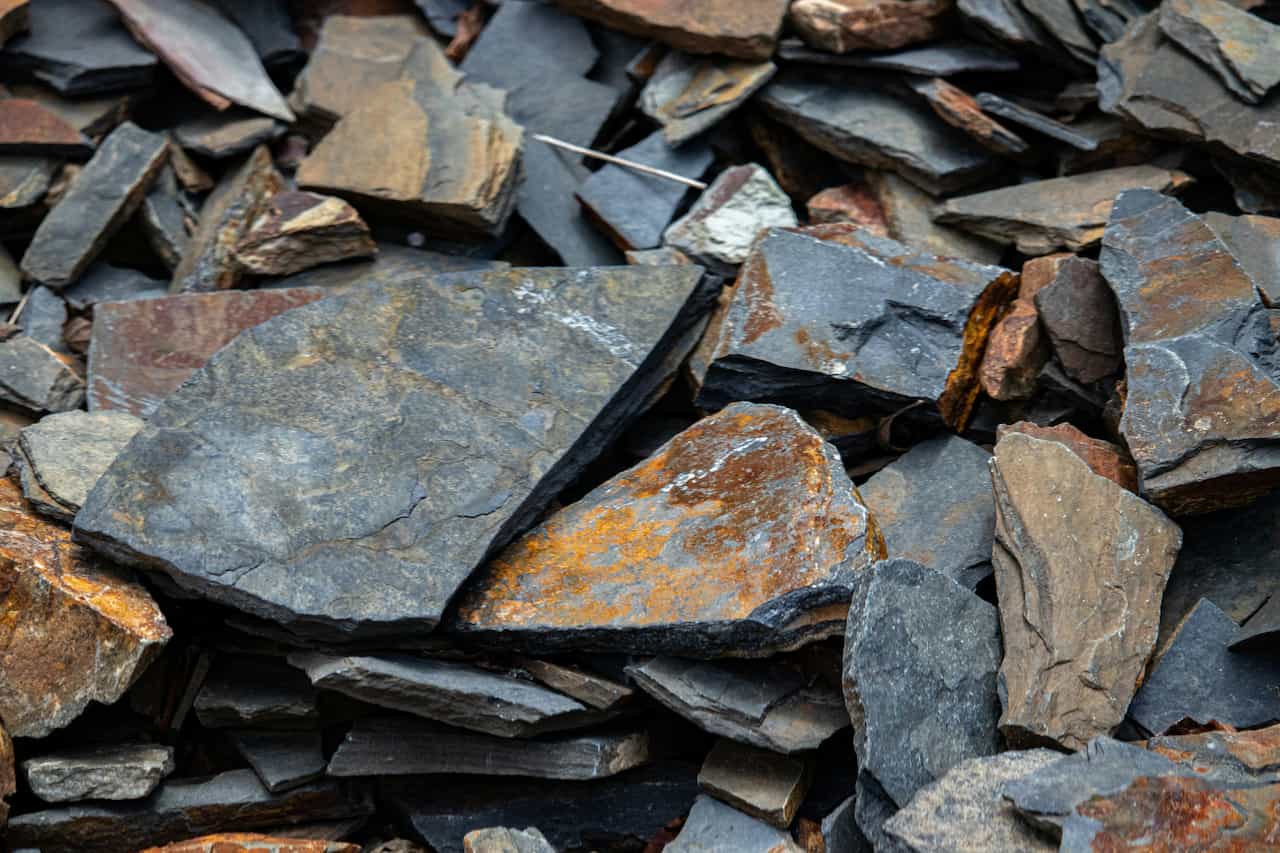
Slate’s colour range is its most distinctive characteristic. Natural blue slate presents as a rich blue-grey when wet and a cooler, lighter grey-blue when dry, making it one of the few garden materials that genuinely looks good in both conditions. Green slate offers a more muted, sage-green tone that suits naturalistic planting schemes and woodland garden settings. Red or purple slate products are available but less commonly used in UK gardens, where the cooler blue-grey tones tend to complement planting more naturally. In all cases, the real product differs from the photographs on packaging – slate that appears vivid blue in a marketing image often presents as more grey-blue in quantity outdoors, and viewing a sample in natural light before ordering in volume saves disappointment. Welsh slate is generally considered the premium product for colour depth and quality but carries a higher price premium over Chinese or Spanish imported alternatives, which vary considerably in quality between suppliers.
What You’ll Need
Slate Chippings
Slate chippings are the most widely used and most versatile of the three slate products, suitable for mulching around plants, surfacing paths and driveways, filling gravel gardens, and covering borders to suppress weeds while retaining moisture. The standard size for garden use is 20mm, which provides good coverage, doesn’t compact excessively, and is heavy enough to stay in place in most conditions. Smaller 10mm chippings are available and give a finer appearance but migrate more easily and are harder to walk on comfortably. Larger 40mm slate pieces are sometimes used for decorative water features and as a mulch around large specimen shrubs or trees. The key installation requirement is depth – for weed suppression in a border, a minimum 5cm depth of chippings over landscape fabric is needed. For a path or driveway surface that will be walked on regularly, 7-8cm over a compacted sub-base is the minimum for a stable surface that doesn’t move underfoot.
Landscape fabric under chippings is essential for weed suppression but must be the right grade. Cheap thin fabric compresses under the weight of the chippings and allows weed roots through within a season. Use a woven polypropylene fabric of at least 100gsm – the heavier grades provide significantly better long-term weed suppression. Overlap fabric joins by at least 20cm and pin all edges and overlaps with landscape pegs before laying the chippings. Edging boards or steel lawn edging around the perimeter contain the chippings and prevent migration into adjacent grass or borders – without edging, chippings spread gradually over years and require constant retrieval from lawn edges. When cutting fabric to fit around existing plants, use an X-cut rather than removing a large circle – the X-cut allows the fabric to sit snugly around the plant stem while minimising the exposed soil area where weed seeds can settle and germinate.
Wet slate chippings are slippery on slopes. The smooth, flat surfaces of slate pieces become treacherous when wet on any incline steeper than about 5 degrees. For sloped paths and drives, angular crushed slate rather than the standard washed and sorted product provides better grip, or use slate stepping stones set into the chippings to provide a firm, non-slip walking line through the area.
Slate Paving Slabs
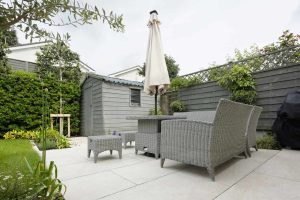
Slate paving slabs are cut or riven natural slate supplied in regular or irregular shapes for use as a primary patio or path surface. Natural riven slate has an uneven, textured surface that provides good grip even when wet and gives the characteristic handmade appearance associated with traditional slate paving. Calibrated slate slabs have a more consistent thickness (typically 20-25mm) and are easier to lay to a level surface than uncalibrated riven material where individual slabs can vary by several millimetres in thickness. For a patio that will be used regularly by multiple people, calibrated slate is significantly easier to work with and produces a more even, safer finished surface. Both types are fully frost-resistant and will not delaminate or crack in normal UK winter conditions, unlike some cheaper sandstone or limestone alternatives.
Laying slate slabs requires a properly prepared sub-base – a minimum 100mm depth of compacted MOT Type 1 hardcore, topped with a 30-40mm sand and cement bed at a ratio of 4:1 sharp sand to cement. Lay slabs on five blobs of mortar (one at each corner and one in the centre) and bed firmly with a rubber mallet, checking constantly with a spirit level and maintaining a slight fall of 1:60 away from the house for drainage. Point the joints with a mortar mix after the bed has set – typically 24-48 hours. Leave the finished surface undisturbed for at least 48 hours before walking on it. Slate is frost-proof and does not need sealing, though a slate sealer can enhance the natural colour and reduce surface staining in areas near planting. When cutting slabs to fit edges or curves, use an angle grinder fitted with a diamond blade – a bolster chisel can split thin slate along natural cleavage lines but produces rough, unpredictable cuts on calibrated material. Always cut slate wet or with dust extraction to manage the fine silica particles released during cutting.
Slate Stepping Stones
Slate stepping stones are thicker, irregular pieces of natural slate used as individual stepping pads set into lawn, gravel or planting areas. The typical thickness is 40-60mm, which provides the mass needed to sit stably without rocking underfoot when properly bedded. Thinner pieces are sometimes sold as stepping stones but flex and can crack under repeated foot traffic, particularly when bedded on anything less than a firm sand base. Setting stepping stones correctly is the key to a professional result – a stone that tips or rocks underfoot is both irritating and a trip hazard. Each stone should be set on a bed of compacted sharp sand or a 4:1 dry mortar mix, pressed firmly into position, and checked that it does not rock in any direction before moving to the next.
In a lawn, stepping stones should be set 12-15mm below the lawn surface so the mower passes cleanly over them without blade contact. Mark the outline of each stone on the turf, cut around it with a spade or half-moon edger, and remove the turf and some soil beneath to the depth needed for the stone plus a 30mm sand bed. Bed the stone firmly, check it is level and stable, and fill any gaps around the edge with soil and re-seed or replace turf. Spacing between stepping stones should be set to a comfortable natural stride – typically 45-55cm centre to centre for most adults, measured from the middle of one stone to the middle of the next. For a curved path through a lawn, lay out a garden hose in the desired line first and mark around it before excavating – this allows you to walk the line and adjust the curve before committing to cutting the turf. Irregular slate stepping stones look best when set with the longest axis perpendicular to the direction of travel, which presents the widest stepping surface and looks more deliberate than stones placed lengthways along the path.
Check the weight of slate paving slabs before ordering – large slabs are extremely heavy. A 600x600mm slate slab at 20-25mm thickness weighs 25-35kg. Moving these safely requires two people and appropriate lifting technique. For a large patio project, factor delivery access and handling into the project plan before ordering. Many suppliers offer pallet delivery to kerbside only, which means all material must then be moved manually to the laying area.
Share on socials: