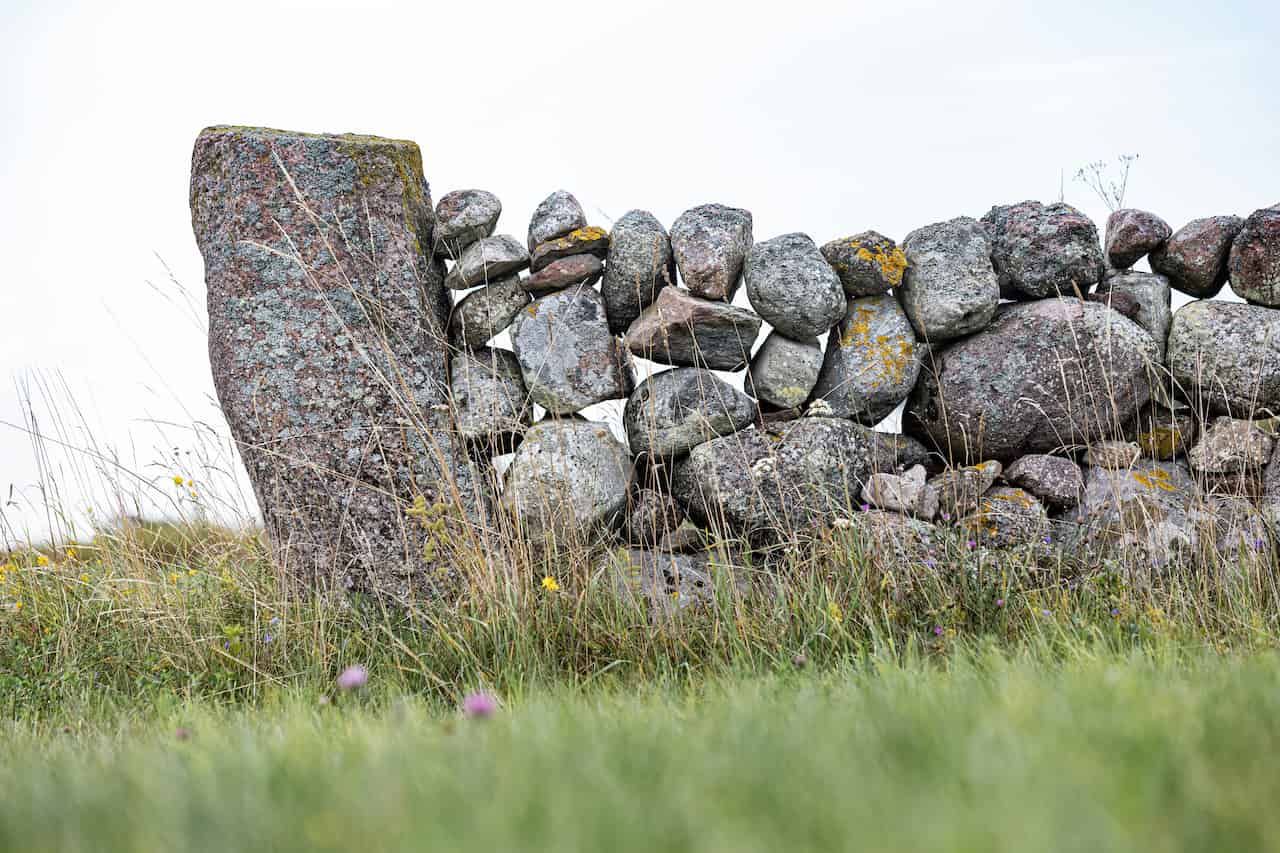
A well-built dry stone wall is one of the most satisfying garden projects you can undertake. No mortar is used – the wall is held together entirely by the weight, shape and careful placement of the stones themselves, which is why the craft requires skill and patience rather than materials and speed. Done well, a dry stone wall will outlast every other structure in your garden by decades. The oldest dry stone walls in the UK date back thousands of years and are still standing, which is a testament to the principle that when you remove the weakest component – mortar, which cracks and degrades – the structure becomes self-sustaining.
Dry stone walling is a skilled craft and it is worth being honest about the learning curve. A first attempt at a short decorative garden wall will not look like the work of an experienced waller, and that is fine – the technique is learned through doing and improves noticeably with each project. The Dry Stone Walling Association of Great Britain runs courses across the country for those who want to learn from professionals, and a one-day introduction gives a much better foundation than reading alone. That said, a committed beginner who follows the structural principles correctly – batter, hearting, through stones, good coping – can produce a functional and attractive wall from their first attempt.
Planning and materials
Stone types for UK dry stone walls
Limestone – the most traditional and widely used dry stone walling material in the UK, dominant in the Yorkshire Dales, Peak District and Cotswolds. Splits and shapes well, produces a clean aesthetic and weathers beautifully. Widely available from local quarries across most of England and Wales.
Excellent
Sandstone – common in northern England, Scotland and the Welsh borders. Softer than limestone and easier to shape with a bolster chisel, but weathers more quickly in exposed positions. Works well for garden walls where appearance matters more than extreme longevity.
Good
Granite – extremely hard and durable, dominant in Cornwall, Scotland and parts of Wales. Difficult to shape and heavy to work with, but produces walls of exceptional longevity. The irregular rounded shapes of granite stones make traditional battered wall construction challenging – patience required.
Challenging
Reclaimed stone – demolition stone from old buildings, field clearances or bought from salvage yards. Variable quality and shape. Check that reclaimed stone is free from mortar residue and not too weathered or friable. Often the most cost-effective source for garden projects and can produce a beautifully aged look from the outset.
Variable
The golden rule when sourcing stone is to use locally available material wherever possible. Not for aesthetic reasons alone – though a dry stone wall built from the local stone of your region will always look more appropriate than imported material – but because transporting heavy stone over long distances is expensive and unnecessary. A tonne of locally sourced limestone will cost significantly less than the same quantity imported from elsewhere. Contact local quarries directly before approaching builders merchants, as quarry prices for rough walling stone are typically much lower than retail prices for dressed stone.
Calculating how much stone you need requires knowing the dimensions of your wall. A traditional freestanding dry stone wall has a base width roughly equal to half its height – so a wall 1 metre high will have a base approximately 50cm wide. The volume of stone required per linear metre runs to approximately 1 tonne for every 0.5m of height. A 1m high wall therefore requires around 2 tonnes per linear metre, and it is standard practice to order 10-15% extra to account for wastage and stone that proves unusable once sorted on site.
What you’ll need
Walling stone – 1 to 2 tonnes per linear metre
Source locally from a quarry wherever possible – cheaper and more visually appropriate to the site
Profile frames or boning rods and string line
Set at each end of the wall to maintain a consistent batter angle and course height throughout the build
Lump hammer and bolster chisel
For shaping and splitting stones to fit – a dedicated walling hammer is also useful for knapping
Spirit level and tape measure
Check foundation level and course heights throughout – levelling errors compound quickly as the wall rises
Batter frame
Two angled timber pieces set to the correct lean – held against the wall face to check the batter as courses rise
Wheelbarrow and knee pads
Stone is very heavy – a barrow is essential. Knee pads prevent significant discomfort over a long day of walling
Foundations and building up
1
Mark out and excavate. Mark the wall line with pegs and string. Excavate a foundation trench 15-20cm deep and slightly wider than the wall base. Remove all soft soil and any vegetation roots. The foundation trench should be level from end to end – use a spirit level on a long straight edge to check. A wall built on an uneven foundation will lean.
2
Lay the foundation course. Select your largest, flattest stones for the foundation. Place them in two parallel rows with their best face outward, using the full width of the trench. These are the footing stones and they carry the entire weight of the wall above. Fill any gaps between the outer rows with smaller hearting stone packed tightly. Do not leave hollow spaces in the foundation.
3
Build with batter. A dry stone wall leans inward slightly from base to top – this is called the batter and it is what gives the wall its structural stability. The standard batter for a freestanding wall is approximately 1cm of lean for every 6cm of height. Use a batter frame – two angled pieces of timber set at the correct angle – to check the wall face as you build. Place each stone so its weight slopes back slightly into the wall rather than outward.
4
One over two, two over one. This is the fundamental rule of stone laying – each stone should bridge the joint below it, just as bricks are laid in a running bond. Never allow two vertical joints to line up, as this creates a plane of weakness through the wall. Fill the centre of each course with hearting stone as you go – small, irregular pieces packed tightly between the two outer faces. Well-packed hearting is as important as the face stones.
5
The wobble test. Every stone should sit solidly before the next is placed on top of it. If a stone wobbles, remove it, add small packing stones beneath to stabilise it, and replace. A wobbly stone creates a weak point that will eventually cause the course above to shift. Use small slivers of stone rather than wedges of wood to stabilise – wood rots and shrinks, creating the very instability it was meant to prevent.
As an Amazon Associate I earn from qualifying purchases. Prices correct at time of publishing.
Through stones and coping
Through stones – what they are
Through stones are single large stones that span the full width of the wall, tying the two faces together. They are placed at roughly mid-height – typically at the two-thirds point – and at intervals of about 1 metre along the wall. They are the structural key that prevents the two faces from spreading apart under their own weight.
Through stones – how to use them
Source through stones at the same time as your main walling stone and set them aside. They should be at least 50cm long for a standard wall, flat enough to bed down solidly and wide enough to project slightly on both faces. Do not omit them – a wall without through stones will eventually fail.
Coping – the topstone layer
The top course of a dry stone wall – the coping – is both functional and decorative. It protects the courses below from frost damage by preventing water from pooling in the top of the wall and freezing, and it acts as a final structural clamp holding everything together. Coping stones are usually set vertically on edge rather than laid flat.
Coping styles by region
Coping style varies by region and stone type. Yorkshire Dales walls traditionally use through-and-through coping with a large flat capstone. Cotswold walls use small upright coping stones called combers. In the Lake District and Scotland, a rounded coping of smaller stones follows the natural shape of the granite. Use the local style wherever possible.
Repair and maintenance
Dry stone wall problems – how to fix them
Problem
Fix
Bulging face – outer face pushing outward in a section
Rebuild that section from the ground up. Bulging means hearting has collapsed or through stones are missing. Do not patch over a bulge.
Fallen coping stones – topstones dislodged
Replace immediately before frost damage affects the exposed top courses. Reset coping stones on a firm, level bed of the top course.
Vegetation growing through the wall
Remove by hand from the root. Do not use weedkiller on stone walls as it damages the lichen and moss communities that are part of the wall’s ecology and appearance.
Leaning wall – whole section tilting to one side
Check foundation level before rebuilding. Leaning usually indicates uneven settlement – the foundation soil has compressed unevenly. Address the soil before rebuilding or the problem will recur.
💡
Never attempt to repoint a dry stone wall with mortar. It is tempting when a wall shows gaps or loose stones to apply mortar as a quick fix, but this is exactly the wrong approach. Dry stone walls are designed to flex slightly with ground movement and to allow water to drain freely through the structure. Mortar prevents both – it locks the wall rigidly, water becomes trapped and freeze-thaw cycles crack the mortar and the stone behind it. The correct repair is to dismantle the affected section and rebuild it dry. It takes longer but it is the only repair that lasts.
As an Amazon Associate I earn from qualifying purchases. Prices correct at time of publishing.
Share on socials:
J
James Fletcher
James Fletcher is a home and garden enthusiast based in the north-west of England. He's been growing vegetables in raised beds for over four years and writes practical, no-nonsense guides for UK gardeners and homeowners.