At a glance
Most UK gardens are planned by default rather than by design – a patio goes where the builders left a concrete slab, a lawn fills whatever’s left, and plants go in wherever there’s a gap. The result is a garden that functions but never quite works as well as it should. Taking a day to actually plan your garden layout before you start digging or buying plants saves money, avoids mistakes, and produces a space that works the way you want it to.
I redesigned my own north-west-facing back garden three years ago. The planning process took two weekends and the result – a garden that now has proper zoning, good drainage and year-round interest – would have been impossible without it. Here is the process I used, adapted for any UK garden size.
Assessing what you have
Before you plan anything new, spend time properly understanding what you currently have. This is the step most people skip – and it’s the reason so many garden redesigns underperform.
| What to assess | How to check it | Why it matters |
|---|---|---|
| Soil type | Squeeze a damp handful – does it hold together (clay) or crumble (sandy)? | Determines what will grow and whether drainage work is needed |
| Soil pH | Buy a £5 soil test kit from any garden centre | Affects which plants thrive – acid vs alkaline preferences vary hugely |
| Sun patterns | Observe and photograph the same spot at 9am, 12pm, 3pm and 6pm | The most critical factor in plant placement and patio positioning |
| Drainage | Check after heavy rain – does water sit for more than 2 hours? | Poor drainage limits plant choice and kills roots |
| Existing features worth keeping | Walk the garden and list what works | Removing mature plants costs money to replace and takes years |
| Eyesores to screen | Stand at your main viewing point and note what you see | Screening bins, fences, neighbouring buildings changes how a garden feels |
Do your sun assessment on a clear day in spring or autumn, not midsummer. The sun is higher in the sky in June than it is in April or October, which means areas that seem sunny in summer may be heavily shaded for most of the year. The lower sun angles of spring and autumn give you a more representative picture of what your garden actually receives.
Dividing your garden into zones
Zoning is the single most useful concept in garden planning. Rather than thinking about individual plants or features, divide your garden into areas based on use and conditions. This produces a garden that works logically and avoids the common mistake of placing features in the wrong position for how they’ll actually be used.
The standard zones for a UK domestic garden are:
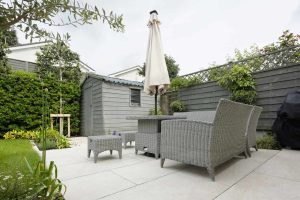
- Entertaining and relaxation zone – the patio or terrace. Ideally south or south-west facing, close to the house, large enough for a table and chairs with room to move around them. Most UK patios are too small – a usable entertaining space needs a minimum of 3m x 3m.
- Lawn or open space zone – the visual centrepiece of most UK gardens. Positioned to maximise the sense of space and avoid awkward shapes. Curved edges look more natural than rectangular ones and are easier to mow.
- Growing zone – raised beds, vegetable plots or cutting gardens. Needs maximum sunlight – at least 6 hours per day. Keep it accessible from all sides if possible.
- Utility zone – bins, compost, shed, bike storage. Should be screened from the main garden view but accessible from the house. Often underplanned and then visible from everywhere.
- Planted borders – the decorative framework of the garden. Positioned to provide structure, seasonal interest and screening where needed.
Understanding sun and shade in your garden
Sun direction in a UK garden is determined primarily by which direction the garden faces. This is the single most important factor in planning and the one that most people underestimate.
| Garden aspect | Sun received | Best for | Challenges |
|---|---|---|---|
| South-facing | Full sun most of day | Entertaining, Mediterranean plants, vegetables, patio | Can be very hot and dry in summer |
| North-facing | Limited direct sun | Shade-tolerant planting, ferns, hostas | Grass struggles, vegetables difficult, damp |
| East-facing | Morning sun only | Many shrubs and perennials, seating for morning use | Afternoon shade limits warm entertaining use |
| West-facing | Afternoon and evening sun | Evening entertaining, most vegetables, most perennials | Morning shade, can be exposed to prevailing wind |
Trees and buildings create localised shade that overrides aspect. A south-facing garden with a large tree to the south will have significant shade regardless of its orientation. Always map actual light conditions rather than relying solely on which direction the garden faces. Shade from buildings is permanent – shade from deciduous trees is seasonal and the ground beneath them may receive good light for 6 months of the year.
Practical layout principles
Once you have your zones mapped and your sun assessment done, these principles will help you turn them into a workable layout on paper.
- 1Sketch to scale on squared paper Measure your garden accurately and sketch it on 1cm = 1m scale. Mark the house, boundaries, any fixed features (manholes, drains, existing mature trees) and compass direction. This takes 30 minutes and prevents expensive mistakes.
- 2Place the patio first It should be adjacent to the house for practical access, oriented towards the most sun, and large enough for your actual use. Cut out a paper rectangle to scale and move it around until the position feels right before committing.
- 3Draw the lawn shape next Whatever is left after patio and borders becomes lawn. Avoid narrow strips under 2m wide – they’re impractical to mow and look awkward. Curved shapes work better than right angles in most UK gardens.
- 4Position the utility zone last and screen it Put practical elements in the least visible, least sunny corner. A simple trellis with climbers or a row of bamboo creates effective screening quickly and cheaply.
- 5Live with the plan for two weeks before acting Pin your scaled drawing in a place you’ll see it daily. You’ll notice problems and improvements you wouldn’t have caught in a single planning session.
As an Amazon Associate I earn from qualifying purchases. Prices correct at time of publishing.
Small garden design – specific advice
Small UK gardens – the typical terraced or semi-detached back garden of 30-60m² – require a different approach to larger spaces. The temptation is to divide the space into many small areas, but this almost always makes a small garden feel smaller. The opposite approach – fewer, larger elements – creates the illusion of more space.
- One large patio, not two small ones. A single 4m x 3m patio reads as generous. Two 2m x 2m areas read as cramped.
- Vertical space is your most underused resource. Climbers on walls and fences, tall narrow plants and wall-mounted planters add planting without using floor area.
- Diagonal lines make spaces feel larger. Setting a patio or lawn at 45 degrees to the boundaries draws the eye across the widest part of the garden rather than the shortest.
- Avoid too many materials. Using the same paving throughout, the same fence treatment and the same two or three plant species in multiples creates coherence and calm. Gardens with five different paving materials and dozens of different plants feel chaotic and small.
- Mirror the indoors. The garden visible from your main living room window is an extension of that room. A garden that feels stylistically connected to the interior feels larger and more considered.
Common garden planning mistakes to avoid
| Mistake | Why it happens | How to avoid it |
|---|---|---|
| Patio too small | Looks big on paper, feels small in reality | Minimum 3m x 3m – use garden furniture to test scale first |
| Paths too narrow | Saved space on the plan | Minimum 90cm for a single person, 1.2m if you want to walk side by side |
| Wrong plants for conditions | Bought before assessing sun and soil | Always assess first, plant second |
| Planting too close together | Small plants don’t look like their mature size | Always check mature spread on the label and space accordingly |
| No year-round structure | Planned for summer only | Include evergreen structure plants that give form in winter |
| Utility zone as afterthought | Bins and compost added last wherever fits | Plan utility zone position at the start, not the end |
A well-planned garden is genuinely lower maintenance than an unplanned one – the right plants in the right conditions need less intervention, the right patio size gets used and enjoyed, and the right layout flows naturally rather than requiring constant rethinking. For more on making the most of outdoor spaces, read our guide on how to build a garden shed UK – a shed in the right position is one of the most useful planning decisions you can make.
As an Amazon Associate I earn from qualifying purchases. Prices correct at time of publishing.
Share on socials: