At a glance
In a normal UK year with average rainfall, established lawns rarely need supplementary watering at all. The British climate delivers enough moisture through most of the growing season that a healthy, deep-rooted lawn can sustain itself without a hose or sprinkler. The exception is during sustained dry spells in summer – typically a fortnight or more without meaningful rainfall – when even deep-rooted grass begins to show stress. Understanding whether your lawn actually needs water, and how to apply it correctly when it does, makes the difference between a genuinely resilient lawn and one that suffers every dry summer.
The most common watering mistake UK gardeners make is light, frequent watering – a brief daily sprinkle that wets only the surface thatch without penetrating to the root zone. Shallow watering encourages shallow roots that are more vulnerable to drought and disease, and creates a cycle of dependency where the lawn needs watering constantly rather than developing the deep root system that makes it resilient. The counter-intuitive answer is to water less often but much more thoroughly – a principle that applies to almost every lawn in the UK regardless of soil type or grass species.
Does your lawn actually need watering?
Before reaching for the hose, check whether the lawn actually needs it. A simple test is to push a screwdriver 15cm into the soil – if it goes in easily, the soil is moist and no watering is needed. If it stops at a shallow depth and the soil is dry and hard, water is needed. The grass itself gives a reliable indicator too: a lawn that has lost its springiness underfoot and shows a slight blue-grey tinge to the green colour is under drought stress and needs water. Brown, straw-coloured grass that has completely stopped growing is drought-dormant – it still needs water but is in no danger and will recover fully when rain returns.
When to water
Early morning is the best time to water a lawn in the UK – ideally between 6am and 9am. At this time, temperatures are cool, wind is usually minimal and the water has time to soak into the soil before the heat of the day increases evaporation. Morning watering also allows the grass surface to dry during the day, reducing the risk of fungal disease that thrives on wet grass overnight.
Evening watering is the worst time despite being the most convenient for most people. Water sitting on the grass surface overnight in UK conditions – where temperatures are rarely high enough to dry it quickly – creates the ideal environment for fungal diseases including red thread, fusarium and dollar spot. If morning watering is impractical, midday is preferable to evening despite the higher evaporation rate. Fitting a basic hose timer removes the need to be up early and is the simplest way to establish a consistent early morning watering habit without any effort.
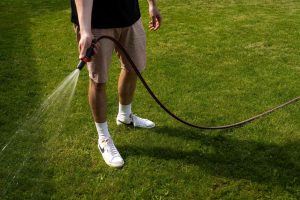
A hose timer removes the habit problem entirely. Fitting a timer to the tap end of your hose or irrigation system allows you to set early morning watering without being up to manage it. A basic digital timer costs around £15-30 and pays for itself in water saved over a single summer by preventing overwatering and reducing the evaporation losses of midday application.
How much water to apply
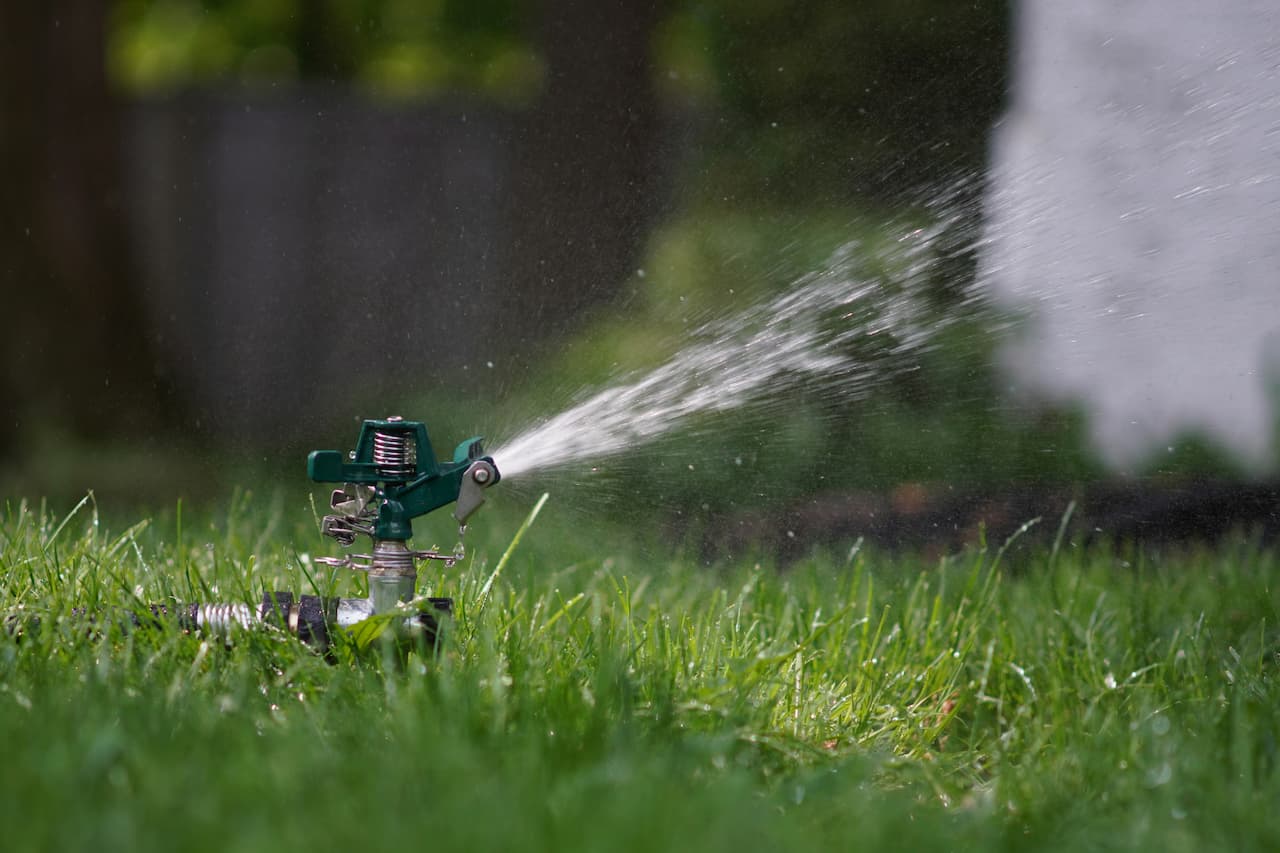
An actively growing UK lawn in summer requires approximately 25mm of water per week – from rain or irrigation combined. Placing a rain gauge or empty tuna tin on the lawn during a sprinkler session shows exactly how much water is being delivered in a given time, allowing accurate calibration. A typical oscillating sprinkler covering 50 square metres delivers 25mm in roughly 30-40 minutes – the exact time varies by water pressure and sprinkler design, so measuring rather than guessing is worthwhile.
The target depth of moisture in the soil after watering is 15-20cm. Shallow watering that only wets the top 5cm encourages shallow root growth – those surface roots are the first to suffer in any future dry spell, creating a lawn that becomes more drought-vulnerable with each season of light watering rather than less. A deep weekly or twice-weekly soak that reaches the full root zone produces a more resilient lawn than daily light sprinkling, and uses no more water in total over the course of a week.
Watering technique
Apply slowly – match the rate to what the soil can absorb
If water is pooling on the surface or running off the edge of the lawn, the application rate is too fast. Slow the sprinkler, use a finer spray pattern, or water in two shorter sessions with a gap between them to allow the first application to penetrate before adding more. Sandy soils accept water quickly; clay soils need a slower rate.
Move the sprinkler to ensure even coverage
Oscillating sprinklers cover a rectangular area and need repositioning to cover the full lawn evenly. Overlap coverage areas by around 20% to avoid dry stripes between passes. Rotary sprinklers cover a circular area and leave the corners of rectangular lawns under-watered unless positioned carefully.
Check penetration depth after watering
Push a screwdriver or soil probe into the lawn 30 minutes after watering finishes. It should penetrate easily to at least 15cm. If it stops at 5-8cm, the session was not long enough. Adjust the timing for subsequent sessions to ensure the full root zone is reached each time.
Know your soil type
Sandy soils drain rapidly and need more frequent watering with smaller volumes at each session. Clay soils absorb water slowly but retain it well and are less likely to need supplementary watering at all in a normal UK summer. Loam soils sit between the two. Knowing your soil type helps calibrate the watering regime rather than following a generic schedule that may not suit your lawn.
During a drought
The question of whether to water during a UK drought is partly practical and partly personal. Established grass is remarkably resilient and will survive prolonged drought by going dormant – turning brown and stopping growth to conserve energy. It looks bad but it is not dead, and normal rainfall will restore the green colour within 1-2 weeks of returning. A lawn that has gone brown in drought will recover fully and unaided; there is no permanent damage to an established lawn from even a severe UK dry summer. The temptation to panic-water when the lawn goes brown is understandable, but unnecessary – patience is the correct response.
Watering during a hosepipe ban is not permitted, and during prolonged dry periods is often impractical even without legal restrictions. The practical advice is to raise the mowing height to 40-50mm during dry periods to shade the soil surface and reduce moisture loss from the ground, and to accept temporary browning as a normal seasonal event rather than a lawn disaster. Avoid applying any lawn feed during drought – feeding dry grass encourages growth the plant cannot support and increases stress. Once conditions return to normal, a nitrogen feed applied to recovering turf accelerates the return to green colour significantly and helps the lawn rebuild leaf density after the dormant period.
Share on socials: