At a glance
Walk past the begonia section in any garden centre in May and you could be forgiven for thinking they’re all the same plant. They’re not. The bedding types in polystyrene trays have got nothing in common with the tuberous ones sold as flat brown discs, and if you treat one like the other you’ll either rot everything or throw away something that was worth keeping. The label usually says “begonia” and not much else, which doesn’t help.
Before anything else: work out which type you’ve got. Not because the rules are complicated, but because everything from watering to October changes completely depending on the answer.
Tuberous or fibrous: the difference that decides everything
The tuberous types are the ones with the huge flowers. Doubles the size of a fist, in colours that run from cream through orange and red to deep magenta. They grow from a flat disc-shaped tuber, they want starting indoors in March, and in October you dig them up and store them somewhere frost-free or you lose them. There’s more involved than the bedding types, but the payoff is a plant that genuinely turns heads.
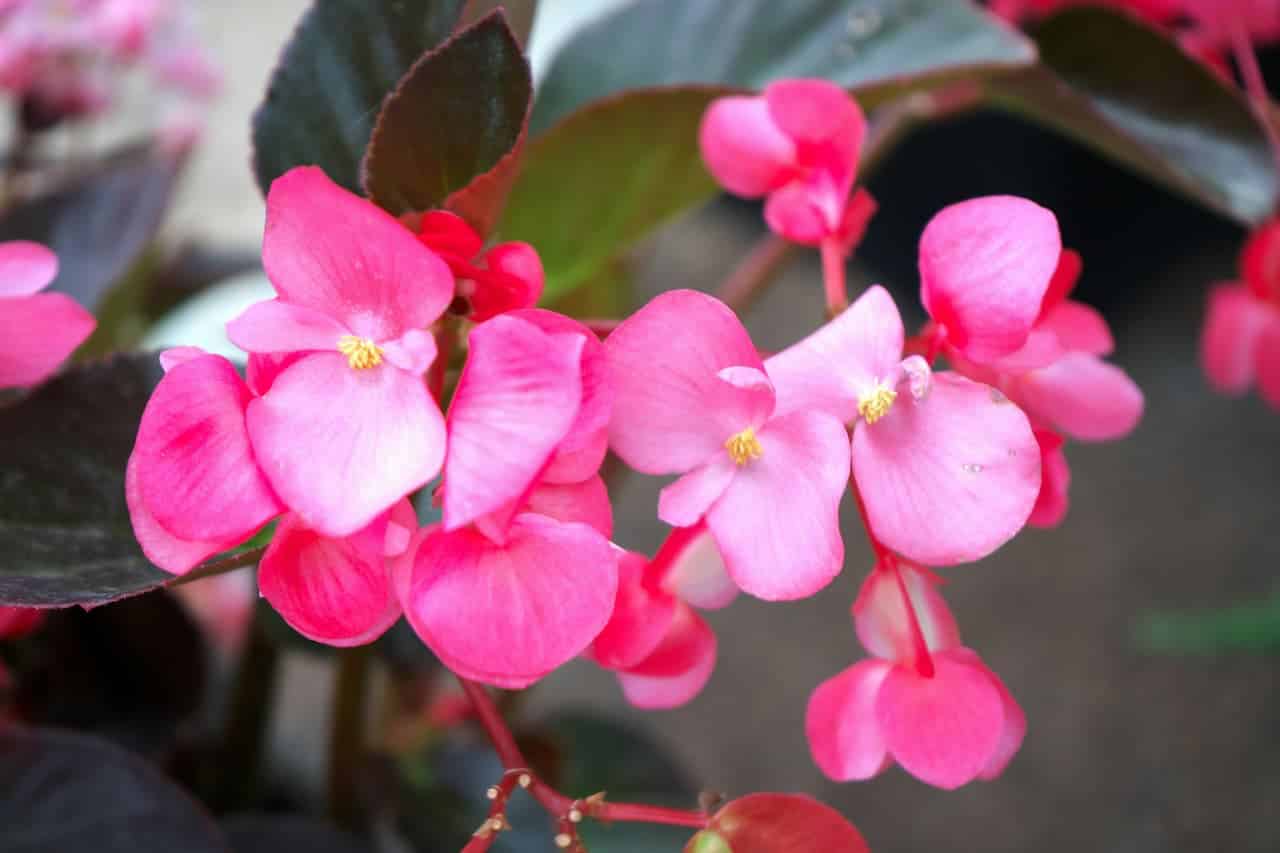
Fibrous begonias (the wax begonias, the semperflorens types) are entirely different in what they ask of you. Small compact plants, continuous flowers from late May to the first frost, no lifting, no storing, no starting indoors. They go in as bedding plants, they do their job all summer, and most people compost them at the end without a second thought. That’s not laziness, it’s just how they work. Worth knowing: fibrous types tolerate more sun than tuberous ones, which makes them useful for spots the big showy varieties can’t handle.
There’s also Begonia grandis, the hardy type, which survives in very sheltered spots in mild parts of the UK, south-west coastal gardens mainly. It’s not something most gardeners in the Midlands or north can rely on. Don’t plan around it unless you’re somewhere genuinely mild.
Starting tuberous begonias: March, warm, and the right way up
Pick up a tuberous begonia tuber and look at it properly before you do anything else. One side is slightly concave, hollowed out, and that’s where the shoots come from. The other side is more rounded and smooth. Hollow side up. Always. Put it in wrong and you’ll get nothing, or a stem that fights its way through from underneath and emerges late and weak. It’s not a mistake you make twice.
In March, set the tubers hollow-side-up in a tray of barely moist compost (not wet, barely moist) with the tuber surface just at compost level. Not buried. Not sitting on the surface with nothing around it. Just pressed in so the rounded base has compost contact while the top stays exposed. Then somewhere warm. 18°C is the target, and it matters. Below about 10°C they won’t break dormancy at all. A heated propagator is ideal but a warm windowsill will do it.
Within a few weeks you’ll see pink buds appearing. When the shoots are around 3cm, pot the tubers on individually into 15cm pots of free-draining compost. If a tuber is pushing out six or eight shoots, rub the weakest ones off until you’ve got two or three. One big tuber trying to feed eight stems produces weaker growth all round. Three strong stems is better than eight thin ones.
They stay indoors until late May. Not mid-May, not whenever the forecast looks reasonable. Late May, once the overnight temperatures have settled. Even then, harden them off over a week or two before leaving them out permanently. March to late May on a warm windowsill is a sheltered environment. The shock of going straight outside into a cool evening in mid-May sets them back in ways that take weeks to recover from.
Position and containers
Full sun kills tuberous begonias. Not gradually, not slowly over a season. Within hours on a hot day the petals scorch and brown at the edges in a way that doesn’t recover. East-facing is the ideal: morning light, shaded from the afternoon. North-facing often works better than south-facing for these. A sheltered spot in dappled shade is what they want.
Fibrous begonias are more forgiving. The bronze-leaved varieties in particular handle more sun, which is why you see them planted out in much more exposed spots than you’d ever put a tuberous type.
Wind is a problem for the upright tuberous varieties. The flowers are large and the stems are hollow and brittle. A breezy spot will break stems and trash flowers in short order. Trailing types in baskets aren’t the same issue, but uprights in containers on an exposed patio will need a single cane per plant, put in early, before you think they need it. Once they’ve flopped in a gale the damage is done.
For containers, peat-free multipurpose compost, decent drainage holes, and a pot that’s not sitting in a drip tray full of water. Tuberous begonias in waterlogged conditions get root rot very quickly. A 30cm pot is enough room for one tuber to perform properly; don’t overcrowd them.
Watering and feeding
Overwatering is the most common way to kill a tuberous begonia in a container. They want the compost to stay moist but not wet, and letting the top couple of centimetres dry between waterings is the right approach. The weight of the pot is a better guide than looking at the surface. Pick it up and if it feels light, water it. If it’s still got weight, leave it.
Don’t water overhead. Wet flowers and leaves in warm weather is a straight route to powdery mildew and grey mould. Water at the base, slowly, until it drains through. A quick splash from above wets the surface without reaching the roots and sets you up for fungal problems at the same time.
Fibrous begonias in the ground need very little watering once they’re established. In containers they dry out quickly in warm weather and need checking regularly, but they’ll tell you when they need water by wilting slightly rather than dying from root rot. More forgiving than tuberous types.
Start feeding when you pot the tubers up in spring. Balanced liquid feed every fortnight. Once flower buds form, switch to a high-potash feed. Tomato fertiliser is the right product and you probably already have it. Keep feeding fortnightly through summer. Stop in September. A tuberous begonia still being fed hard into October produces soft growth that stores badly and rots in the box before February.
Flowers, deadheading and bud drop
Tuberous begonias produce male and female flowers on the same plant. The males are the big doubles, the ones that look like roses. On either side of each male you’ll find two smaller single flowers. Those are the females. If you’re growing for display and want bigger male flowers, remove the females while they’re small. If you’re not bothered about competition results, leave them alone and deadhead everything as it goes over.
The spent flowers don’t always drop cleanly. A flower sitting against a stem, stuck rather than falling, will rot in wet weather and give botrytis an entry point. Check when you water and clear anything that’s stuck rather than dropped.
Fibrous begonias look after themselves on deadheading. The flowers drop naturally and they flower continuously without any help from you.
Tuberous begonias drop buds when they’re under stress. Temperature swings, being moved from warm to cold, inconsistent watering, or wind. Any of these will trigger it. The practical answer is to settle them into a sheltered spot and leave them there. Plants that get shuffled around looking for a better position rarely perform as well as one that was put somewhere decent and left alone.
Stake upright varieties before they need it. Push a cane in at planting time and tie loosely. A heavy flower on a brittle stem in a light breeze can snap the stem in minutes, and there is no fixing it after the fact.
Lifting and storing tubers
The foliage is the signal for lifting. When the leaves start to yellow (most years that’s sometime in October) ease off watering and let the plant wind itself down. Don’t cut it back, don’t force it into dormancy. If a frost gets there first and blackens the leaves before they’ve gone yellow naturally, lift straight away rather than leaving a frost-damaged plant in the ground.
Lift with a fork, working well away from the stem to avoid spearing the tuber. Shake off loose soil. Cut the stems back to about 5cm above the tuber. Don’t pull them, they’ll drop off when they’re ready and pulling risks tearing into the tuber itself. Lay them somewhere dry and airy, a frost-free shed or garage, and leave them for seven to ten days. When the remaining stem stubs have shrivelled and come away easily, they’re ready to go into storage.
Store in trays with dry peat, old compost, or vermiculite packed around them, in somewhere that stays between 5 and 7°C. Too warm and they’ll start growing prematurely; too cold and the tuber tissue dies. Check them monthly. Any that feel soft when you squeeze them need to come out. A rotting tuber in a tray will spread to its neighbours. If you catch soft rot early and the tuber is still mostly firm, cut out the affected part with a clean knife and dust the cut surface with sulphur powder. Some recover. Many don’t. In March, pot up anything that feels firm and shows bud growth. Something that feels completely hollow or mushy is gone, but a tuber that looks dead while still being firm is often just dormant. Give it the chance before you throw it away.
What goes wrong: vine weevil is the one to watch
Begonias in containers get vine weevil. Not occasionally. Reliably, year on year, unless you actively prevent it. The adults are small black beetles that notch U-shaped holes in the leaf margins at night, which is unpleasant but not the real problem. The problem is the larvae: fat white C-shaped grubs in the compost that eat through the roots and hollow out the tubers from late summer through winter. By the time you see a plant wilting, the grubs have usually already done most of the damage. There’s nothing to rescue at that point.
The only reliable prevention is nematodes. Steinernema kraussei, watered into moist compost when the soil temperature is above 5°C. Late August to early September is the window. Apply as a routine, every year, whether or not you’ve seen any adults. An application before the larvae get established is worth ten times the effort of trying to deal with a full infestation at lifting time. When you do lift tubers in autumn, check the compost carefully. White grubs in the mix around the roots confirms it.
Share on socials: