At a glance
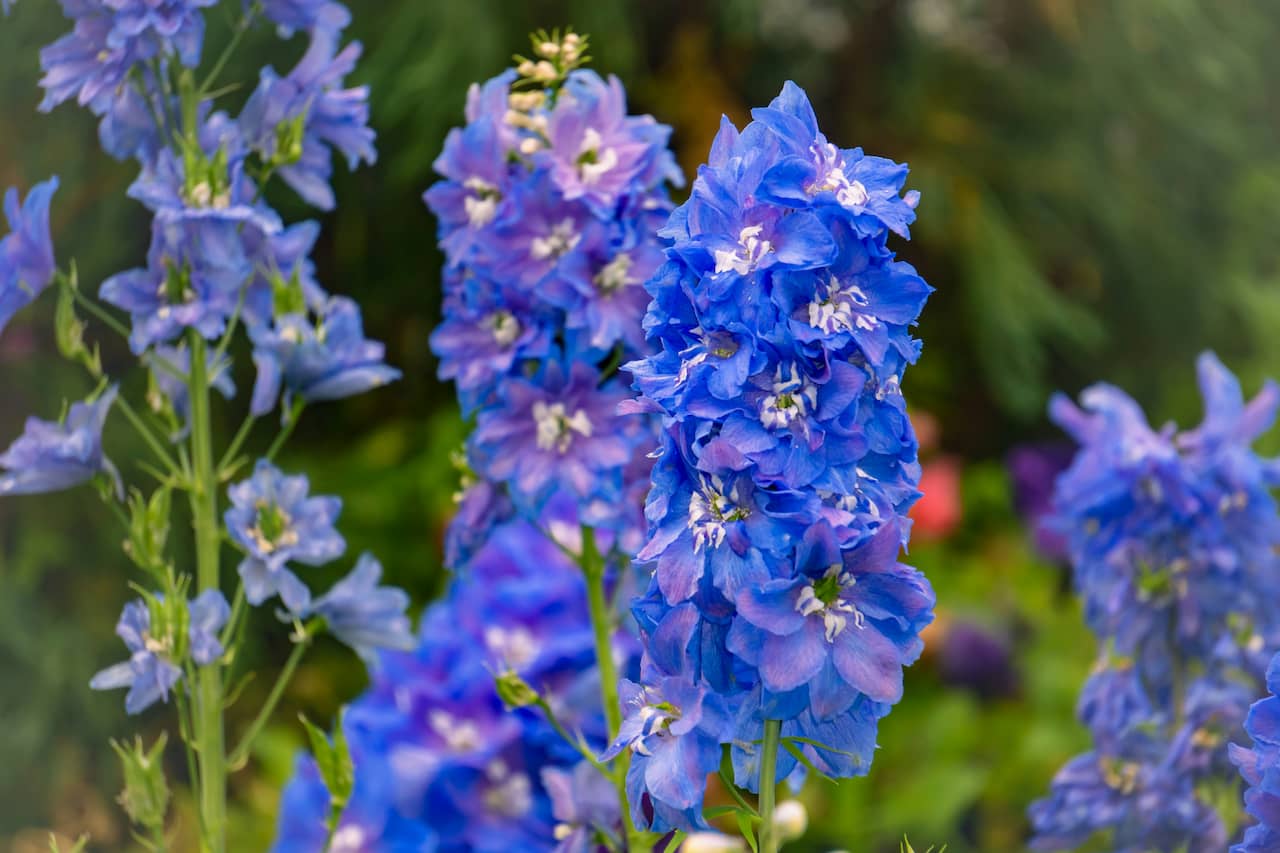
Nobody tells you that delphiniums are quite that tall the first time you grow them. You plant a small thing in a pot in April, and by late June you have got a flower spike taller than your shoulder with more blue on it than you thought a garden plant was supposed to produce. Something about that first summer changes what you think is achievable in a UK border. Then you find out about the slugs, and the staking, and the hollow stems that snap in June thunderstorms, and why yours did not come back after a wet February, and you realise the drama does not come for free.
It does come, though. The effort is specific rather than excessive. Slug protection starting in February. Stakes in the ground before the stems think about being tall. Drainage that does not let the crown sit in water over winter. A hard cut after the first flush if you want a second one. That is most of it. Get those four things right and delphiniums will make the rest of your border look like it is not really trying.
What you are in for
The first thing to understand is that the frost will not kill your delphiniums. The rain will. These plants are hardy to around -20C in well-drained soil, which in a UK context means they can stand almost any winter we throw at them, except a waterlogged one. A crown sitting in soggy ground from November to March rots. The plant does not come back in spring. You stand there wondering if it was the frost, and it was not. This is such a common failure that it is worth establishing before you plant rather than after.
These are perennials in the full sense: the crown and roots persist, the top growth dies back each autumn and returns each spring. Expect three to five good years from most varieties before they lose vigour and start producing fewer, weaker spikes. This is not a failure of your soil or your care. It is just what delphiniums do. Taking basal cuttings from your best plants every year or two is the answer. Twenty minutes work, free replacements. Neglecting that means buying new plants every few years and wondering why the border keeps declining.
Everything in the plant is poisonous. Stems, leaves, flowers, seeds, roots: all of it contains diterpene alkaloids that cause serious harm to humans, pets and livestock if ingested. Young growth is most toxic. Wear gloves when you handle them, especially when cutting or propagating, and wash hands afterwards. Worth knowing if you have small children or dogs who treat the garden as a buffet.
Which one to grow
The tall delphiniums most people are picturing when they decide they want delphiniums are Elatum hybrids: dense flower spikes, 1.5 to 2 metres, the full range of blues and purples and pinks, the whole summer border statement. These need staking. Every stem, before it gets tall. Elatum types with particularly good stem strength include the New Millennium Hybrids, bred in New Zealand specifically for outdoor performance and worth seeking out if you are in an exposed spot.
Named Elatum varieties worth growing: Black Knight is such a dark violet it reads almost black in certain lights, with a very dark centre that earns its place at the back of any border. Faust produces intense blue double flowers on stems that are a genuine two metres in a good year. Both are reliable if you keep the soil right and protect against slugs.
Belladonna delphiniums are different in habit: shorter (90cm to 1.2m), more branching, single flowers on multiple stems rather than one big spike. They need far less staking and tolerate windier positions than the tall Elatum types. They are also significantly better as cut flowers because the branching stems work in an arrangement where a massive single spike largely does not. If you have a smaller garden or an exposed site and you want delphiniums without the full infrastructure commitment, Belladonna is the honest recommendation.
Pacific Hybrids are sold everywhere in spring because they look like Elatum types in the pot and are cheap to produce from seed. They are shorter-lived than Elatum, genuinely better treated as biennials, and while they look fine for a couple of seasons they are not the plants you are going to be propagating from and maintaining for years. Magic Fountains are a dwarf series at 70-80cm: proper spikes, good colours, substantially less staking required, and they do it all without requiring you to stake in May and pray in June.
Where to put them and what to do to the soil first
Six hours of direct sun. That is the minimum, not the target. Below that, the spikes get shorter, the colour is less intense, and the plant gradually runs down. South-facing, at the back of a border where the height makes sense and the wall or fence behind cuts the wind. The hollow stems of a tall Elatum delphinium are not built to withstand a June gust. They do not bend. They snap cleanly at whatever height you failed to stake to, and the stem is finished at that point. A sheltered position is not a luxury. It is half the battle.
Drainage is the other half. Neutral to slightly alkaline soil (pH 6.5-7.5) is the preference but delphiniums will grow in a wider range than that without complaint, as long as the water moves through. On heavy clay, dig in grit and well-rotted compost across the whole bed before planting, not just in the planting hole. Improving a planting hole in clay just creates a sump where water collects and the problem gets worse. A raised bed on clay is genuinely worth the effort because the alternative is repeating the drainage problem every winter.
Before planting, work in well-rotted compost or manure generously. Bone meal or blood, fish and bone in the planting hole as a slow-release feed. Plant at the depth the plant was growing in the pot, with the crown at soil level and no deeper. Deep planting in a delphinium is a shortcut to crown rot. Space at 60cm minimum. That spacing is as much about air circulation and powdery mildew prevention as it is about display. Groups of two or three look better than single plants and give the border the mass these plants earn at full height. April to May, or September to October, are the right planting times.
The slug situation
Slugs destroyed my first season of delphiniums completely. I did not see any damage because there was nothing left to see damage on. By the time I was looking for signs of growth in March the slugs had already been at the crowns for weeks, and what came up was weak, reduced and mostly eaten before it got anywhere. The second year I started in February and had a completely different experience.
The problem is that delphinium shoots emerge from the soil in late February and March as soft, extremely palatable growth at exactly the point when slug populations are coming out of winter and actively feeding. A single night of slug activity on a new crown can take out all the growth that was going to make your June display. The crown sits there looking fine. The damage is underground and you will not know until the plant either fails to appear or emerges stunted.
Start slug controls in February, before you can see any growth. The critical window is February to late April. After that, the plant has built enough mass that slug damage is less catastrophic. But miss the window and you are not recovering it that season.
The staking problem
Most people stake too late. They wait until the plant is tall and the stems are already finding ways to lean on neighbouring plants or prop themselves against the fence, and then they try to persuade the whole thing into canes without snapping anything, which is somewhere between difficult and futile. Stake when the shoots reach 20-30cm, typically late April to early May.
Use canes at least as tall as the variety’s expected final height. For Elatum types this means 1.8 to 2 metre canes. Three canes around each plant, pushed firmly into the ground 10-15cm from the main stems, tied around with soft garden twine to form a cage. Tie loosely. Delphinium stems are hollow and a tight tie will damage them over time. Add ties every 30cm as the plant grows. The top tie matters as much as the middle one. A stem that is supported at the base and the middle will still snap above the highest tie in a strong wind.
Grow-through metal supports placed over the crown in March, before growth begins, are genuinely better than canes if you are willing to spend a bit more. They support the stems from below as they grow through the hoops rather than constraining them from outside, which is more effective and looks cleaner in the border. If you have more than a couple of established plants, they are worth having.
Thinning shoots: the step most guides skip
When the shoots emerge in spring there will be more of them than the plant should carry. Thin them when they are 5-8cm tall, taking the weakest ones out at soil level. An established delphinium, two years or older, should carry five to seven main spikes. A plant in its first year is better at two or three.
More than that and the plant divides its resources too many ways. Every spike gets less than it needs, and you end up with a lot of thin, short spikes rather than a few properly impressive ones. I tried to get away with not thinning for a whole season once to see what would actually happen. What actually happened was that I had more spikes than usual, all of which were shorter than usual, none of which were as good as the thinned ones. Fewer is more, and it is counterintuitive enough that it catches people out every time.
Feeding and watering
Delphiniums are heavy feeders. Two metres of growth plus a flower spike every year means the plant is asking a lot from the soil, and if the soil is not delivering, the spikes are honest about it. Short, thin spikes on an established plant that had good ones before are usually a feeding problem. Rule out slugs and drainage first, then look at the feeding programme.
On nitrogen: do not go heavy on it. Excess nitrogen produces exactly the lush, leafy, hollow-stemmed growth that looks good in April and snaps in June. The plant puts everything into foliage and the structural integrity suffers. A balanced or high-potash feed is what delphiniums need, not the nitrogen-heavy feeds you might use on leafy crops.
On watering: keep the soil consistently moist from May through August. Deep watering once or twice a week is better than light daily watering: it encourages roots to go further down, which makes the plant more resilient when dry spells arrive. Water at the base, not overhead. Wet foliage in the evening is a reliable way to introduce powdery mildew and does nothing that a morning soak at the base would not do better.
Getting the second flush
Delphiniums will flower twice in a season if you cut them correctly after the first flush, and the second flush arrives in late August and September when most of the summer perennials are finishing. It is worth having.
When the first spikes start looking tatty, not when the last individual floret has fallen but when the general impression has shifted from spectacular to tired, cut every flowered stem to the ground. Leave the foliage. Feed and water immediately. The plant will push new growth within a few weeks and produce a second set of spikes that are shorter and less dense than the first, but in a good year are still a proper display.
What people get wrong is waiting. If you delay a week because it seems a shame to cut something still vaguely blooming, the plant has started directing resources into seed production rather than regrowth, and the second flush will be weaker or may not appear at all. Cut when it looks past its best, not when it is finished. Feed the moment you cut. That sequence matters.
Autumn and winter
After the second flush ends, cut the stems down to 15-20cm above ground. Some people leave them until spring and tidy up then, which works fine, but clearing debris from around the crown in autumn is not optional. Dead leaves and plant material around the base are exactly where slugs overwinter, and removing that cover now directly reduces the problem you will face in February.
Mulch the crown in November with well-rotted manure, leaf mould or garden compost. Aim for two to three inches over the root zone. This protects against freeze-thaw cycles that heave shallow crowns, not against the cold itself. Delphiniums handle frost without difficulty. Standing water over winter is what kills them.
If you have any doubt about drainage, mound the soil slightly around the crown so surface water runs away from it rather than toward it. On genuinely heavy clay, raised beds are not an overreaction. They are the answer. Container-grown plants need moving to a sheltered spot against a wall for winter. Less insulation around the roots means more vulnerable to both cold and wet. Reduce watering to almost nothing. Just enough to stop the compost drying completely.
Propagation
Delphiniums are short-lived. Planning to propagate from them is not a gardening hobby. It is the reason the best plants in your border do not quietly disappear over five years. Easier than it sounds, too.
Basal cuttings are the only method that reproduces named varieties true to the parent. If you have a Black Knight that is performing particularly well, cuttings are the only way to guarantee the next plant will be the same. Seed-grown plants produce a reasonable mixture of blues and purples, fine for filling a border economically, but not the same as the specific named variety you want to keep.
Problems
Most delphinium problems trace back to three things: slugs, poor drainage, or insufficient air circulation. Get those three right and the plant is resilient. Get any one of them wrong persistently and the problems below become a recurring pattern rather than an occasional one.
Share on socials: