At a glance
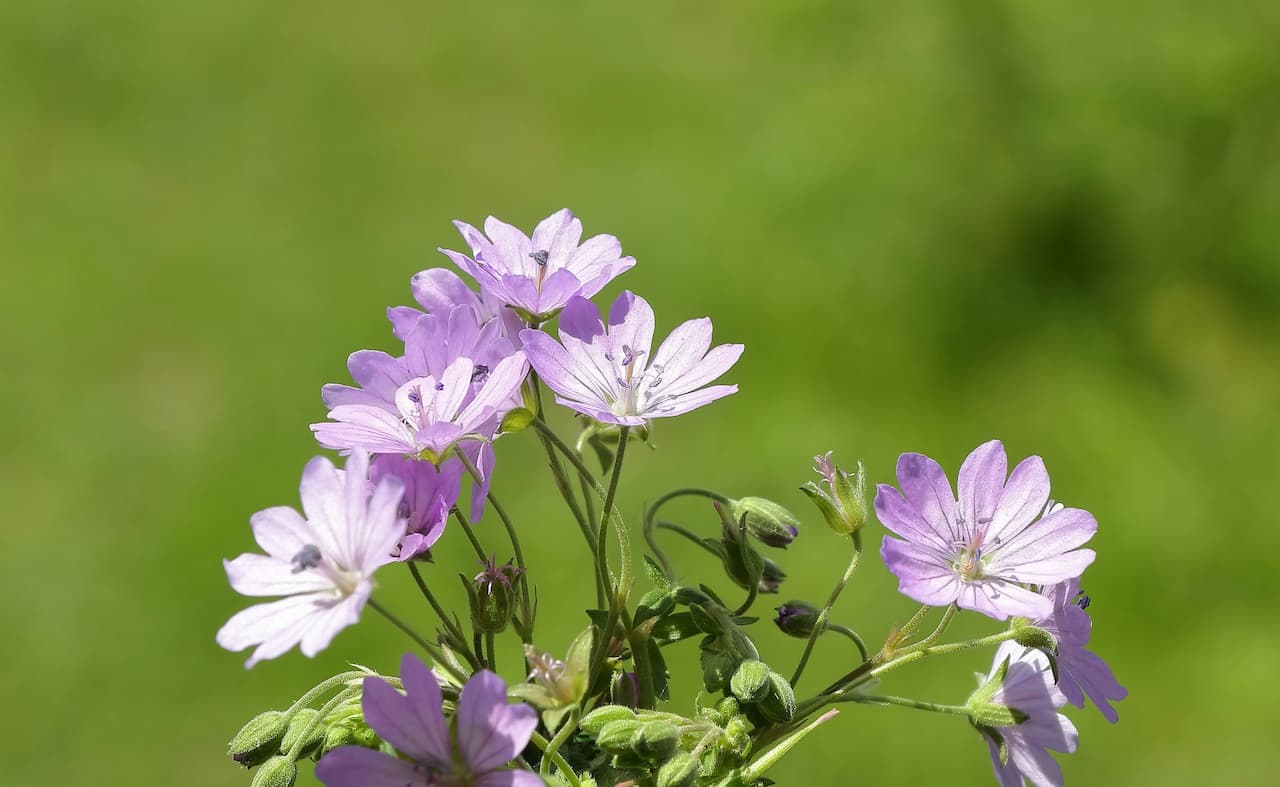
Hardy geraniums – properly called cranesbills to distinguish them from the tender Pelargonium commonly sold as “geraniums” at garden centres – are among the most useful and widely planted perennials in UK gardens. They flower prolifically, tolerate a broad range of soils and conditions, suppress weeds effectively when established, and require minimal maintenance beyond a single cut-back after flowering. The genus Geranium contains more than 400 species, with dozens of named garden varieties covering every situation from full sun to deep shade, compact rockery plants to sprawling ground cover and upright border specimens to 1.2 metres tall.
The flowering season for hardy geraniums collectively runs from May through October, though individual varieties flower for shorter windows within that period. The popular practice of cutting plants hard back to the base immediately after the first flush of flowers in June or July is one of the most rewarding low-effort garden tasks – within three to four weeks a fresh mound of foliage emerges and in many varieties a second flush of flowers follows from August onwards. This simple technique transforms a plant that would otherwise look tired and straggly through late summer into one that remains presentable until the first frosts.
About hardy geraniums
Hardy geraniums are herbaceous or semi-evergreen perennials in the family Geraniaceae, native to a wide range of temperate habitats across Europe, Asia and North America. The common name “cranesbill” refers to the elongated beak-like seed capsule that follows the flower – a distinctive shape that is easy to recognise once you know what to look for. UK gardeners benefit from one of the broadest ranges of species and varieties in the world, and the genus has been extensively developed by British nurseries over the past 50 years. The range spans plants of very different character: G. sanguineum is a low spreading carpet of magenta flowers, while G. psilostemon can reach a metre and requires staking in exposed positions. RHS Award of Garden Merit varieties represent a reliable starting point for most UK growing conditions, and there is an AGM hardy geranium suited to almost every garden situation from dry chalk to heavy shade.
Best varieties for UK gardens
The range of hardy geraniums available to UK gardeners is exceptional, covering everything from ground-hugging alpine types to tall border perennials and robust ground cover plants for difficult sites. Height and spread vary so widely across the genus that checking mature dimensions before purchasing is essential, particularly for smaller gardens where a spreading variety like G. macrorrhizum can quickly colonise more space than intended.
‘Rozanne’ remains the most widely sold hardy geranium in the UK and with good reason – it flowers from late spring until the first frosts, tolerates a wide range of conditions, and its bright violet-blue flowers with white centres are produced with exceptional continuity over a long season. G. psilostemon is the most striking species for back-of-border use, with vivid magenta flowers each marked with a black eye, growing to 60cm or more with an arching habit. G. macrorrhizum is the most practical ground cover option, tolerating poor dry soil under trees where little else survives. G. phaeum, the mourning widow, is valuable specifically for its deep shade tolerance and early May flowering season.
Planting and conditions
Hardy geraniums are planted from pot-grown stock in spring or autumn, or divided from established clumps at either time. They establish readily in most UK soils without special preparation, though working in a little compost around the planting hole speeds establishment in very poor or heavy clay soils. Spacing depends on the variety – compact types like G. sanguineum can be set 30cm apart, while large spreading varieties like ‘Ann Folkard’ or G. psilostemon need 60-75cm to develop properly. Planting in autumn gives plants time to establish a strong root system before winter, which means they flower more freely in their first summer; spring planting works equally well but plants may be a little slower off the mark in their first season.
The single most important planting consideration with hardy geraniums is matching the variety to the site conditions. Most need reasonable drainage and do not perform well in waterlogged ground through winter, but beyond that their requirements are minimal. The popular varieties ‘Rozanne’, G. pratense and G. psilostemon all prefer a reasonably sunny position and will flower less freely in heavy shade. G. phaeum and G. macrorrhizum are the exceptions, both performing reliably in the dry shade under deciduous trees that defeats most other perennials. This shade tolerance makes them genuinely invaluable in gardens with tree cover and limited border options.
Cut back hard immediately after the first flowering flush. Most hardy geraniums become straggly and untidy by late June or July after their main flowering period. Cutting the entire plant back to 5-10cm above the ground with shears or a hedgecutter takes less than a minute per plant and prompts rapid regrowth. New foliage appears within two weeks and a second flush of flowers follows in August and September in most varieties, extending the season by two months.
Care and cutting back
Hardy geraniums are among the lowest maintenance perennials available to UK gardeners. Established plants in appropriate conditions need no staking, little feeding, and minimal watering beyond their first growing season. The main annual intervention is the post-flowering cut-back described above – a single action that transforms the plant’s appearance and extends its seasonal value considerably. Beyond this, a mulch of compost applied in spring feeds the soil and retains moisture through the summer months, and dividing clumps every three to four years prevents overcrowding and keeps plants vigorous and free-flowering. Feeding with a balanced slow-release fertiliser in early spring is worthwhile in poorer soils, but in average garden ground with an annual compost mulch no additional feeding is needed. The remarkable thing about hardy geraniums is how little they ask in return for a long season of colour – they are genuinely among the most rewarding perennials available for the effort they require.
Problems and companions
Hardy geraniums are largely trouble-free and resistant to most of the common garden pests and diseases. Their foliage is mildly aromatic and generally unpalatable to slugs, snails and rabbits, which makes them particularly useful in gardens where these pests are a persistent problem for other plants. This pest resistance is one of the reasons hardy geraniums are so frequently recommended for low-maintenance planting schemes and naturalistic borders where chemical intervention is not desired. The most common issue is vine weevil in container-grown specimens, where the grubs feed on roots and cause sudden wilting. In open ground vine weevil is rarely a serious problem. Powdery mildew can affect some varieties in very dry conditions – cutting back hard when symptoms appear and keeping the soil mulched reduces recurrence.
Hardy geraniums combine readily with a wide range of border companions. Catmint shares a similar mounding, sprawling habit and the two together create a long-flowering cottage-style planting in a sunny border. Lavender makes an excellent dry-soil partner for G. sanguineum and G. macrorrhizum, with both thriving in well-drained, poor ground where richer-soil plants struggle. Achillea and hardy geraniums flower simultaneously in early summer and their contrasting flat-headed and cup-shaped blooms create a naturalistic combination that is highly attractive to pollinators. For shadier spots, pairing G. phaeum with astrantia gives a long sequence of woodland-style flowers from May right through to August.
Share on socials: