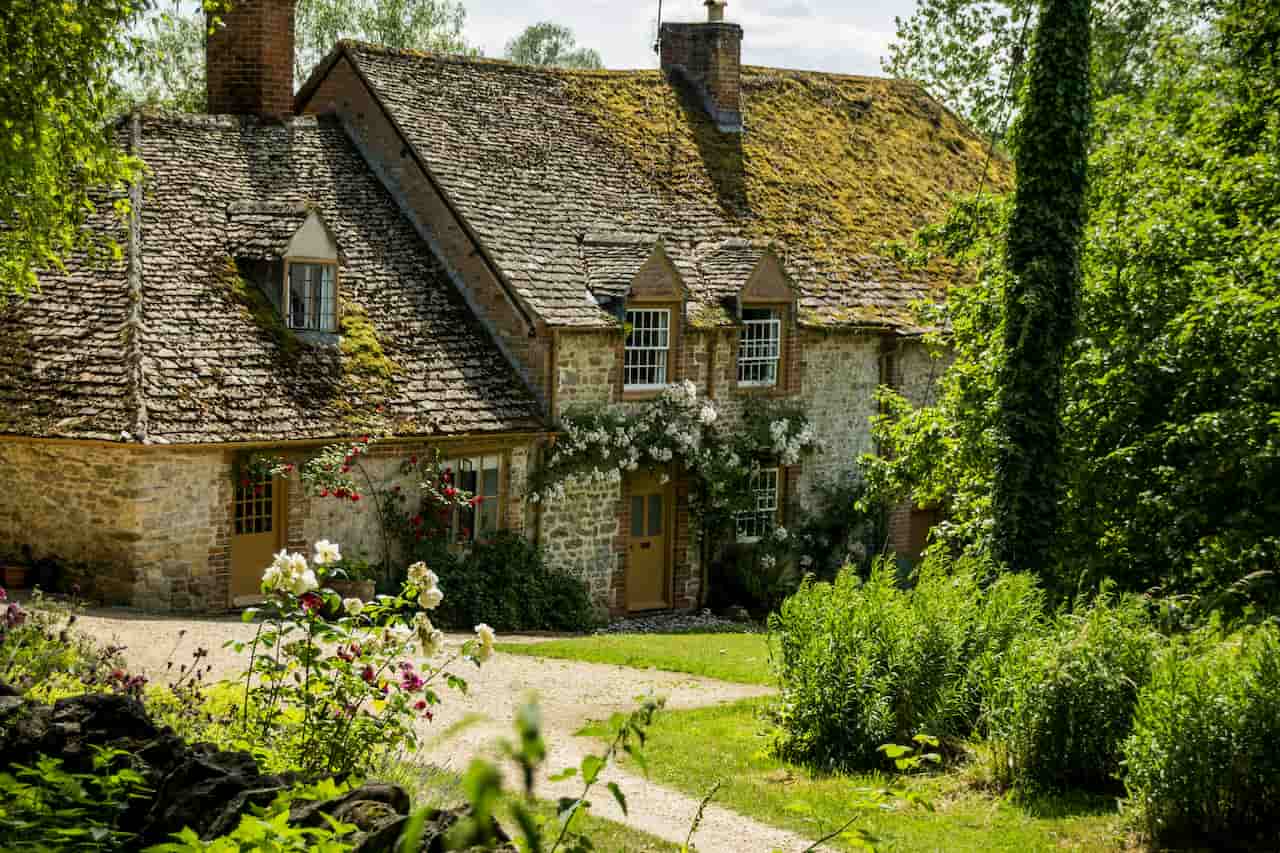
The English cottage garden is one of the most copied and most misunderstood garden styles in the UK. At its best it achieves a quality of abundance and naturalness that looks entirely unplanned – plants tumbling over path edges, self-seeded foxgloves appearing in unexpected gaps, roses threading through other shrubs – while actually being the result of deliberate selection and careful management. At its worst it is a muddle of plants that have no relationship to each other, chosen in the moment at the garden centre without thought for how they will look together across a full season. The difference between the two is usually the plant selection rather than the labour involved.
The authentic cottage garden palette is more restrained than many people realise. The signature look is built on soft, hazy pinks, mauves, blues, cream and white – the colours of old roses, lavender, catmint, foxgloves, delphiniums, aquilegias and sweet peas. Strong oranges, vivid yellows and harsh reds – colours that demand attention rather than inviting it – were historically rare in cottage borders, and their presence tends to undermine the gentle, romantic quality that the style depends on. This does not mean the cottage garden is a bland one-palette scheme: the variation of tone, texture, height and seasonal timing within this soft palette is enormous and provides all the visual complexity the style needs.
What Defines a Cottage Garden Planting Scheme
The cottage garden style is characterised by several qualities that emerge from the plant selection as much as from the design. Dense planting that leaves little bare soil visible creates the sense of abundance that defines the style – plants are placed closely enough that they lean against each other, fill every gap, and create the layered, multi-level effect that distinguishes a cottage border from a more formal planting. Self-seeding is actively encouraged rather than controlled: foxgloves, aquilegias, Verbena bonariensis, Nigella and sweet rocket all seed freely and the unexpected placements they produce – a foxglove spike rising through the centre of a rose, aquilegias dotted through the front of a border – are not mistakes to be corrected but contributions to the naturalistic character of the planting.
Height variation is as important as plant selection. The classic cottage border works in three distinct layers: the back third is tall – climbing roses, delphiniums, hollyhocks, tall Verbena bonariensis; the middle third is mid-height – peonies, geraniums, catmint, scabious, salvias; and the front third is low – lavender, alchemilla, violas and sprawling dianthus. This layering creates a graduated profile from ground level to the top of the tallest plants that is the structural foundation of the cottage look, regardless of which specific species are used to fill each layer.
The Essential Plant List – Ranked
Cottage garden essentials – ranked by importance
1
Old-fashioned roses (Rosa) – The defining plant of the English cottage garden. Shrub roses and climbing roses with full, many-petalled flowers in pink, white and cream form the structural and ornamental backbone. ‘Gertrude Jekyll’, ‘Munstead Wood’, ‘Constance Spry’ and ‘The Generous Gardener’ are all authentic choices.
Essential
2
Foxglove (Digitalis purpurea) – A biennial that self-seeds prolifically to maintain a permanent colony. The tall spires of spotted tubular flowers in pink, purple and white provide vertical structure and height. Allow to self-seed rather than deadheading and the colony renews itself without any action from the gardener.
Essential
3
Aquilegia (Granny’s Bonnet) – A freely self-seeding perennial that dots itself through the border in unexpected positions. The spurred, nodding flowers appear in May and June in mixes of blue, purple, pink and white. The species and its hybrids readily cross-pollinate to produce unique seedlings every year.
Essential
4
Lavender (Lavandula angustifolia) – The definitive front-of-border plant for the cottage style. Grey-green foliage and purple-blue flower spikes from July through August, beloved by bees. ‘Hidcote’ and ‘Munstead’ are the most compact and reliable UK varieties. Clip after flowering to maintain shape.
Essential
5
Delphinium – The tall blue spire that most encapsulates the grand midsummer border. ‘Pacific Giants’ provide the most dramatic effect. Plant at the back or centre of the border; stake early with canes before the spike develops. Cut stems back after first flowering to encourage a second flush.
Very useful
6
Catmint (Nepeta x faassenii) – A sprawling, aromatic perennial that softens path edges and border fronts with clouds of small lavender-blue flowers from May to September. Cut back hard after first flowering for a second flush. ‘Six Hills Giant’ is the most vigorous cultivar; ‘Walker’s Low’ is more compact.
Very useful
7
Sweet Pea (Lathyrus odoratus) – Fragrance is as important as colour in the cottage garden, and no plant delivers it more powerfully than sweet peas climbing through a rustic obelisk or hazel wigwam. Sow in October for strongest plants or February under cover. Pick every flower to prolong the season.
Very useful
8
Alchemilla mollis (Lady’s Mantle) – An indispensable edging plant with scalloped leaves that hold dewdrops and frothy lime-yellow flowers from June. It softens hard edges between path and border, self-seeds freely and is almost indestructible. The catch-all filler plant of the classic cottage garden.
Supporting role
Amazon
Cottage garden essentials – UK seeds and plants
As an Amazon Associate I earn from qualifying purchases. Prices correct at time of publishing.
Seasonal Colour Across the Year
Apr – May
The cottage garden opens with aquilegias, forget-me-nots and tulips. Alliums begin their architectural globe phase. Early clematis on walls and fences provide vertical colour. Sweet rocket and honesty seed themselves around the border giving waves of mauve and white.
Jun – Jul
Peak cottage season. Roses are at their first and best flush. Foxgloves rise above everything. Delphiniums provide intense blue. Geraniums, catmint and lavender fill mid and front of border. Sweet peas at full production. Peonies briefly spectacular in early June. Scabious begins.
Aug – Sep
Second rose flush on repeat-flowering varieties. Salvias reach their peak. Echinacea and rudbeckia bring late warmth. Cosmos provides airy height from seed. Verbena bonariensis continues through September. Dahlias and Japanese anemones extend the season.
Oct – Mar
Cottage garden structure held by rose hips, seed heads left standing, and evergreen framework. Hellebores flower from January. Allow seed heads of aquilegias, foxgloves and Nigella to disperse freely for next season’s self-seeded colony.
Design Principles for the Cottage Look
Cottage garden planting rules – and why they work
Rule
Why it works
Plant more closely than you think necessary
The abundance that defines the cottage style requires density. Bare soil between plants reads as unfinished. At 30-40cm spacing, plants fill gaps and support each other within one season.
Allow and encourage self-seeding
Self-seeded plants place themselves in positions no designer would choose, and those unexpected placements create the naturalistic quality that makes the cottage style look uncontrived. Edit, but do not eliminate.
Mix annuals, biennials and perennials
A border of only perennials has structural periods of near-invisibility. Biennials (foxgloves, sweet rocket) and annuals (cosmos, nigella, sweet peas) fill gaps and provide continuous colour while perennials bulk up.
Keep the colour palette soft
Strong, saturated colours disrupt the dreamy, painterly quality of the cottage garden. Restrict the palette to pinks, blues, mauves, white and cream. If you want orange or red, choose dusky, muted tones – not vivid primaries.
The cottage garden style is more achievable than it appears from the outside. The plants that define it – foxgloves, aquilegias, roses, lavender, catmint, sweet peas – are all available from mainstream UK garden centres and online seed suppliers, all straightforward to grow, and all forgiving of the imperfect conditions and occasional neglect that most gardens inevitably experience. The key is not expertise but patience. A cottage garden planted in spring looks sparse in its first season, deliberately crowded in its second, and genuinely abundant and naturalistic in its third – the point at which the self-seeding colonies have established and the perennials have bulked into the substantial clumps that provide the visual density the style requires. Investing in good varieties and placing them correctly at the outset produces an increasingly impressive result with each passing year.
Key Variety Comparison
Within the essential cottage plant categories, variety selection makes a significant difference to performance. The table below covers the most important choices within roses, lavender and geraniums – the three categories where variety choice is most consequential for UK garden conditions.
The hardy geranium deserves particular attention as one of the most useful and underrated of all cottage garden plants. Unlike the tender pelargoniums sold as summer bedding, the hardy cranesbill geraniums are fully frost-proof perennials that return and improve each year. Geranium ‘Rozanne’ is the most valuable of all – its violet-blue flowers appear from May and continue without pause until the first frosts of October, making it the longest-flowering perennial available in the UK. It spreads gently and weaves through other plants in exactly the naturalistic way the cottage garden style requires. G. psilostemon produces vivid magenta flowers with a black eye and provides a useful tonal contrast in a predominantly pink and blue border; G. macrorrhizum is the most shade-tolerant and covers difficult dry areas under trees where most other plants struggle.
Key variety comparison – cottage garden staples
Variety
Category
Height
Colour
Best for
Gertrude Jekyll
Shrub rose
1.2m
Deep pink
Fragrance, repeat flowering
The Generous Gardener
Climbing rose
3-4m
Blush pink
Walls and arches
Lavender ‘Hidcote’
Lavender
45cm
Deep purple
Path edging, compact borders
Geranium ‘Rozanne’
Hardy geranium
40cm
Violet-blue
Long season, ground cover
Nepeta ‘Six Hills Giant’
Catmint
60-90cm
Lavender-blue
Path softening, bee habitat
Amazon
Cottage garden essentials – UK seeds and plants
As an Amazon Associate I earn from qualifying purchases. Prices correct at time of publishing.