At a glance
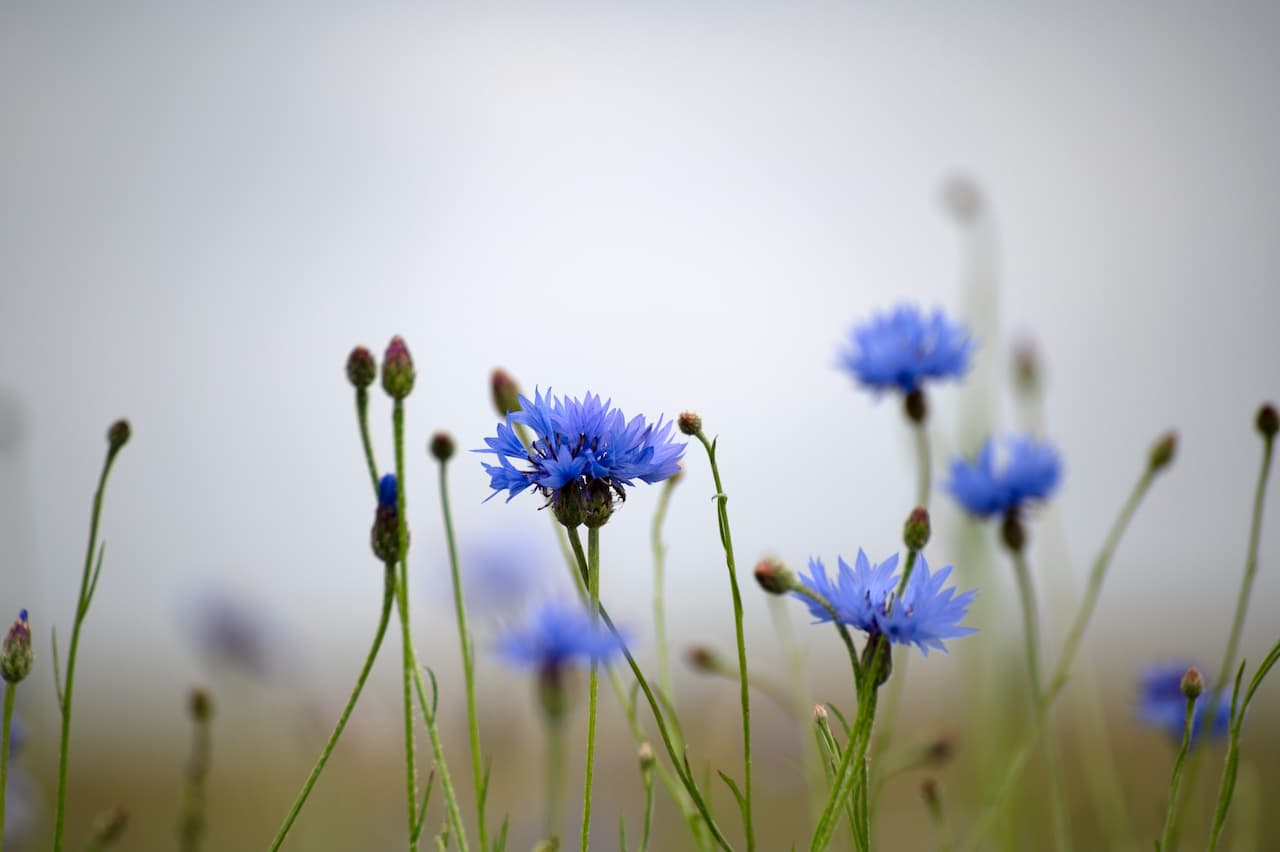
The cornflower is one of the most recognisable wildflowers in the world – its intense, saturated blue appearing on the packaging of seed products, the label of several major brands and in the memory of anyone who has ever walked a traditional cornfield edge in summer. Centaurea cyanus, the annual cornflower, was once a weed of arable land and is now naturalised in verges, wasteland and gardens across the UK, where its ability to self-seed in thin, poor soil makes it one of the most dependable and low-effort flowering plants available. Scatter seed in autumn on bare, raked ground and it will germinate, overwinter as a small rosette and flower in June with almost no further intervention required.
Beyond the annual species, the centaurea genus contains a number of excellent perennials that deserve wider use in UK borders. Centaurea montana, the mountain cornflower, is a reliably hardy perennial with large blue flowers in May and June and silver-grey foliage that remains attractive through the season. Centaurea macrocephala produces large, thistle-like yellow flowers on tall stems that are both bold in the border and excellent for cutting. Centaurea ‘Jordy’ is a hybrid with deep purple-red flowers on compact stems. Each of these perennial species is considerably easier to establish and maintain than the annual, and all three reward the investment of permanent planting with years of flowering from established clumps.
Types and best varieties
Annual cornflower – sowing guide
The annual cornflower is one of the easiest plants to grow from direct-sown seed in UK gardens. It germinates readily in open ground, tolerates poor, thin soil, is fully frost-hardy as a seedling and self-seeds so prolifically that a single sowing often establishes a self-sustaining colony that returns year after year without any deliberate effort. The main decision is timing – autumn sowing in September or October produces the strongest plants and the earliest flowers from June, while spring sowing in March or April produces plants that flower from July into August. For a cutting garden or cutting patch, a double sowing of both autumn and spring is worth doing to extend the picking season.
Choose position and prepare soil
Select a sunny position with reasonably well-drained soil. Cornflowers perform best in average to poor soil – rich, fertile ground produces leafy plants with fewer flowers. Rake the surface to a fine tilth, removing any large stones and weeds. No need to add compost or fertiliser.
Scatter seed and lightly rake in
Broadcast seed thinly across the prepared surface and rake lightly to barely cover. Cornflower seed needs only the lightest covering – no more than half a centimetre of soil. Water gently if the ground is dry. Autumn sowings will germinate quickly then slow through winter; spring sowings germinate in 7-14 days in warm conditions.
Thin to 15-20cm once established
Once seedlings are 5-8cm tall, thin them to 15-20cm spacing. Crowded plants produce fewer, weaker stems and are more susceptible to powdery mildew. The thinnings can be transplanted to fill gaps elsewhere in the garden, though cornflowers transplant less well than some annuals and direct-sown plants always outperform moved ones.
Deadhead regularly or allow to self-seed
Regular deadheading extends the flowering period significantly into late summer. For a cutting garden, cutting stems regularly achieves the same effect. To establish a self-seeding colony, leave some stems to set seed and ripen fully in August and September. The seeds fall and overwinter in the soil, producing new plants the following spring without any further intervention.
Perennial centaurea – growing and care
Centaurea montana is one of the most reliable and unfussy perennials in the UK garden. It establishes quickly from pot-grown plants, spreads gradually into a sizeable clump and flowers freely in May and June with minimal attention. The flowers are a distinctive combination of blue outer petals and a dark reddish-purple centre, making them more complex and interesting up close than the typical annual cornflower. The foliage is soft, grey-green and attractive, remaining in reasonable condition through summer before dying back in autumn.
The single most effective maintenance technique for C. montana is cutting the whole plant back hard to ground level immediately after the first flush of flowering in June. This sounds drastic but the plant responds by producing fresh basal foliage and, in most years and most soils, a second wave of flowering in late summer. Without this cut, the plant produces some later flowers but the overall display is significantly reduced and the foliage becomes untidy. With it, the plant effectively flowers twice – once in May-June and again in August-September – doubling its value in the border.
C. macrocephala requires more space but delivers a striking effect. The flower heads are large, spherical and thistle-like with bright yellow petals emerging from a brown papery base, carried on stout stems 80-120cm tall. The dried seed heads persist well into autumn and winter, providing structure and interest long after the flowers are spent. Plant in full sun with good drainage and allow plenty of space – individual plants spread to 60cm or more in established clumps. Like C. montana it benefits from cutting back after flowering, though the dried heads are attractive enough that many gardeners leave them standing through winter and cut back in early spring instead.
Centaurea works particularly well in combination with other long-flowering perennials that share its preference for a sunny, well-drained position. The blue of C. montana in May pairs beautifully with the silvers and greys of stachys, artemisia and the emerging foliage of ornamental grasses, while the annual cornflower’s intense blue is one of the finest colour combinations in the garden when grown alongside red or orange poppies and yellow rudbeckia in a hot-coloured annual scheme. In a more naturalistic planting, the annual species naturalises readily among grasses and low-growing wildflowers, creating a meadow effect in any area of open, disturbed soil.
The pollinator value of centaurea is high across all species. Both annual and perennial types are excellent sources of nectar for bumblebees, honeybees, long-tongued solitary bee species and a range of butterfly species including the common blue, small tortoiseshell and several skipper species. The open, accessible flower structure makes nectar available to a broader range of insect visitors than many more complex flower forms, and the long flowering season – particularly in the annual species with deadheading – extends the benefit across most of the summer. For any garden focused on supporting pollinators, including centaurea in both its annual and perennial forms is a straightforward and highly productive choice.
Cornflowers are outstanding for cutting and last well in the vase. Harvest stems when the buds are just opening rather than in full flower – they will continue to open in water and will last 7-10 days. Cut early in the morning when stems are fully turgid, place immediately into deep water and remove any leaves below the water line. Tall varieties like ‘Blue Boy’ and ‘Black Ball’ produce the longest stems. For a cutting patch, sow in a dedicated row and cut regularly to encourage continuous stem production from June through to the first frosts.
Division is the simplest method of increasing perennial centaurea stock and is best carried out in early spring as growth begins, or in early autumn after the main flush of flowering has finished. Lift the clump with a fork, split it into sections of 3-5 shoots each and replant immediately at the same depth. C. montana in particular benefits from division every three years to maintain vigour – older, congested central portions of established clumps produce progressively fewer flowers and dividing restores the flowering output reliably. Divisions establish quickly and will flower in the same season if divided in early spring.
Common problems
Share on socials: