At a glance
Swede is one of the most reliably productive winter vegetables you can grow in the UK. Sow in late spring, leave it to bulk up through summer and autumn, and then harvest as needed from October right through to March. The roots sit happily in the ground through hard frosts and actually improve in flavour as the cold weather develops – a swede pulled after the first serious frost is noticeably sweeter than one lifted in early autumn, because the cold converts starches in the root to sugars.
Despite its modest reputation, swede is genuinely versatile in the kitchen. Roasted in wedges, mashed with butter, added to a slow-cooked stew, or eaten raw in a winter slaw – a well-grown swede has a nutty sweetness that supermarket specimens rarely hint at. For the effort involved, it is one of the best-value crops in the kitchen garden: one sowing in May gives a harvest that lasts the whole of winter from a relatively small patch of growing space.
About swede
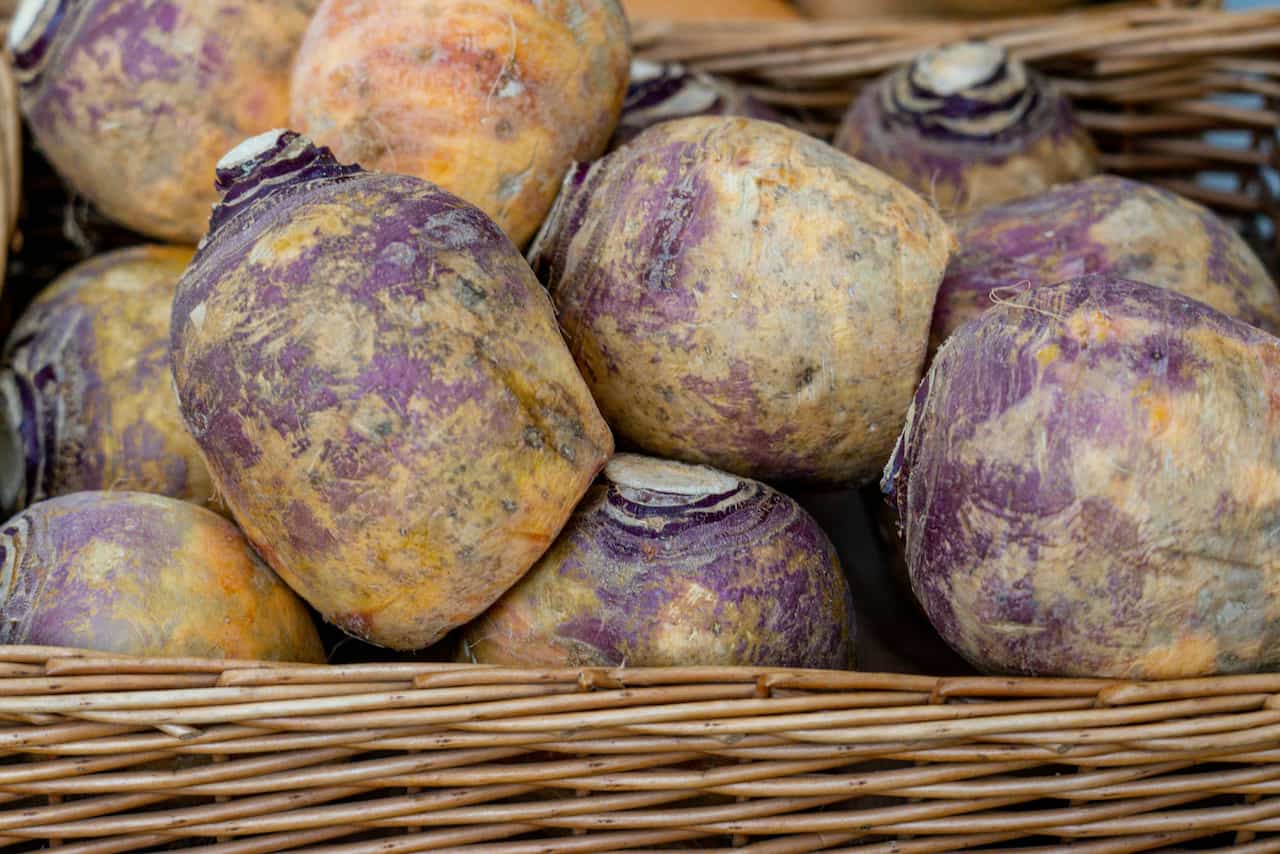
Swede (Brassica napus Napobrassica Group) is a cross between a cabbage and a turnip that arose in Scandinavia, probably during the 17th century. It is sometimes called rutabaga in North America, Swedish turnip, yellow turnip or – in Scotland, where it is a staple ingredient of Burns Night – neeps. The roots are typically globe-shaped with a purple-green top and cream to yellow flesh. In terms of growing season, swede is one of the longer-commitment vegetables in the kitchen garden, taking up to around 20-24 weeks from sowing to harvest – roughly twice as long as turnips, to which it is closely related.
Swede’s long season is not a disadvantage so much as a different way of using growing space. It occupies a bed from late spring through to the following March, but during the majority of that time it requires almost no attention. The plants grow slowly and steadily, resisting cold and frost far better than most vegetables. The extended in-ground storage is one of its most useful qualities – where most crops need to be lifted and stored artificially once mature, swede simply stays in the ground and stays fresh, making it an unusually convenient crop for a UK winter garden.
Sowing swede
Swede is sown directly outdoors in late spring and early summer – the RHS recommends late spring to early summer as the main sowing window for UK gardens. May is the most reliable month for most UK regions, giving the plants time to establish well before summer heat arrives and ensuring the roots are large enough to harvest from October. Sow thinly in rows, pressing seeds to around 1-1.5cm deep. Spacing varies between varieties – always check the seed packet – but as a general guide, thin plants to 23-30cm apart in rows 30-45cm apart. Larger-growing varieties need the wider end of this range; compact types can be grown closer. The seeds are small and willing germinators, so sow thinly or the thinning work becomes laborious.
Thin in two stages rather than all at once. The first thinning to around 10cm apart removes the weakest seedlings and reduces competition; the second thinning four to six weeks later, once it is clear which plants are growing strongest, takes the spacing out to the final recommended distance. The thinnings from the second stage can be transplanted if they are handled carefully and moved with some root intact, though direct-sown swede generally outperforms transplanted specimens.
Raised bed tip. Swede does particularly well in a raised bed with deep, loose growing medium. The roots can push 15-20cm into the growing medium, so a bed of at least 30cm depth gives them room to develop properly and prevents the forking and stunting that happens in shallow or compacted ground. Deep, well-worked beds also make lifting at harvest much easier – a gentle pull is usually enough rather than needing a fork.
Ongoing care
Once swede seedlings are past the vulnerable first few weeks, the crop is largely self-sufficient. The main priorities are keeping the bed weed-free in the early stages, watering in dry spells, and staying alert to the two pests that can cause serious damage – flea beetle on seedlings and cabbage root fly on developing plants. Outside of those, swede needs remarkably little attention through its long growing season.
Harvesting and storing
Swede roots are ready to harvest from October onwards, once they reach around 10-15cm in diameter – roughly the size of a large grapefruit. The most practical approach is to leave them in the ground and pull as needed through autumn and winter. The roots are frost-hardy and the flavour improves after cold snaps, so there is genuinely no urgency to lift them all at once. The ground acts as a natural cold store and keeps swede in excellent condition for months longer than most vegetables would survive. Pull firmly by the foliage or lever gently with a hand fork if the soil is compacted around the base of the root.
If the bed is needed for another purpose, or if a prolonged hard freeze threatens, the whole crop can be lifted and stored. Twist or cut off the tops, brush off excess soil and pack in boxes of barely damp sand in a cool, frost-free shed. Stored this way they keep well for two to three months. Unlike parsnips, which generally benefit from being left in the ground as long as possible, swede can be lifted without significant quality loss if storage conditions are good.
Using swede in the kitchen
Swede responds dramatically to good cooking. Plain boiled swede can be unimpressive, but roasted, mashed with butter, or slow-cooked in a stew it becomes genuinely flavoursome. The key is giving it enough heat and enough time – swede needs longer cooking than most root vegetables, and cutting pieces smaller than you think necessary helps ensure even cooking throughout.
For mashed swede, peel and cut into roughly equal cubes, then simmer in well-salted water for 20-25 minutes until completely tender when tested with a knife. Drain very thoroughly – swede holds significantly more water than potato – then mash with plenty of butter and season generously with black pepper. A half-and-half combination of mashed swede and potato, the Scottish neeps and tatties combination, works particularly well as the potato gives body while the swede contributes flavour and sweetness. A little cream stirred through at the end produces a noticeably smoother result.
Roasting concentrates the natural sweetness and is the simplest way to impress with swede. Cut peeled swede into 3-4cm chunks, toss well in oil with salt, pepper and a little thyme, and roast at 200C for 45-50 minutes, turning halfway through. The edges should caramelise to a deep golden brown. Roasted swede works very well alongside other winter roots – it has a similar cooking time to parsnips at this temperature and makes a useful addition to any mixed winter roasting tray. In soups and stews, swede adds body and a mild, earthy sweetness that builds well over a long, slow cook without overpowering other ingredients.
Common problems
Swede shares the pest pressures common to all brassicas but is generally more resistant than faster-growing crops like cabbage or kale. Insect mesh applied immediately after sowing solves the two most frequent problems before they begin.
Club root is worth mentioning specifically because it is a persistent soil disease that affects all brassicas and can make growing them in the same ground impossible for many years. Unlike flea beetle or cabbage root fly, which cause immediate visible damage, club root builds up in the soil silently and reveals itself only when roots are lifted and found to be swollen and distorted. It is most severe in acidic, waterlogged soils. Liming the bed to keep pH above 7 and maintaining a strict four-year brassica rotation are the most effective preventive measures. If club root is known to be present on a plot, choosing disease-resistant varieties is essential – several of the best swede varieties have been specifically bred with strong club root resistance and will crop well in conditions where susceptible varieties fail entirely.
Best varieties
Several of the best swede varieties carry the RHS Award of Garden Merit, which is awarded after trials at RHS gardens and is a reliable indicator of all-round performance in UK conditions.
A note on variety choice for problem plots: for gardens with a known club root problem, ‘Marian’ – although not currently on the RHS AGM list – has long been valued specifically for its strong club root and powdery mildew resistance, and remains a practical choice where other varieties struggle. Both varieties are readily available from UK seed suppliers and well worth growing together to compare flavour across the season. Swede grows well alongside leeks in a raised bed rotation – both crops are sown in late spring, occupy the bed through summer and autumn, and are harvested through winter. Together they make excellent use of the same growing space and provide a reliable supply of winter vegetables from a single planting in May.
Share on socials: